

Breaking
the mold of
pediatric health
adults. But in the nation's capital,
Children's National Hospital
is advancing treatments that
help kids grow up stronger.

Most medical research focuses on adults. But in the nation's capital, a leading pediatric health system is advancing treatments that help kids grow up stronger.
Pediatric health care has come a long way in recent decades. Survival rates for children with cancer are up, for instance. Sweeping innovations in treatments and public health campaigns have helped lower national preterm birth rates and the overall mortality rate for children in the U.S. has dropped.
But there remains an urgent need for cutting-edge research to better understand, prevent and treat childhood disease. The American Academy of Pediatrics warns that the proportion of the National Institute of Health (NIH)’s budget dedicated to pediatric advancements is declining. Fewer research studies focus on children, and so many of the treatments they receive have only ever been tested in adults—even though children’s bodies and their immune systems are unique.
Against this backdrop, however, at least one institution stands apart.
Children’s National Hospital in Washington, D.C., is a global leader in clinical research that has widened the range of what’s possible in pediatric medicine. The hospital is nationally renowned for its expertise and groundbreaking treatments in pediatric care—but its researchers don’t simply innovate for innovation’s sake. They pioneer therapies and treatments with the singular aim of changing children’s lives.
“Everybody here has the same goals, from the CEO to the physician and bedside nurse,” said Dr. Taeun Chang, director of the Children’s National Hospital Neonatal Neurology and Neonatal Neurocritical Care Program. “We’re changing the paradigm.”
In the 150 years since it opened, the hospital has stood at the vanguard of children’s health care, with its researchers leading 1,300 active clinical trials in 2020 alone. And it has been recognized for its excellence, ranking among the nation's top 10 children's hospitals by U.S. News and World Report. Take a closer look at what Children’s National Hospital does every day to transform pediatric health care—and dive into four areas where the team’s researchers have reached new heights in innovation.
the top 10 in seven
pediatric specialtiesby U.S. News and World Report’s Best Children’s Hospitals rankings in 2020



A new way to treat neonatal seizures
For children born with hemimegalencephaly (HME), abnormal seizures are a fact of life. HME is a rare, spontaneous neurologic condition in which half the brain is abnormally large. In severe cases, infants may have 10 or more seizures every hour from the moment they’re born.




Physicians try to manage those seizures with medications until the babies are old enough to tolerate surgery, usually at three months old. But the procedure is invasive, requiring surgeons to remove or disconnect half the brain.
“[HME and its current treatments] can just completely derail the child’s development and entire life,” said Chang.
To create a safer, better option for newborns with HME, Chang and her colleagues at Children’s National had a novel idea: to use an established technique, embolization, to block the blood supply to the larger half of a child’s brain.
the paradigm.”Dr. Taeun Chang, director of the Children’s National Hospital Neonatal Neurology and Neonatal Neurocritical Care Program
During this procedure, Dr. Monica Pearl, director of the Children’s National Neurointerventional Radiology Program, threads a tiny catheter into the blood vessels in the brain and then injects glue to stop blood flow. The procedure induces carefully controlled strokes in the seizing half of the brain. The body then naturally removes any injured tissue, permanently removing the cause of the seizures.
“Everything is so tiny,” said Pearl. “That is why you need a team that is highly experienced and highly skilled in dealing with the delicate vasculature of the neonate.”
Chang and Pearl both credit the team at Children’s National with supporting their vision by providing the tools and funding needed. They have treated five patients with the procedure so far; one of the earliest patients to receive the treatment has now been seizure-free for years and has not required any brain surgery.
“Our patients challenge me to think of novel ways we can use the tools that we have, and the skill sets that we have, to change the status quo,” said Pearl. “They make me think we can always do better.”
the paradigm.”Dr. Taeun Chang, director of the Children’s National Hospital Neonatal Neurology and Neonatal Neurocritical Care Program
More targeted therapy for tumors



Children with osteoid osteoma, a benign bone tumor, are often jolted from sleep by their pain. Many stop playing sports and struggle to fully engage at school or with friends. Despite their suffering, however, they may wait a year or more for a proper diagnosis, said Dr. Karun Sharma, director of Interventional Radiology at Children’s National Hospital.
The challenges don’t stop there. While some patients can manage pain with NSAID drugs, others require radiofrequency ablation. The treatment, which has been the gold standard of care since the 1990s, sends electric current through thin needles to effectively burn a tumor from the inside out, eliminating the need to surgically remove it. Sharma noted the procedure has a high success rate, but it’s invasive and can cause skin burns, nerve injuries and infection. The process also relies on CT scans, exposing children to radiation that could increase their risk of developing a secondary cancer.
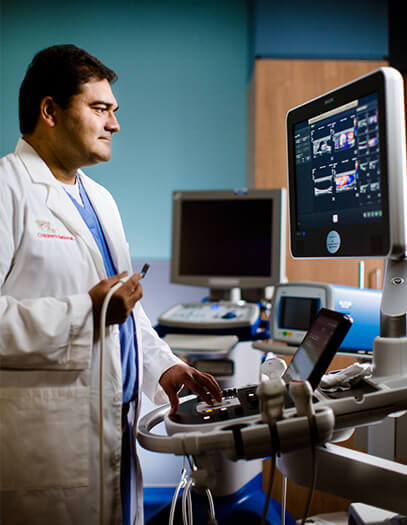

Given those limitations, Sharma and his colleagues were inspired to pioneer a new treatment for osteoid osteoma: Magnetic Resonance High Intensity Focused Ultrasound (MR-HIFU). MRI scanners identify and target the tumor, while an external ultrasound generates high-intensity waves that are sent into the tumor and create enough heat to burn it.
“Because MRI is used to identify the target and monitor the treatment, there is no radiation exposure to the patient or operator,” Sharma said. “Also, because the ultrasound transducer is external to the body, the treatment is completely non-invasive.”
Buoyed by the success of using MR-HIFU to treat osteoid osteoma, Children’s National researchers are now studying how the technique could be used to target malignant tumors in children, without the kind of side effects seen with chemotherapy and radiation.
“Our overarching goal is to find better therapies that are more targeted and less toxic,” said Dr. AeRang Kim, a principal investigator with the Children’s National Cancer and Immunology Research Center.
To conduct these robust clinical trials, it “sincerely does take a team,” Kim said, praising the cross-discipline collaboration possible at a world-class research institution like Children’s National. And it inspires Kim and her colleagues to aim high in their work.
“We really hope that we can change the treatment paradigm for pediatric cancers,” she said.




A closer look at the developing brain
For decades, physicians have relied on conventional ultrasounds or MRIs to monitor a developing fetus during pregnancy, but those tools lack “sensitivity and specificity to track the fast-growing fetal brain,” said Dr. Catherine Limperopoulos, director of MRI research for the Developing Brain Institute at Children’s National Hospital.




“By the time conventional MRI or ultrasound pick up a problem with the fetus, we have to quickly move into damage control mode,” Limperopoulos said. By then, windows of therapeutic opportunity have slammed shut. Mothers may have to endure uncertainty for weeks or months, agonizing over what the images have truly shown. And that latter point is crucial, as studies show that high levels of stress during pregnancy can have an adverse effect on the developing fetus, Limperopoulos said.
So she and her team have revolutionized what is possible in diagnostic imaging, using advanced tools to study the structure and connectivity of the developing brain, from the fetal period through toddlerhood.
Their innovative MRI techniques have broad applications, from measuring lactate levels in a fetal brain to helping clinicians determine when and how a woman should deliver her baby. They also can more accurately assess conditions like ventriculomegaly, which is linked to serious neurological concerns like hydrocephalus. The overarching goal is to move beyond “rescue,” Limperopoulos said, and more toward “prevention.”
Recently, the team used advanced MRI techniques to probe the developing neural circuitry of fetuses in the second and third trimesters of pregnancy. They found that high levels of maternal anxiety can change a baby’s brain function in utero; now, they’re studying whether interventions that lessen maternal stress could safeguard fetal neural development.
“This really represents the next frontier of medicine,” Limperopoulos said. “We will be able to further develop and deploy these tools that allow us to identify, diagnose, intervene and ultimately prevent a lot of these conditions, even before the baby is born.”
The healing power of
t-cells
For Dr. Catherine Bollard, director of the Center for Cancer and Immunology Research at Children’s National Hospital, the drive to find new ways to treat pediatric cancer is personal.




As a teen, her best friend developed Hodgkin lymphoma and endured years of chemotherapy and radiation. Bollard’s friend was cured of her lymphoma but soon after developed leukemia as a result of her treatments (in some cases, radiation and chemotherapy can lead to other cancers down the line). She passed away in her mid-20s.
“I was driven, at that point, to develop new therapies for cancer that would only kill the cancer cells, and not kill the healthy cells,” Bollard said.
Now, at Children’s National, Bollard leads one of the few programs in the world offering novel cellular therapies for children—an approach that is particularly useful for children for whom traditional cancer treatments have not succeeded. She and her team take viable, healthy cells that could help fight off or improve illness, then transfer them into that patient’s body (similar, conceptually, to a bone marrow transplant).
When treating a child with cancer, Bollard and her team manufacture T-cells that can recognize and kill cancer cells in a child’s body. Unlike chemotherapy or radiation, the treatment does not lead to potential organ toxicities, Bollard said, nor does it place children at a greater risk for secondary cancers.


“It’s so important that we develop these more targeted therapies that will preserve healthy tissues,” she said.
Moreover, cell therapy can last a lifetime. Standard antibodies, which are typically used to fight off infections, have a finite half-life. But the T-cells that Bollard and her team create can become “memory T-cells,” she said. “The idea is that if a patient were to develop [cancer] again, the memory T-cells would still be there to prevent relapse.”
that we develop
these more targeted
therapies that will
preserve healthy
tissues.”Dr. Catherine Bollard, director of the Center for Cancer and Immunology Research at Children’s National Hospital
Preventing long-term side effects is crucial when treating pediatric cancer, said Bollard. She believes that if T-cell therapy had been around when her friend was sick, then things may have gone differently—and she hopes she can prevent other young people from experiencing the same fate.
For her, and all the researchers at Children’s National Hospital, the drive to pioneer new treatments and therapies is directly inspired by their patients’ needs—and their potential. All health care and medical intervention is important, but there’s a special significance to healing children.
“The impact is so great,” Bollard said. “You’re treating patients at the beginning of their lifetime.”
that we develop
these more targeted
therapies that will
preserve healthy
tissues.”Dr. Catherine Bollard, director of the Center for Cancer and Immunology Research at Children’s National Hospital