Cloud superiority and the future of the U.S.’s technological edge
By Jason Payne
For centuries, military planners have organized around the principle that armies march on their stomachs. In modern warfare, shortening decision loops and providing actionable insights to forward-deployed defense and intelligence personnel is just as important as keeping them well fed. In another 21st century innovation, analysts armed with laptops have also become crucial players in the defense of our values and way of life, both at home and abroad.
To preserve our national security, defense and intelligence agencies need to be able to ingest staggering quantities of data, analyze it quickly, and move forward with decisiveness. In this context, anything that slows down the decision-making process, especially incompatible or unsecure technology, can have serious consequences.
Even in remote corners of the world, it is critical that data processing occur closer to data collection at the tactical edge. When this happens, and when teams are empowered to use artificial intelligence (AI) and machine learning (ML) tools, they can make faster, better decisions that lead to enhanced operations and improved outcomes.
Fortunately, recent advances can produce insights in minutes and seconds that just a few years ago would have taken hours and days. AI and ML can analyze data from diverse sources and unlock insights and potential actions within a wide range of applications. Our adversaries know this and are not slowing down in their development of new technologies. The United States cannot take its foot off the accelerator if we hope to maintain our technological superiority and information advantage.
Making classified missions safe and secure in the cloud
Classified missions require tools that can safely operate in secret and top-secret environments. To give those who plan and execute classified missions the greatest advantage, the Defense Department and intelligence community are increasingly using multiple clouds for maximum mission resilience and capability.
The intelligence cycle is accelerated when agencies adopt a unified data strategy and process it on a classified network. Visibility is improved, even in degraded environments, and analytics can be conducted in real time on fast-moving data streams from myriad human, mechanical, and technological sources. This is possible only when teams can ingest, clean, and integrate the deluge of data quickly enough to be timely and actionable.
The dynamic nature of classified missions demands tools that can expand, or contract, based on mission need. A grave national security need can arise at a moment’s notice and be called off just as quickly. By bringing a hyperscale cloud into classified environments, commanders gain instantly scalable, on-demand capacity.
Though the stakes are much higher, the fundamental principles of security, trust, and compliance are no different for any other sensitive workload. Intelligence and military actors need to be confident that they can control their own data and that it is secure both at rest and in transit. Government partners must be transparent about where data is stored and how it is used, and be prepared to defend it from all black hats, both foreign and domestic.
Keeping troops, analysts, and commanders all connected during military engagements can have force-multiplying effects. The best military intelligence in the world is useless if it does not get to those in a position to use it. And, when dealing with information as sensitive as troop movements and other war plans, securely transmitting data via the world’s fastest, most advanced networks is paramount.
Public-private partnerships are critical to maintaining America’s technological edge
Keeping America safe and maintaining our technological edge will require urgent partnership between government, aerospace and defense companies, and commercial technology providers. Lockheed Martin recently announced they will be exploring the use of Microsoft Azure’s Private 5G Core along with their secure Hybrid Base Station technology, to provide military leaders and service members an interconnected edge over adversaries.
Working together, the trio successfully demonstrated how advanced networking technology capabilities support the secure linking of 5G and military networks needed for applications out to the tactical edge.
By nature and training, the defense and intelligence communities are composed of risk takers. They are experts at facing problems, dutifully considering possible solutions, and then carefully managing risk to achieve their desired outcomes. It is the role of private industry to provide solutions that make regular, incremental progress so that successes are built upon, failures are learned from, and those who are charged with safeguarding democracy around the world have the best, most effective tools at their disposal at all times.
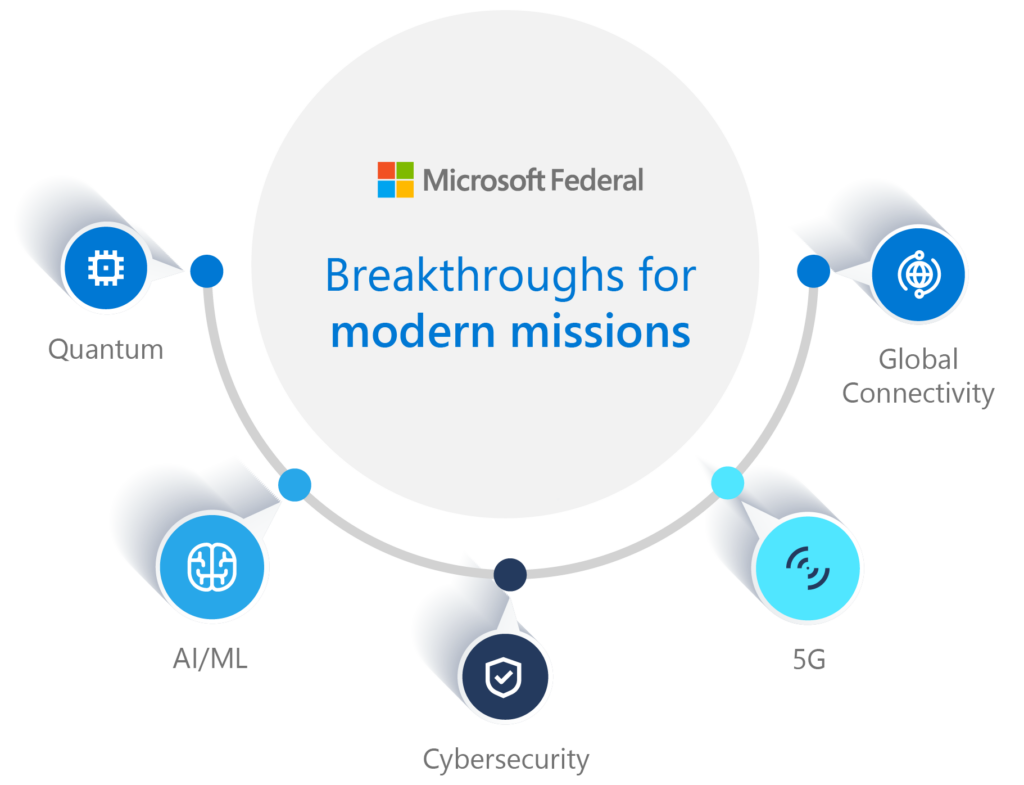
As the threats to national security grow more complex and more geographically dispersed, the symbiosis of government and private actors becomes increasingly important. With the Department of Defense and intelligence community’s knowledge of who and where the threats are, and the expertise of companies like Microsoft in digital transformation, terrestrial and orbital connectivity, tactical communications, cyber security, and quantum computing, these partnerships are helping to keep the United States one step ahead.
A holistic approach to technological mission readiness
When evaluating potential solutions, it is imperative that every tool used in a mission work together seamlessly. All of Microsoft products are designed with trust at the forefront of mind to keep our tools secure, data private, and processes transparent. Technology should be commercially innovative, flexible, and collaborative, particularly when it matters most. By providing a best-in-class platform, interoperable with multiple vendor products, we help ensure those keeping America safe have the very best tools available.
From the reaches of space to the depths of the ocean, and whether in a firefight or carrying out a humanitarian mission, equipping those who serve with secure tools to capture, analyze, and use data quickly is critically important. It is literally Microsoft’s mission “to empower every person and every organization on the planet to achieve more.” We know that when military and intelligence personnel are armed with the very best of tomorrow’s technology today, lives are saved and national security is strengthened.
Microsoft has spent the last four decades developing cutting-edge technology, including hybrid and multi-cloud environments, to support the brave men and women of our armed forces and intelligence community. We have no greater privilege than to equip them with the most innovative, complete, and secure technology solutions for missions ranging from the unclassified to top secret, and from the cloud to the farthest edges. They, and those they serve, deserve nothing less.
As Chief Technology Officer for Microsoft Federal, Jason Payne creates and drives technology and solution strategies that enable digital transformation across the federal government in civilian, defense, and intelligence verticals within Microsoft and across partner ecosystems.
The content is paid for and supplied by advertiser. The Washington Post newsroom was not involved in the creation of this content.
Content From