Frozen in time
A daring expedition to extract a record-breaking ice core could give a glimpse into the future of Earth’s climate.
Rolex’s
Perpetual Planet Initiative
supports individuals and organizations
developing solutions to today’s environmental challenges.
Last year, a uniquely skilled team of seven people — chosen for their uncommon combination of science, ice core drilling and high-alpine mountaineering expertise — commenced an ambitious expedition to extract an estimated 30,000 years-worth of climate data from the summit of Canada’s highest peak, Mount Logan. After facing storms, complex icefall climbs and punishing altitudes on their ascent, the team drilled a rare and record-breaking ice core, thought to be the oldest ever retrieved in North America.
It is hoped the expedition will reveal new information about climate transitions on Earth in the past and help prepare us for future transitions. It is one of a multi-part series, the Perpetual Planet Expeditions, a partnership between Rolex and the National Geographic Society that supports scientific research in some of the Earth’s most vulnerable environments, harnessing world-renowned scientific expertise and cutting-edge technology to unveil new insights into the impacts of climate change. The Mount Logan expedition complements previous National Geographic and Rolex Perpetual Planet Expeditions to high mountain environments, including Mount Everest in 2019 and the Andes’ Tupungato volcano in 2021.
Leading the team on the Mount Logan expedition was Alison Criscitiello, a former climbing ranger and mountain guide, and today an ice core scientist, National Geographic Explorer, and Director of the Canadian Ice Core Lab at the University of Alberta. The reason this ice core is so crucial, Criscitiello explains, is because, at 327 meters, it is the deepest (and likely oldest) ever retrieved from the top of a mountain, rather than at one of the poles.1
“Ice cores have this powerful ability to tell us something climatically about the whole Earth,” Criscitiello says. “But they also contain a lot of very local and regional climate information.” The longest climate records we have, she adds, were obtained from the polar regions, meaning much of the data we possess about past climates is specific to the poles. And these, she notes, “are far from where a lot of the human population lives.”
1 Several important ice cores deeper than 327 meters have been drilled outside of the polar regions, but at locations other than the top of a mountain, such as cols and non-polar ice caps, at lower altitudes than the 2022 Logan core.
Mount Logan, located in Canada’s Yukon Territory and sitting about 300 miles east of Anchorage, Alaska, is rare because there are few places outside the poles where you can find such a long climate record preserved in the ice. “They have to be locations that essentially haven’t seen summer melt over grand timescales,” Criscitiello notes. The icefield on Mount Logan’s summit plateau is uniquely located along the North Pacific storm track, resulting in high snowfall that is unaffected by summer melt due to unusually low annual temperatures. For scientists, this presents a singular opportunity to find out more about climate transitions in a part of the world that is closer to human populations — and to discover new information about global atmospheric changes.
“The things that
make Mount Logan
a good ice core
location also
make it a place that’s hard to stay.”
A treacherous trip
That groundbreaking information would not be easy to retrieve, as Criscitiello’s team found out. Climbing from base camp at 9,350 feet to the summit plateau at 17,475 feet was the first hurdle.
“You really feel the altitude on Mount Logan. It’s a harsh mountain,” Criscitiello says. Her team used a double-carrying method, performing each section of the climb twice to help their bodies acclimatize. Even then, three crew members had to turn back owing to altitude-related illnesses. “This is not weird [given the conditions],” Criscitiello says. “It was what I’d planned for.”
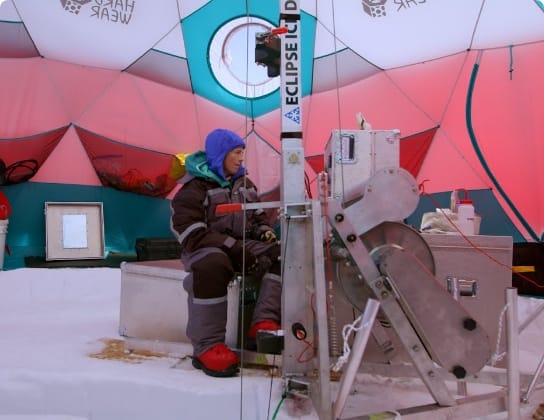
Following the 10-day climb to the summit, the four scientists who remained worked in three-hour shifts over 11 days to operate the 900-pound, custom ice core drill, a state-of-the-art piece of technology designed specifically for the expedition. This would be a physically demanding task in everyday circumstances, never mind at high altitude. “And the things that make Mount Logan a good ice core location also make it a place that’s hard to stay,” Criscitiello notes. “It’s just this huge, open, windy, very, very cold location, and you’re at an altitude that you don’t really recover from. You can’t sleep, you can’t eat. You’re all just slowly deteriorating.”
“The chances of the expedition being successful were probably pretty low,” Criscitiello reflects now. But, despite the challenges, her team beat the odds.
Inside the ice
The information we extract from ice cores doesn’t only tell us what past climates were like. It can give us clues about what caused climates to change, too.
Now back in her laboratory in Edmonton, Criscitiello and her colleagues are using cutting-edge methods to analyze the ice and unlock the environmental history of the region. Oxygen isotopes, for example, can help the team reconstruct temperature, while the gas content found in deeper parts of the core will provide an atmospheric record, revealing the levels of carbon dioxide in the atmosphere at different points in time.
The team can also investigate the climatic impact of various events, such as volcanic eruptions, detected via signs of volcanic ash fallout. “Big volcanic eruptions can have global cooling effects and other impacts,” Criscitiello says. By cross-referencing the timing of large volcanic eruptions with other climate signals in the ice, her team can better understand the extent of those impacts.
Other events of interest include wildfires, particularly considering the frequency and intensity of wildfires today. Traces of wildfire ash in the ice can demonstrate the frequency and intensity of wildfires in the past. New techniques are also allowing scientists to identify changes in the kind of vegetation burning during wildfires across several millennia. These discoveries can help scientists better understand atmospheric and environmental changes in the past, which could provide clues to potential atmospheric and environmental changes in the future.
“Ice cores have this powerful ability
to tell us something climatically
about the
whole Earth.”
The process of analyzing all the signs stored in the ice, however, will be slow. “We’re in the middle of creating the [official] age scale right now,” Criscitiello reveals. “I don’t even know how old the bottom ice is yet. We employ various methods to date the ice that take a while. And we don’t publish any findings until we’ve defined the age scale.” The time between completing an expedition and publishing the full range of findings, she adds, can be as much as five years.
If Criscitiello’s hopes are realized, though, the ice core will give us information so new, we can’t anticipate what it is. Early indications are encouraging. With the caveat that her team is working with a preliminary age scale, Criscitiello says that analyses so far are showing findings that seem distinct from those extracted on other expeditions.
Preparing for the future
Ultimately, it’s not only the Mount Logan expedition’s findings that matter. The stories of Criscitiello’s work, and the work of others like her, matter just as much. Criscitiello is passionate about bringing climate science to a broader audience, spreading the message beyond niche scientific circles, and encouraging more people to become actively involved.
To make the science visible and accessible, Criscitiello has opened her Edmonton lab to local schools and visitors from around the world. And she is a co-founder of Girls on Ice Canada, which offers tuition-free wilderness expeditions to young girls, empowering them to pursue careers in climbing and science. Partnering with Rolex and the National Geographic Society on the Perpetual Planet Mount Logan expedition has also created a unique opportunity for Criscitiello to build more awareness and understanding.
“I feel very lucky to have the storytelling platform that partnering with Rolex provides,” Criscitiello says. “The ability to tell these stories to such huge and broad audiences has an enormous impact.”
Whatever Criscitiello and team find in the ice, it will help her, and other scientists, tell more stories about Earth’s climate. And, as we use those stories to prepare for the future, they might also help the world to write the next chapter.