

How technology can help predict eruptions
This article reports on the impact of Rolex’s Perpetual Planet initiative, which supports outstanding individuals and organizations that are implementing novel solutions to the world’s most pressing environmental challenges. The initiative includes the Rolex Awards for Enterprise, a program that for over four decades has recognized changemakers from around the world, including Andrew McGonigle, who is featured in this story.
Standing on the edge of the Masaya volcano in Nicaragua on his first field expedition in the spring of 2001, Scottish physicist Andrew McGonigle had a question: “This volcano is not going to do anything, is it?”
“Absolutely not,” replied volcanologist Clive Oppenheimer. “It hasn’t done anything in years.”
Two days later, Masaya erupted.
McGonigle and Oppenheimer weren’t there to witness the main event, but that night, they drove through the darkness to the peak to see for themselves the remnants of molten rock. “I’ll never forget that vista,” he recalled. “There was the dark void of the crater, and there was a circle of fire corresponding to the grass, which had all been set ablaze by the lava.” At that moment, he says he realized on a visceral level: this is real. And he was hooked.
In the years since, McGonigle has emerged as a leader in the field of volcanology—in particular in developing a scientific approach to predicting eruptions. Today, an estimated 800 million people in 81 different countries around the globe live within 60 miles of an active or potentially active volcano. And McGonigle has made it his life’s work to help protect those individuals living in the shadows of active volcanoes.

His research is focused on studying the gaseous emissions that are released by volcanoes. Changes in discharge levels can be a precursor to more significant geologic activity, something of an early warning system for eruptions. Yet, as McGonigle learned in his first field excursion, taking readings on the lip of a volcano has its hazards. So the Scottish scientist has turned to technology. Throughout his career, McGonigle has spearheaded the development of a range of advanced digital tools—all of which are designed to more effectively study the emissions of volcanoes and keep nearby communities safe.
This mission got a boost in 2008, when McGonigle was honored with a prestigious Rolex Award for Enterprise. With the company’s support, he has been able to expand his efforts, collaborating with other volcanologists to bring the gas-sensing tech to sites all around the world.
The paradox of volcanoes
Andrew McGonigle grew up in Edinburgh, Scotland, a city of seven hills formed by ancient volcanoes. On weekend mornings, his school running club would circle around Arthur’s Seat, the tallest of the long-dormant cones. “In my upbringing there was always this reference to volcanism within the geology that Edinburgh was built around,” he said.
Even as McGonigle pursued an academic path in physics, earning a MSci in theoretical physics from the University of St. Andrews and a DPhil in laser physics from the University of Oxford, he remained interested in volcanoes. This passion was nurtured in part by the geography of his childhood, but also the sheer environmental impact of the venting behemoths.
listen
CLIP 1
Andrew McGonigle discusses the childhood experiences that inspired his early interest in volcanoes.
CLIP 2
Andrew McGonigle discusses the unexpected impact of eruptions on global temperatures.
These clips were taken from Episode 3 of Planet Visionaries, a podcast that delves into the extraordinary work of a range of Change Makers supported by Rolex. The episode, which features a conversation with McGonigle, is available for download now.
Explore the Series“Volcanoes are the ultimate paradox,” McGonigle said. On the one hand, he explained, they shaped our physical world. Billions of years ago, volcanic outgassing created the conditions for our bio-friendly atmosphere. Volcanic vents in the ocean floor helped generate and sustain early life forms. Eons of eruptions moved land masses, and freed vital metals and minerals from deep below the earth’s surface. Today, volcanic ash continues to produce some of the world’s most fertile soil.

On the other hand, volcanoes have long been one of nature’s most frightening and lethal forces. Over the course of human history, it is likely that hundreds of thousands of people have died directly from volcanic activity. Most recently, in 2018, some 200 people lost their lives in an eruption in Guatemala. The threat of volcanoes persists in part because of their unpredictability. For nearby communities, there simply hasn’t been a consistently effective way to forecast imminent danger.
When McGonigle finished his graduate studies, it was this problem he set out to solve.

On the other hand, volcanoes have long been one of nature’s most frightening and lethal forces. Over the course of human history, it is likely that hundreds of thousands of people have died directly from volcanic activity. Most recently, in 2018, some 200 people lost their lives in an eruption in Guatemala. The threat of volcanoes persists in part because of their unpredictability. For nearby communities, there simply hasn’t been a consistently effective way to forecast imminent danger.
When McGonigle finished his graduate studies, it was this problem he set out to solve.
The Laureate Questionnaire
Andrew McGonigle explains how Rolex helped him give the age-old science of volcanology a technological makeover.
-
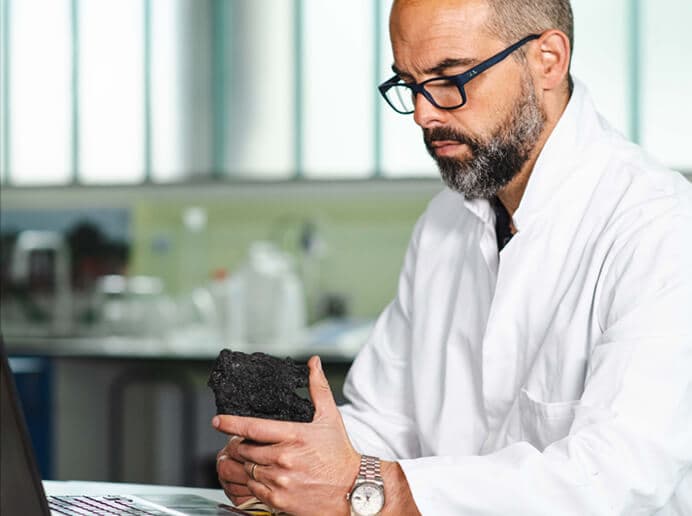
What was it like to receive the Rolex Award for Enterprise?
I was just really grateful. You’ve got these ideas, which of course you think are brilliant—but maybe your colleagues or the funding agencies might not think they’re great ideas. It was gratifying to see that the independent jury who selects the Laureates could see potential in my research.
-
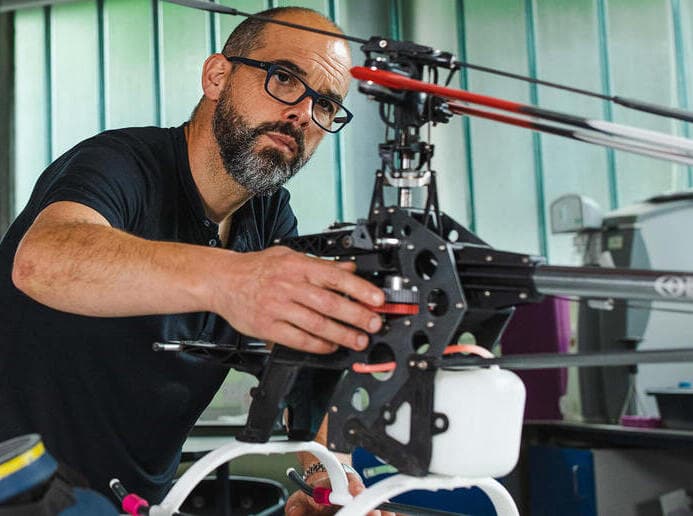
How has Rolex supported your research?
We were able to push forward the drone implementation, such that drone usage on volcanoes has gone from being kind of a slightly madcap pipe dream to something which is really being applied now quite extensively across the community. We were also able to start prototyping the more recent tech, which combines a small computer with a smartphone camera.
-
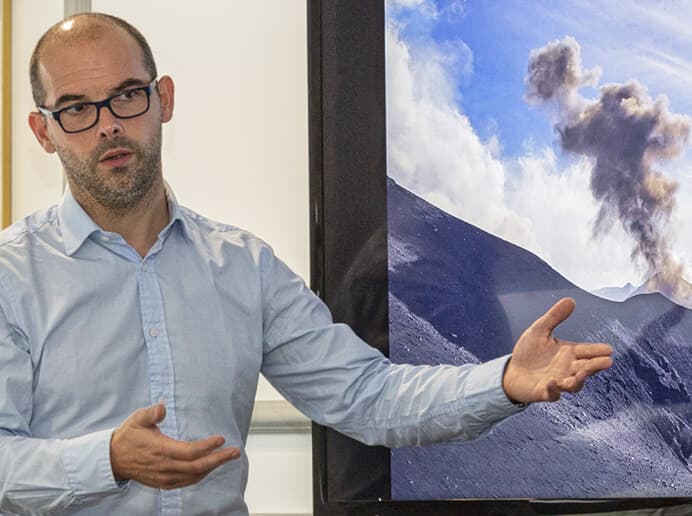
What is it like being a part of the network of Rolex Laureates?
The community is almost as much of a gift as the award. I was asked to speak at a Rolex event in 2019 on some collaborative work that I’d done with another Laureate named Forrest Mims. We had worked together to study the effect of UV light on humans. One thing I said at the end was that I felt that the community was characterized by a mixture of ability and humility. We’re just so grateful to have had this opportunity and this platform, and to maintain this connection to one another.

What’s your story?
How technology transformed volcanology
Even as a child, McGonigle had been a tinkerer. He’d spend his weekends fixing bikes—taking them a part and rebuilding them as new. He just liked figuring out how to make things work. This passion for the mechanics of technology has informed his particular focus in the field of volcanology.
Scientists have long known that studying emissions may hold the key to forecasting eruptions. An issue, though, was how to safely gather the data. McGonigle, ever the technician, believed he could develop a simple innovation to assist with the readings. His first solution was drones. He and his colleagues began flying sensor-bearing equipment directly over the mouths of volcanoes to record subtle changes in sulphur dioxide and carbon dioxide emissions. “A volcanic eruption is really quite analogous to a champagne bottle when it's uncorked—the physics are similar,” McGonigle noted. “So measuring the pressurized gases at the crater can tell you if you’re in trouble.”


Soon, the technique was adopted by other scientists looking for a safe and efficient way to monitor emissions. “The implementation of drones on volcanoes was something that lots of people started doing, and it was great to see that catch on,” McGonigle said.
More recently, the Scottish scientist—who is now on faculty at the University of Sheffield in England—has continued to innovate by exploring new sensing solutions. He’s currently working on an updated system to evaluate emissions that combines a small computer unit with camera modules, like those found in a basic smartphone. Designed to sit on a tripod, the contraption can detect gas discharge via UV light from as far away as five kilometers. It also costs just a few hundred dollars to build, which has tremendous benefits. McGonigle’s vision is that these tools are democratized, available to anyone that lives in a hazard zone. Since a high percentage of active volcanoes are found in developing countries and remote areas, affordability, as well ease-of-use, will be critical.
Volcanic Zones Worldwide
A majority of volcanic hazard zones are in the developing world—in countries that may not have the resources to deploy complex, expensive instruments to chart eruptions. Explore the map below to see where in the developing world significant volcanic activity has occurred in the past few decades. These are areas where local volcanologists could use McGonigle’s inexpensive tools to save lives whenever the next eruption occurs.
Philippines
The Philippines hosts four volcanoes that have erupted in recent decades, including Pinatubo; the 1991 eruption was the second largest of the 20th century.
Papua New Guinea
Papua New Guinea hosts five volcanoes that have erupted in recent decades, including Rabaul, which erupted in 2014, sending an ash plume 11 miles into the sky.
Indonesia
Indonesia hosts sixteen volcanoes that have erupted in recent decades, including Sinabung, which has been periodically active since 2010; before then, the volcano had been dormant for more than 10,000 years.
Mexico
Mexico hosts three volcanoes that have erupted in recent decades, including Colima, which has been characterized by frequent activity dating back to the 16th century.
Guatemala
Guatemala hosts three volcanoes that have erupted in recent decades, including Fuego, which was emitting ash plumes as recently as March 2021.
Nicaragua
Nicaragua hosts six volcanoes that have erupted in recent decades, including Concepción, which is one of two volcanoes that form the island of Ometepe in Lake Nicaragua.
Costa Rica
Costa Rica hosts two volcanoes that have erupted in recent decades, including Poás, which is located in a popular national park; the park was forced to temporarily close after an eruption in April 2017.
Montserrat
The island of Montserrat hosts one volcano that has erupted in recent decades, Soufrière Hills, which has been inactive for nearly a decade.
Colombia
Colombia hosts four volcanoes that have erupted in recent decades, including Nevado del Ruiz, which erupted as recently as July 2021.
Ecuador
Ecuador hosts five volcanoes that have erupted in recent decades, including Sangay, which has been frequently active for nearly a century.
Peru
Peru hosts two volcanoes that have erupted in recent decades, including Ubinas, which has produced frequent eruptions since the 16th century.
Chile
Chile hosts two volcanoes that have erupted in recent decades, including Cerro Hudson, which erupted in 2011 in tandem with a series of earthquakes.
Cape Verde
Cape Verde hosts one volcano that has erupted in recent decades, Fogo, which erupted in 2015 and has a summit crater that stretches six miles.
Democratic Republic of Congo
The Democratic Republic of Congo hosts one volcano that has erupted in recent decades, Nyiragongo, which was active as recently as August 2021.
Tanzania
Tanzania hosts one volcano that has erupted in recent decades, Ol Doinyo Lengai, which is known for the comparably low temperature of its lava.
drag
In just the last few years, McGonigle’s sensors have been used in diverse locales around the world. In Italy, in particular, the technologies are giving researchers greater insight into emissions and helping them to forecast volcanic activity. McGonigle believes these tools could be critical to saving lives whenever the next big eruption occurs.
Yet while he’s motivated by these humanitarian aims, on some level, his commitment to the world of volcanology is grounded in something more essential. “For better or worse, I came out of the womb interested in technology and the outdoors, and so I’ve been very fortunate in being able to do something along both of those lines,” he said. “At the end of the day, you’re you and you’ve simply got to be true to who you are.”

Photos: © Rolex and Roxy Furman