PROTECTING
‘THE THIRD POLE’
Nepal, a tiny community forges a blueprint for fighting
climate change in the Himalaya — and beyond.
This article reports on the impact of Rolex’s Perpetual Planet initiative, which supports outstanding individuals and organizations that are implementing novel solutions to the world’s most pressing environmental challenges.
The initiative highlights the Rolex Awards for Enterprise, a program that for over four decades has recognized changemakers from around the world, including Rinzin Phunjok Lama, who is featured in this story.
If you were to close your eyes and picture the Himalaya, you might conjure an image that looks very much like Humla, a vast region in northern Nepal bordering Tibet. The thin air is fresh and clean. Dramatic, snowcapped peaks tower more than 20,000 feet above dense coniferous forests. Rare Tibetan gazelles, wild yak and musk deer graze in the rocky hills and valleys. Occasionally, there’s even a sighting of the elusive snow leopard. But not all is so serene at the roof of the world.
Daily life in Humla comes with hardships for the more than 50,000 people who call it home. The second largest of Nepal’s 77 districts, it is also arguably the most remote. With no roads connecting Humla to the rest of the country, the only options to move goods or people in and out of the area are by plane or a long trek on foot, pony, mule, or yak. Residents must rely on their own subsistence farming for food.
Adding to these difficulties is an increasingly unstable climate. Local conservation biologist Rinzin Phunjok Lama, who grew up in these mountains, has witnessed how changing weather patterns are intensifying Humla’s hardships first-hand.
“When I was a kid, back in early 2000, the mountains here had snow cover all the time,” he recounted. “Now, the mountains are bare. Water sources are drying out, and the days are getting hotter.”
And it’s not only Humla. Sometimes referred to as “The Third Pole” for its huge stores of ice, the Hindu Kush Himalaya region and its glaciers source 10 major Asian rivers and provide freshwater, food and energy for more than two billion people. But the fact that regional temperatures are rising up to three times faster than the global average, and Himalayan ice is melting at a faster rate than ever recorded in human history, points to an overlooked climate crisis with far-reaching effects. Some scientists have even called it, “The climate crisis you haven’t heard of.”
In Humla, rising temperatures make high elevation farming harder, compelling residents to plant their crops even further upslope as they chase cooler conditions and water sources for irrigation.
Winter snowfalls and seasonal monsoons now arrive late or not at all — or dump a month’s worth of snow or rain in just a couple of days. This loss of consistent seasons makes farming all but impossible for a community that relies on the land to survive.
“It’s not just impacting the environment,” Lama explained. “It’s impacting the people’s livelihood, too.”
Sensing mounting urgency, Lama decided to act. After traveling abroad to study conservation techniques, he returned to his native land with a plan. Combining conservation science with local, lived experience, he would help the community improve their quality of life by better safeguarding their most important resource — the natural environment.
“The remoteness here — the dependency on environmental resources, including forests, pastures, and wildlife — is a problem. But it’s also an opportunity,” he said.
The Laureate Questionnaire
Rinzin Phunjok Lama explains how Rolex helped him scale up his conservation projects in Humla and reach more people with his work.
-
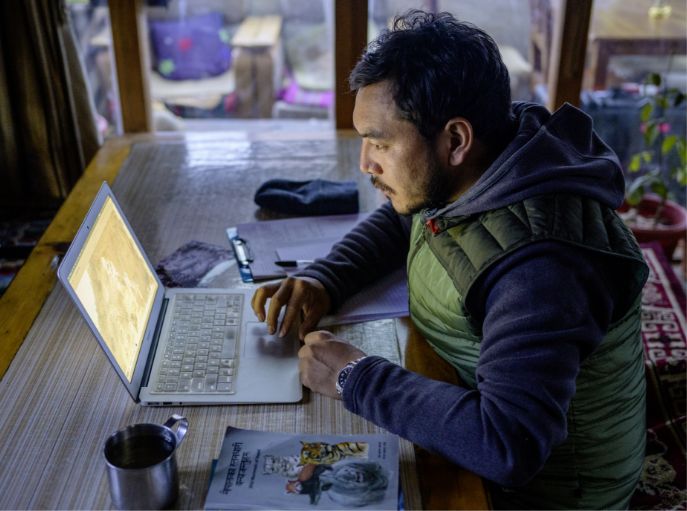
What did winning the Rolex Award for Enterprise mean to you?
It means a lot. We’ve been struggling to start a multi-faceted program of conservation projects in Humla that have potential to grow. We’ve been struggling with small funds for small-level programs. But the Rolex Award is a strong endorsement that what we're doing at a community level has international significance. Our initiatives can now reach that wider audience.
-
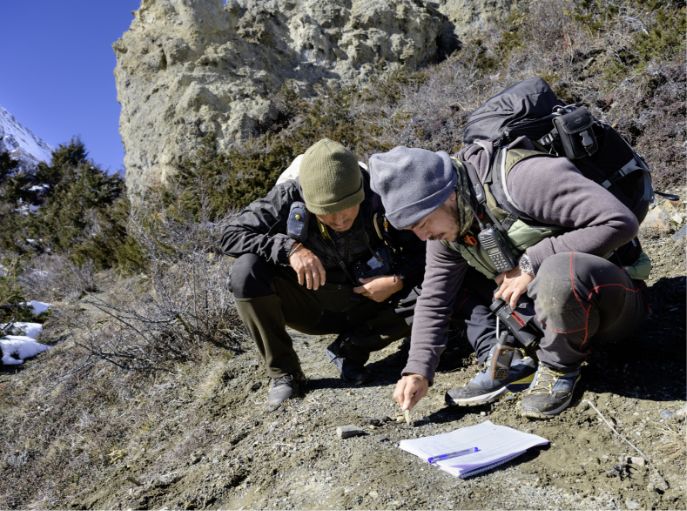
How will the Rolex Award help you develop your programs?
Apart from the recognition, Rolex is supporting what we plan to do over the next few years. Our wish is coming true. So, along with our community livelihood programs, we can focus on more biodiversity documentation, and on an inventory of endangered species. And through this, we'll also focus on developing local leaders, training them in conservation and biodiversity monitoring.
Hear more pioneers tell their stories of innovation in conservation in season 2 of “Planet Visionaries.” Rock climber and “Free Solo” star Alex Honnold hosts this podcast series, which explores the extraordinary work of Rolex Awards for Enterprise Laureates, who are safeguarding our planet for future generations.
LISTEN NOWA COMMUNITY COMES TOGETHER
For Lama, that opportunity is about empowering Humla locals to protect the rich biodiversity of their environment and so become sustainably self-sufficient.
The nonprofit he works for, Third Pole Conservancy, works to preserve Humla’s environment via three branches of work. One branch focuses on snow leopard conservation, as this keystone species is a pivotal part of keeping Humla’s unique ecosystem — on which the community’s livelihood relies — in balance. Similarly, another branch, the Nepal Pallas’s Cat Project, works to conserve this small, little-researched wildcat, another threatened element of the ecosystem. Both branches of work focus on creating the region's first baseline biodiversity data set, and by extension are training locals in monitoring habitats and species numbers, as well as engaging in community education and outreach.
But it is perhaps the third branch of work, Project UKALI — a 360-degree program that approaches conservation on multiple fronts — that is most ambitious, with far-reaching implications beyond Humla. It is also closely tied to Lama’s own, deeply personal understanding of the realities of local life.
“In Humla, income generation — livelihood — is the only priority,” he explained. “The majority of people here are living hand-to-mouth. So, when we talk about conservation, we need to talk about it as something that protects, and benefits, the people and their livelihoods, too. It can’t only be about wildlife and the environment.”
To show the community how conserving their environment also improves their own prosperity and resilience, Lama’s multi-faceted program encompasses a range of initiatives, from grassroots projects to targeting established leaders in the region.
Some of those grassroots projects include introducing greenhouses for weather-proof vegetable farming, and helping locals launch eco-enterprises. The latter has, so far, included teaching beekeeping so that locals can sell rare, high-value Humla honey in urban markets, and guiding local women in turning their traditional handicrafts into businesses.
Third Pole Conservancy is also creating opportunities for residents to earn a living by leading conservation projects, too. This includes training “citizen scientists” in biodiversity monitoring; training and employing community-based anti-poaching units; and providing financial support to herders who lose livestock to snow leopards.
Lama is also eager to introduce eco-tourism to the region as an additional stream of income for the community, via offerings like homestays and wilderness tours.
Bringing tourism to Humla would also raise more awareness of its natural riches, and the need to protect them.
Does Lama worry this could create more problems for Humla than solutions? Conceding the history of tourism in Nepal is “not good” — think those lethally long lines for the Everest summit, and the waste such visitor numbers inevitably bring — Lama again points to Humla’s remoteness as a strength. “For mass tourism to flourish in Humla… that would be challenging,” he said. “But our vast wilderness, our remoteness — that lends itself to heritage tourism, to ethical tourism. And only people who are interested and passionate about that will make the effort to come.”
Lastly, Lama understands the importance of partnering with local leaders. Another facet of his 360-degree approach is winning over people and institutions with influence in the community, creating a trickle-down effect.
Case in point: Lama described a recent local election as an opportunity to educate a new set of leaders about the importance of environmental conservation. He is also collaborating with rural municipalities to implement conservation initiatives and win conservation financing.
Similarly, Lama has forged a partnership with the local monastery because “the monastery is one of the most influential institutions in our region.”
Third Pole Conservancy has also established school eco-clubs — offering education, mentorship, and hands-on fieldwork — not only to usher in a new generation of conservationists, but to enlist yet another important set of influencers. “School students are the best way to reach older generations,” Lama explained. “When the children have the chance to practice conservation, they are excited, and they share that with their parents.”
A herd of goats and sheep approach a river in the remote Himalaya, where farming is a main source of livelihood.
Beyond Humla’s horizons
Given the rapid rate of rising temperatures and glacier melt throughout the Hindu Kush, Lama’s 360-degree solutions have implications for the wider Himalaya region, and vast swaths of the Asian continent. Though the Himalaya’s remoteness has kept the crisis from the international spotlight, the impact is becoming harder to ignore — from increasing natural disasters, such as extreme flooding, to the intensifying hardships of other small communities like Humla.
Rinzin Phunjok Lama's conservation program is rooted in seeing the opportunity in Humla's natural environment.
While Lama’s work may appear to focus on local solutions to local problems, the tangible impacts of climate change reach beyond Humla. And so, too, does the central philosophy that underpins Lama’s work. The better we preserve our environment, the better our resilience and quality of life. It is both a lesson for a sparsely populated, isolated locality, and for the wider world.
“The community here has to accept conservation of the environment as their responsibility,” Lama said.
“We can’t wait for somebody else to come and do it for us.”