Saving Earth’s
life support system
A groundbreaking expedition to the Galápagos led by legendary explorer Sylvia Earle and locally based marine biologist Alex Hearn could provide a blueprint for protecting the world ocean.
Rolex’s
Perpetual Planet Initiative supports
individuals and organizations
developing solutions to today’s environmental challenges.
Without a healthy ocean, there is no habitable Earth. The world ocean produces at least 50 percent of our oxygen and regulates the climate. And yet, according to the U.N., less than 10 percent of it is under official protection.
“The ecosystems of the ocean are the engine that make Earth livable,” says Sylvia Earle, the pioneering oceanographer and explorer. “But, even now, most people don’t think of the ocean as the headline when they’re talking about climate and environment.”
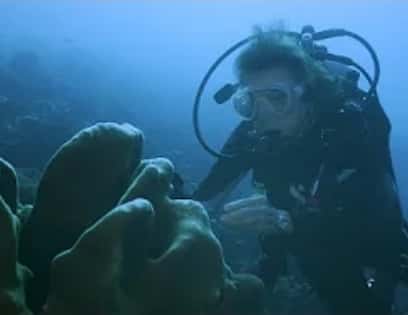
Earle has dedicated her entire career to making the ocean the headline. Nicknamed “Her Deepness,” Earle has been a trailblazer since the 1970s, when, among many other achievements, she lived underwater for two weeks in the famed Tektite II experiment and later set the world record for the deepest-ever untethered dive. Earle also became a Rolex Testimonee in 1982, kicking off a 40-year (and counting) collaboration focused on protecting the ocean and keeping our planet perpetual.
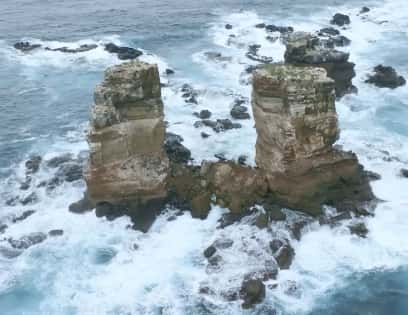
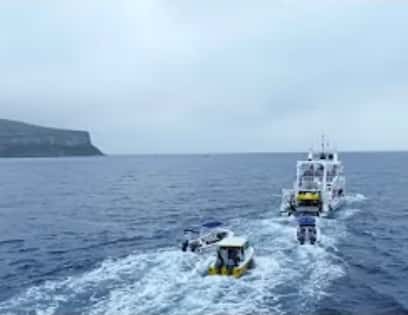
Earle’s latest groundbreaking expedition goes beyond the headline. In the Galápagos Marine Reserve, 1,000km from Ecuador’s mainland, Earle and an international team of explorers and scientists — convened by Alex Hearn, a marine biologist from the local Galápagos Science Center and the principal investigator on the expedition — are working on a blueprint for protecting marine ecosystems across the planet.
It’s all part of Earle’s Mission Blue Hope Spots project, which — with support from Rolex’s Perpetual Planet Initiative — aims to create a worldwide network of marine protected areas, or “Hope Spots,” that are critical to ocean health. More than 151 Hope Spots have been recognized around the world since the program launched in 2009. Today, Mission Blue works directly with communities in more than 69 countries to restore and protect their unique ocean environments.
The Galápagos Marine Reserve is among the most crucial.
A unique ecosystem
“The Galápagos is similar to a microcosm of our own blue planet,” explains Hearn, who is also a co-champion of the Galápagos Hope Spot. “It’s a remote set of islands with a growing human population, trying to come to grips with a limited amount of space and resources. How do we deal with that and maintain our ecosystems?”
“If we can get it right here,
it is a blueprint for getting it right across the planet.”
The Galápagos is also remarkable for being uniquely biodiverse. More than 20 percent of marine species here cannot be found anywhere else on Earth. Many more — including green sea turtles and whale sharks — are endangered.
But, Hearn adds, to better protect this precious ecosystem, we first need to identify the main challenges to, and opportunities for, conserving it. And that’s exactly what Mission Blue has set out to do.
New and endangered species
With support from Rolex’s Perpetual Planet Initiative, the Mission Blue team is utilizing several innovative technologies to aid their work.
One of these innovations is an international network of receivers that tracks tagged species as they migrate throughout the ocean. “We are getting into more detail and tracking species that may have fallen through the cracks,” Hearn explains.
Capturing the movements of endangered species, such as sharks, turtles, rays, and whales has shown Galápagos wildlife migrating as far away as the Mexican Gulf and Costa Rica. According to Hearn, this proves that the current configuration of protections in the Galápagos isn’t enough to safeguard these animals. International cooperation is needed to create a larger network of protected “swimways,” or wildlife corridors.
Another cutting-edge technology Mission Blue uses is environmental DNA (eDNA) analysis. The technique identifies traces of animal DNA left in a water column, helping the team gather vital population data for little-studied animals such as seahorses and endemic slipper lobsters.
But as much as eDNA has helped Mission Blue learn more about life in the Galápagos, it has also spotlighted significant gaps in scientific knowledge. “Most of our sequences are not matching any public database,” says Diana Pazmiño, a conservation geneticist. This means one of two things: firstly, that there is a lot of reference data missing.
“And the second option is that there are some things [here] that are new to science.”
All systems go
For Earle, the key to all this work is that “we have to think like a system” — not just protecting one animal or species but protecting the interconnected whole. “A forest is not just the trees,” she says. “And just planting trees doesn’t make a healthy system.”
Mission Blue’s work in the Galápagos doesn’t try to protect a handful of species but looks at the total system and how it functions.
“You need all the elements. You need the fish, the lobsters, the mollusks, the sharks. It’s like a
symphony with many instruments and all of them have a role.”
And, Earle adds, “When we start removing pieces of that system, we're weakening its resilience.”
That’s why Mission Blue is working to characterize the diversity of the Galápagos — particularly those elements of the system that are little-known or undiscovered. As Earle puts it, “We’re putting the spotlight on the importance of things that most people don’t get to see.”
One of those important, unseen things is the deep-water kelp forests that Earle and her Mission Blue colleague, Salomé Buglass, recently explored for the first time. Going deeper than the scuba diving limit, the pair used the DeepSee submersible to capture footage of a newly discovered kelp forest; a potential new species that occurs at depths deeper than many other species of kelp.
According to Buglass, “Kelp forests in other parts of the world have a critical role in supporting biodiversity, and maybe we have found that piece of the puzzle that explains why biodiversity is so amazingly rich in the Galápagos.”
Empowering local people
One more key piece of the Mission Blue puzzle: local communities. Every
Mission Blue Hope Spot
enlists local champions to win local-level involvement, from meeting government, business, and community leaders, to empowering local people to protect their part of the ocean.Individuals, local governments or community organizations can nominate an area for Hope Spot status on mission-blue.org. Applications are assessed by a team at Mission Blue and then put to the Hope Spot Council, which comprises marine scientists and policy experts. Find out more here.
Local Galápagos Hope Spot co-champion Manuel Yepez was formerly a fisherman. He’s gone from catching and selling the rich marine life of the Galápagos to protecting it. “It’s the present that is the most important now,” Yepez says. “The present and living for the future.”
According to Earle, Yepez is living proof that local communities can — and are beginning to — see the creatures they live alongside in a new way.
“The Hope Spots initiative is altering the way people look at the value of, say, a shark or a lobster or a sea cucumber,” Earle says. “We’re helping communities recognize the value of the ocean not just to their livelihoods, but their lives.”
In the end, Earle says, that’s the headline. “We really need to be serious about scaling up ocean protection,” she says. “Because we literally can’t live without it.”