Unraveling the mysteries
of the Amazon

Rolex’s Perpetual Planet Initiative supports individuals and organizations
developing solutions to today’s environmental challenges.
“There have been thousands of scientific papers and expeditions dedicated to the Amazon Rainforest,” Angelo Bernardino, a Brazilian marine ecologist and National Geographic Explorer, says. “But the Amazon River? It’s a black spot, a mystery.”
That the Amazon Rainforest garners so much attention is no mystery. A bastion of biodiversity and the lungs of the planet, it is also a critical pillar of our climate. Its trees store billions of tons of carbon and release billions of tons of water into the atmosphere, helping stabilize global carbon and water cycles. And yet, the rainforest would be nothing without its lifeline and namesake, the Amazon River. An almost 7,000km tangle of waterways stretching from the Andes Mountains to the Atlantic Ocean, the river’s complex aquatic systems are vital to the health of the rainforest and, by extension, the entire planet. But, as Bernardino says, much about these systems remains a mystery to science.
That might be about to change.
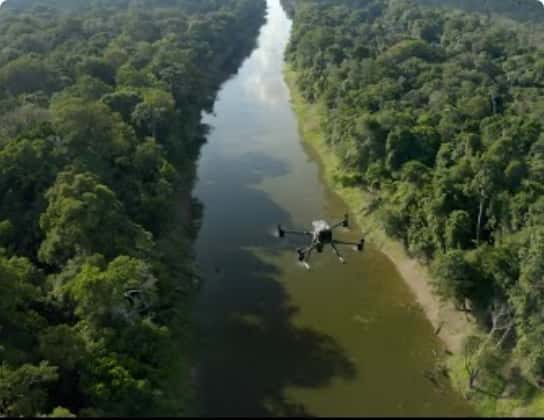
For the past year and a half, a visionary coalition of scientists, explorers and Amazonian communities have been investigating the relationships between people, wildlife and ecosystems in some of the farthest reaches of the Amazon Basin. The hope is to shine a light on the secrets of the region’s waterways. The project, the Rolex and National Geographic Perpetual Planet Amazon Expedition, is an ambitious, two-year endeavor that brings together multidisciplinary scientific expertise, cutting-edge technology and generations of local knowledge to better understand the mighty river system and develop solutions to protect it.
Since launching in April 2022, the Perpetual Planet Amazon Expedition has logged several “firsts.” National Geographic Explorers Baker Perry and Tom Matthews installed the highest weather station in the tropical Andes, giving valuable real-time insights into weather patterns over the Amazon. Rolex Awards for Enterprise Laureate João Campos-Silva and fellow National Geographic Explorer Andressa Scabin became the first people to GPS tag an arapaima, which is not only the world’s largest scaled freshwater fish, but also a key and vulnerable element of local communities’ long-term food security. And then there is Bernardino’s “first,” the first scientific documentation of unique freshwater mangroves that could prove fundamental to future climate resilience.
Why we need mangroves
“Mangroves may be among the world’s most undervalued ecosystems,” Bernardino says. He explains they are routinely cleared to make way for harbors, marinas and other hallmarks of industry and urbanization. “People don’t know how important these forests are for their lives.”
Mangroves, known for their resilience, typically thrive in hot, muddy, salty environments that would quickly kill other plants. Bernardino’s documentation of freshwater mangroves in the Amazon Delta marked the first time such a phenomenon had been scientifically recorded in that region. Prior to this, mangroves were thought to be well adapted to brackish or saltwater.
This new-to-science finding has fueled excitement about what else may be revealed by the wider Perpetual Planet Amazon Expedition’s investigation of remote environments which, in many cases, are being documented for the first time. In the case of the freshwater mangroves, it suggests the survival skills of the plucky plant may be even more adaptable than previously thought. Despite the lack of saltwater, the location, at the mouth of the Amazon River, is a challenging one to survive in thanks to its powerful flow, fed by a formidable combination of tributaries, open ocean and high rainfall.
There have been thousands of scientific papers and expeditions dedicated to the Amazon Rainforest, but the Amazon River? It’s a black spot, a mystery.
But mangroves aren’t only valuable because they are tough. According to the U.N., mangroves globally sequester almost 23 million tons of carbon each year. One recent study suggested more than 8 percent of all carbon stocks are held in Brazil’s mangroves. They make for especially effective carbon storage systems for two reasons: They grow rapidly and capture large amounts of carbon dioxide in the process, and their soils are largely free of oxygen, meaning any carbon that is absorbed into these soils decomposes slowly. All this amounts to large volumes of carbon being kept out of the atmosphere.
Despite this crucial service to the climate, Bernardino estimates “around 1,000 hectares of mangroves in the Amazon coastal area get deforested every year on average.” Not only does the destruction of mangroves release large amounts of carbon, but their removal is often to make way for carbon-producing activities, such as commercial marine industries or cattle farming.
To help make the case to the Brazilian government for better protections, Bernardino and another National Geographic Explorer, Thiago Silva, are developing an uncommonly accurate picture of these mangroves’ carbon stocks. Using cutting-edge 3D laser scanning techniques, they have produced precise measurements of the freshwater mangroves’ plant composition, tree density and volume.
And the value of mangroves does not stop at carbon storage. “In South America alone, it’s estimated nearly 40 million people rely on mangroves, either directly or indirectly, for their way of life,” Bernardino explains.
To learn more about the social and economic value of the Amazon Delta’s mangroves, Bernardino launched a second phase of research in partnership with Margaret Owuor, a fellow National Geographic Explorer and an assistant professor and leader in coastal conservation. Owuor’s focus on fusing traditional, communal knowledge with scientific research would be vital to this next phase of the mission, a collaboration with riverside communities in Brazil’s Amazon coastal area.
Learning from locals
In her native Kenya, Owuor has seen with her own eyes the many threats to mangroves, which are often cut for timber, or cleared to make way for commercial ports. So, she was surprised to see how communities in the Amazon seemed to intrinsically attach value to their mangroves. “We learned that these communities are entirely dependent on the mangroves for their survival,” Owuor says. Mangroves act as “natural fisheries,” capturing fish, crabs and shellfish at low tide that locals can then collect with ease. They also provide protection from coastal erosion and increasingly severe storms.
Owuor describes the work in the Amazon as a “two-way street.” While she and Bernardino primarily aimed to learn from local communities, they used scientific tools and data gathering to record this “undocumented value,” which Owuor explains will not only help her build a case to take to policymakers, but can empower these communities, too.
“You see them really appreciating the science,” she says. “When you explain some scientific concepts to them, they see that mangroves are important to interconnected ecosystems and processes. And so, if developers do then come in, the community has a voice.”
Bernardino and Owuor’s work in the Amazon embodies a major goal of the overall expedition: to create sustainable, community-based management of natural resources across the Amazon River Basin. “People can be fearful of conservation. They think it’s going to lock them out of access to the natural resources they depend on,” says Owuor. She aims to work directly with communities on designing sustainable solutions together, preserving cultures and ways of life by preserving the environment their lives are built around.
In the Amazon, that search for solutions is just beginning. But its future success depends on collaboration: between science and traditional knowledge, and between local communities and governing authorities. On a broader scale, Bernardino says, it means ratifying protections for mangroves around the world.
As the Perpetual Planet Amazon Expedition continues into next year, Bernardino is quick to credit Rolex and the National Geographic Society for their visionary approach to exploration for the good of the planet. “Getting support for this kind of work, where you’re going to new places and you don’t know what you’re going to find, is a big challenge,” he says. “So, the Perpetual Planet Initiative has been crucial to our plans to go and explore — not just new places, but new solutions, too.”