How the public and private sector can help more people with disabilities find employment
A new survey finds that almost half of respondents believe individuals with disabilities are not given equal opportunities for employment and advancement in the workplace.
By Richard Belden, President and CEO of SourceAmerica
September 21, 2023
Veteran Gary M. McCarthy, Jr. faced many challenges trying to re-enter the civilian workforce when he retired from active duty. Coming out of the Army with service-connected disabilities, Gary knew his disabilities and veteran status were major barriers to finding employment. After a long and frustrating job search, Gary found a position at InspiriTec, a Philadelphia-based social enterprise that holds contact center and IT helpdesk contracts with the federal government through SourceAmerica® and the AbilityOne® Program. Gary has had incredible success in his new role as a program manager, attaining four promotions in four years and now overseeing more than 80 employees.

You might be surprised to learn that Gary is part of America’s most underutilized workforce — people with disabilities. More than 16 million working-age Americans have disabilities.1 Yet only 35 percent of them have jobs.2 It is clear more needs to be done to connect people with disabilities to job opportunities.
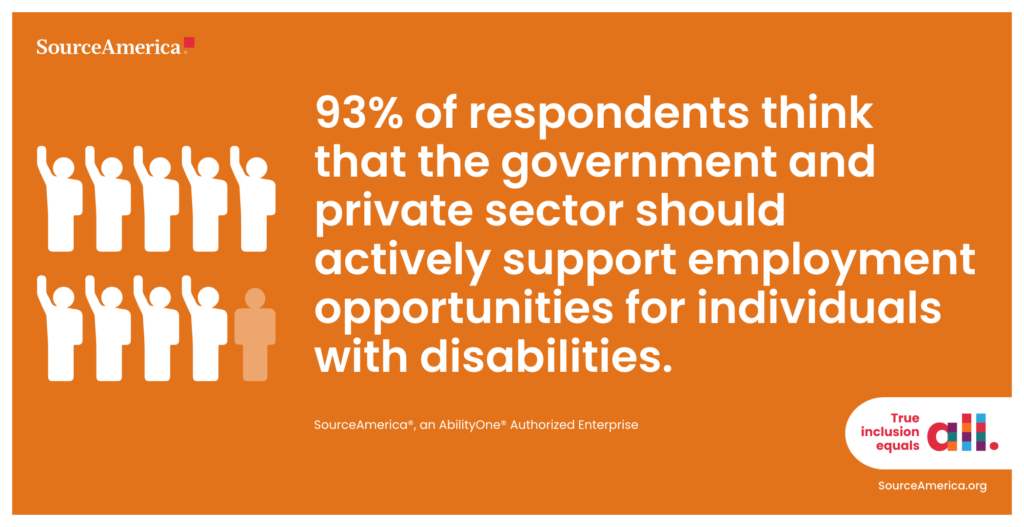
In fact, SourceAmerica’s newly commissioned national survey of 1,000 employed Americans without disabilities and 1,000 employed Americans with disabilities showcases overwhelming support for including individuals with disabilities in public and private sector efforts. Almost all respondents (93 percent) think that the government and private sector should actively support employment opportunities for individuals with disabilities.
The question remains: how best to do that? One simple measure is to ensure that the federal government supports employing people with disabilities in the same manner it does for other programs that are designed to create a more robust and vibrant economy. Currently, individual federal agencies have procurement contracting goals set by the Small Business Administration that range between 3 percent and 23 percent for small business programs. Yet the AbilityOne Program, established to help employ more people with disabilities through federal contracts, has no contracting goal. If implemented, a procurement contracting goal would require all federal agencies to spend at least 1 percent of their federal contracting budgets with AbilityOne authorized providers.
Why is this goal important? Because contracting goals highlight the government’s priorities and incentivize federal agencies across the board to make it a priority as well. This one small policy change could significantly increase employment opportunities for people with disabilities, who are a largely untapped talent pool.
How do AbilityOne and SourceAmerica provide positive economic and social benefits?
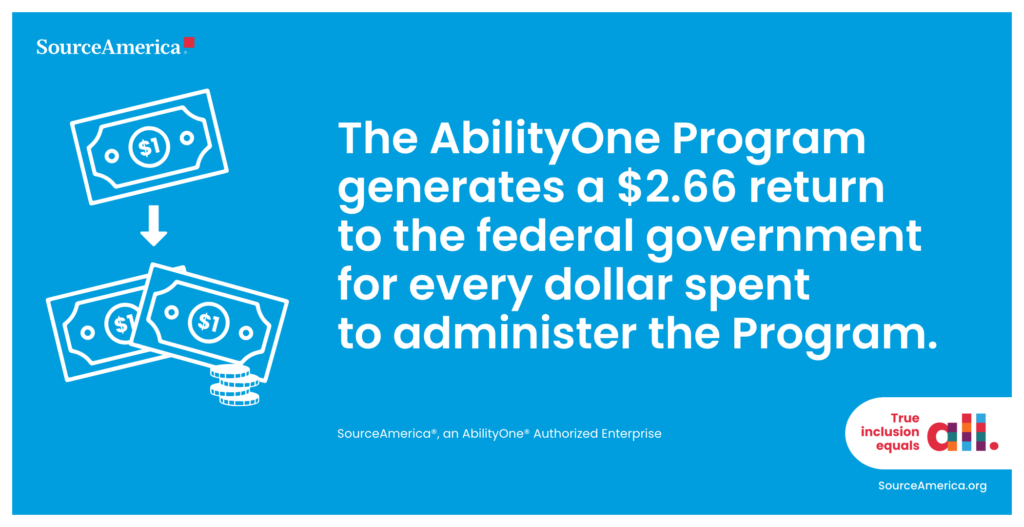
Another important factor to consider is the need to invest in programs that are proven to create positive economic and social benefits for the country. The Mathematica 2023 Socioeconomic Impact Report found that the AbilityOne Program generates a $2.66 return to the federal government for every dollar spent to administer the Program. (This finding is based on the midpoint of the high and low estimates and incorporates both direct and indirect impacts.) Based on the midpoint estimate, that equals $321 million of direct impact and $49 million of indirect impact to the federal government.
SourceAmerica and National Industries for the Blind (NIB), the two central nonprofit agencies in the AbilityOne Program, commissioned the Mathematica report. SourceAmerica connects people with disabilities to federal contract jobs through our network of more than 375 AbilityOne authorized providers across the country. SourceAmerica’s network employs more than 32,500 people with disabilities on AbilityOne contracts. Mathematica’s analysis found that the direct impact on the federal government generated through SourceAmerica’s network is between $103.7 million and $516.6 million annually. This is based on the combination of increased tax revenues and reduced federal benefits payments attributed to the employment of people with disabilities in the AbilityOne Program.
Another important finding from the report estimates that employing people with disabilities through SourceAmerica’s network creates additional jobs in local communities, resulting in increased labor income between $124.9 million and $350.8 million annually. The tax revenue from the increased labor income is the indirect impact of the AbilityOne Program. When sharing the combined direct and indirect impact estimates, Mathematica focuses on the midpoint to provide a fair assessment of the tremendous value created by the AbilityOne Program.
This economic value takes on even greater importance in conjunction with the economic impact that jobs have for people with disabilities. Employment can offer personal financial independence and the opportunity to live independently and contribute to the overall economy. These economic benefits to the government and to the employees can only happen, however, if they are given the chance to work.
Respondents believe that disabilities can limit career opportunities
Our survey found that 43 percent of respondents believe that people with disabilities are not given equal opportunities for employment and advancement in the workplace. These findings underline the importance of beginning to level the playing field for the AbilityOne Program with other federal agency priorities. That is why SourceAmerica supports Congressional efforts to implement the Office of Federal Procurement Policy’s proposed 1 percent AbilityOne contracting goal across the federal government. Currently, only 0.55 percent of federal contracting is awarded to AbilityOne authorized providers.
What impact could this increase have? SourceAmerica calculates that this 1 percent goal could create approximately 28,000 new job opportunities for people with disabilities, including 16,400 through Department of Defense contracts alone, for people with disabilities, veterans and wounded warriors. These are stable, well-paying jobs with career advancement potential that can change the lives of people with disabilities.
Like all Americans, people with disabilities want to live fulfilling, productive lives and to have equal access to job opportunities. The reality is that they remain America’s most underutilized workforce. In fact, 57 percent of Americans with disabilities believe that their disability has limited their career opportunities, according to our survey.
By implementing the AbilityOne 1 percent procurement contracting goal, Congress would be taking a simple, yet powerful step toward creating thousands of job opportunities for a valuable and much-needed addition to our workforce and national economy.
Find a complete list of SourceAmerica Employment Inclusion Survey findings here.
Sources:
[1] Persons with a Disability: Labor Force Characteristics Summary
[2] Labor Force Statistics from the Current Population Survey
The content is paid for and supplied by advertiser. The Washington Post was not involved in the creation of this content.
Content From
