How meaningful careers benefit health, wellness and community
AARP’s purpose-driven workplace benefits employees and communities across the country

By WP Creative Group
October 26, 2023
Mioshi Moses decided years ago that her purpose in life was to serve others.
That belief has been the guiding light in her career journey, leading Moses to her current role as Vice President of Experience Corps at AARP Foundation, the charitable affiliate of AARP.
“Working at AARP is a triple win for me,” Moses said. “One: I’m working towards my purpose, serving people and making an impact in their lives. Two: I’m working alongside people who are just as passionate as I am. And three, just to be practical, it’s great to be paid for a job I enjoy.”
AARP Foundation Experience Corps is a nation-wide, volunteer-based program that pairs students with tutors who help them succeed in the classroom and attain literary proficiency by the end of the 3rd grade. AARP and AARP Foundation believe that adults over 50 have a wealth of experience that can serve their communities and younger generations.

“[Experience Corps] not only helps children become great readers, but it also helps older adults who are looking for ways to contribute to their communities,” Moses said. “Eighty-four percent of our volunteers report that their circle of friends have increased after participating in Experience Corps, and 96 percent say that the program gives them an increased sense of purpose.”
As Vice President of this initiative, Moses has a front row seat to witness how Experience Corps provides tangible benefits to individuals and communities across the country.
“I’ve met so many volunteers who express their joy when they see a student end the school year reading at a level far above where they started,” she said. “When you hear the impact that you’re having, that’s fuel that keeps you going.”
Studies show that individuals, like Moses, who can identify meaning in their lives enjoy a bevy of health and wellness benefits, like a reduced risk of cardiovascular disease and fewer feelings of loneliness and isolation. Tracy Brower, Ph.D., an author and sociologist focused on work-life fulfillment, says that employees are typically much happier and more motivated when they are able to find meaning in their work.

“When the alarm goes off in the morning, it’s pretty natural for everybody to say, ‘Could I have another 10 minutes to snooze?” Brower said. “But when we have a sense of purpose, we feel more meaning about why we’re getting out of bed.”
“When you hear the impact that you’re having, that’s fuel that keeps you going.”
– Mioshi Moses, Vice President of Experience Corps at AARP Foundation
Brower says companies can help employees tap into that sense of purpose by reinforcing how an employee’s role contributes to the overall mission of the organization.
“We tend to think of purpose as this big thing, like solving world hunger, but purpose is just doing the thing that you do well and making a contribution to your community,” said Brower. “Purpose reminds you of that part that you play in the whole.”
As the Director of Fraud Prevention Programs at AARP, Kathy Stokes and the Fraud Watch Network team work to educate adults about the risk of fraud to their financial security and provide support for victims of fraud. One of the reasons Stokes loves her job is that she’s able to see how it directly contributes to AARP’s mission to empower people to choose how they live as they age.
“We’re helping people protect the pensions and savings they’ve worked so hard for all their lives,” Stokes said. “I’m really grateful because every day that I wake up and go to work, I’m doing something that has a real impact.”
AARP’s Fraud Watch Network attacks the epidemic of fraud in several ways. The organization’s outreach and education efforts span 53 state offices and includes a helpline as well as online group sessions for victims and their families to navigate the emotional impact of the fraud experience.

Stokes says she’s particularly proud of AARP’s national effort advocating for change in how society speaks about victims of fraud.
“At every level of society, we use language that blames the victim, instead of focusing on the crime that was committed,” said Stokes. “Headlines might say ‘elderly woman scammed of $30,000,’ and then the article places emphasis on something the victim didn’t do, or didn’t know. This type of language has served to deprioritize fraud as a crime.”
Stokes’ team and the many fraud fighter volunteers across the country work to help families of victims as well as federal agencies like the IRS and the Federal Trade Commission to be more intentional with their words when speaking with and about fraud victims.
By encouraging empathy and understanding, they hope to bring about increased accountability for criminals and create more opportunities for victims to report and share their stories.
“We tend to think of purpose as this big thing, like solving world hunger, but purpose is just doing the thing that you do well and making a contribution to your community. Purpose reminds you of that part that you play in the whole.”
– Tracy Brower, Ph.D.
As Brower points out, purpose will always be about people. “You can be the best corporate citizen and garner 15% profit every year, but your true purpose is going to be about affecting the lives of people,” she said. “Purpose always connects us with others.”
The AARP Purpose Prize Award embodies these ideals by spotlighting the unique contributions of adults ages 50 and older who are pursuing their passions to make a difference in the world. The award is open to non-profit founders, and winners receive $50,000 for their organization as well as a year of technical support to help broaden the scope of their organization’s work.
In her role as Vice President of Enterprise Awards Strategy at AARP, Barb Quaintance oversees the Purpose Prize, now in its seventh year.
“One of the best things the AARP Purpose Prize winners get is each other,” Quaintance said. “It’s not easy being a nonprofit founder. It can be a lonely business, but the winners always make connections with each other.”
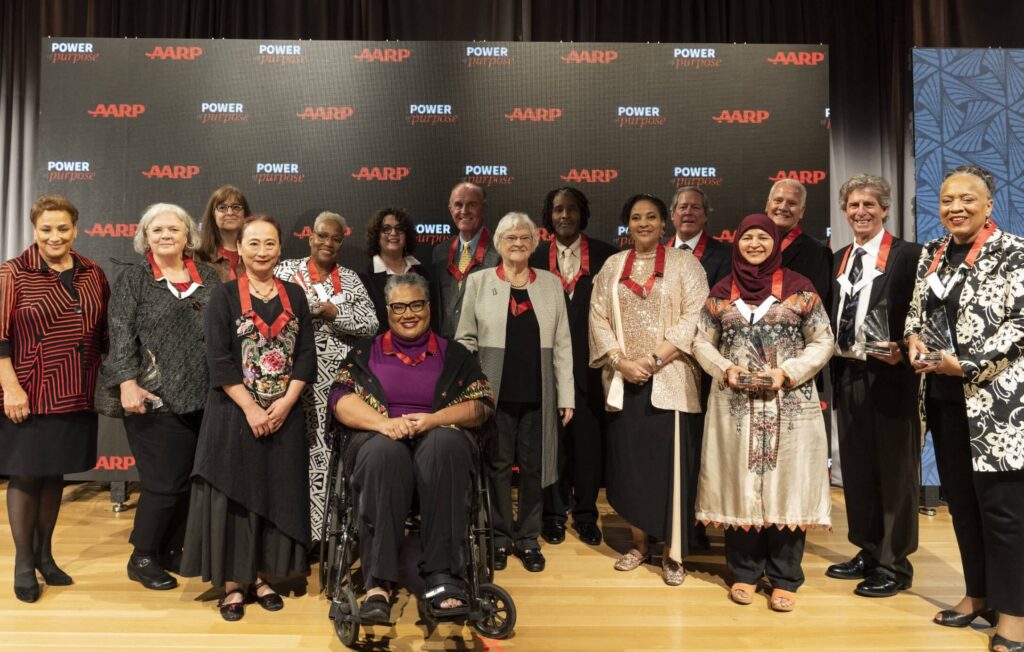
Quaintance, who has worked at AARP for more than 40 years, says she’s been able to find personal fulfillment in each role she’s held at the organization.
“Looking back on it, they all filled me with a sense of purpose because they all contributed to the overall purpose of the organization,” Quaintance said. “Now in this role, I feel so honored to be able to celebrate these people and shed some light in the world. I’m humbled by what it is they do and how AARP can support them.”
Supporting others has always been a main tenet of the AARP mission. AARP was founded in 1958 by Dr. Ethel Percy Andrus with the goal of assisting her fellow retired educators who were living without a pension. For 65 years, the organization has continued to enhance the lives of older adults, while also supporting its own employees with competitive pay and benefits packages.

AARP employees’ benefits include paid parental and family caregiving leave, as well as emergency back-up care, which supports employees when they experience a temporary disruption in their normal caregiving arrangements and need to work – whether its care needed for an infant, spouse or an older parent. Full-time employees also receive 48 hours to use throughout the year (part-time employees get 24) to volunteer in their local communities — whether virtually or safely in-person. The organization’s hybrid schedule allows employees to work from home on Mondays and Fridays.
According to Brower, pay and benefits are all part of the value equation employers offer to retain happy employees.
“On one side of the value equation are the perks such as pay and time off,” said Brower. “But even more important is purpose fulfillment and knowing how an organization will support you and your goals in the long term.”
“Part of the reason I’ve been at AARP so long is the way the organization supports me in taking care of my son who has disabilities,” Quaintance said. “I couldn’t have had the career I did without that sort of support and work flexibility. It makes you pretty loyal to the organization.”