Why age is an asset in today’s workplace
How AARP works to eliminate age discrimination in the workplace and arm older job-seekers with the skills to navigate the job market.

By WP Creative Group
November 24, 2025
Text size
Display theme
Our pages are responsive to your system settings and browser extensions for optimal experience
In today’s rapidly evolving workforce, age discrimination remains a persistent and often overlooked challenge. Despite valuable experience, resilience and perspective that older workers bring to the table, many people face barriers to hiring and advancement simply because of their age.
As Americans live and work longer than ever before, fostering a multigenerational workplace isn’t just a matter of fairness — it’s a strategic advantage. Organizations that embrace a range of ages benefit from broader skill sets, increased innovation and improved employee engagement. Recognizing this, AARP has become a leading advocate for workers aged 50 and over, while also supporting employers in building workplaces where all generations can thrive.
Through education, resources and advocacy, AARP is helping shape a future where age is seen as an asset.

Since 1958, AARP has championed the wellbeing of Americans over 50 — myth-busting stereotypes about the ambitions, personalities and capabilities of older adults that can often lead to age discrimination and bias in the workplace. In recent years, the organization has doubled-down on these efforts because today, there are roughly 38 million people ages 55 and older working or looking for work ─ two and a half times more people than 40 years ago.
“The biggest false stereotype we encounter when working with older job-seekers is that they’re less productive,” said Carly Roszkowski, AARP’s vice president of financial resilience programming. “People also assume they aren’t tech-savvy, or that they’re complacent and just waiting to retire, so upskilling is not worth the investment.”
“Older workers typically have a growth mindset. They want to learn new skills and they want to be challenged.”
– Carly Roszkowski, Vice President of Financial Resilience Programming, AARP
These assumptions have consequences. According to AARP research, 64 percent of older workers have seen or experienced age discrimination, and these numbers climb even higher for Black workers (74%) and women aged 50-plus (65%).
AARP is actively working to contradict these stereotypes by educating employers on the myriad benefits that adults 50-plus bring to workplaces. “The Value of Experience” report, published by AARP in January 2023, showed that older workers are resilient and want to grow professionally. The workers in this survey ranked the opportunity to use their skills and talents as a top job requirement.
“Older workers typically have a growth mindset. They want to learn new skills and they want to be challenged,” Roszkowski said. “That’s one reason that they’re staying in the workforce or if they’re looking for new opportunities, that is one of the main things that they look for in a job.”
AARP also hosts workshops and other educational opportunities for employers on how to best manage mixed-age teams, featuring experts such as Megan Gerhardt, a professor of management at Miami University and the founder of Gentelligence, a branded initiative focused on intergenerational leadership and workforce development.
In her work, Gerhardt encourages management strategies such as offering mutual mentorship opportunities and utilizing mixed-age teams for important projects at work.
“It takes some proactive effort to say, ‘Well, I’m going to staff that project with…’ and then think about the different generations or age of employees and voices needed at the table,” said Gerhardt. “Not only does that create diversity of thought and experience, but it helps break down some of those stereotypes. It’s very hard for me to stereotype an older worker if I have really close workplace relationships with people in that age group.”
AARP research shows that workers of all ages value the experience and knowledge that their older colleagues bring to the workforce and that mixed-age teams can provide more innovation when it comes to problem solving.

In addition to offering education for employers, AARP also provides older jobseekers with resources to navigate the application and interview process.
In August 2025, nearly a quarter of job seekers over 55 were unemployed for 27 weeks or more, caught in a seemingly endless cycle of disappointment. Roszkowski says assistance with resume writing and interview prep are critical for older job-seekers who might be out of practice.
“Our research shows that older workers typically have a longer tenure in their roles,” said Roszkowski. “This means when they do find themselves looking for a job, it’s often the first time in 10, maybe 15 years. Maybe they’ve never done a virtual interview, or maybe there are gaps in their resume they need to explain. Our job seeking resources focus on providing them with everything they need to make that journey successful.”
To help older workers jumpstart their job search and prepare for their next career move, AARP recently collaborated with Indeed to launch a job search platform and career resources hub for older workers . The hub provides resume assistance and interview tips as well as curated job listings with employers committed to wellbeing and inclusion.
Another job search resource, BACK TO WORK 50+ , is overseen by Nicole Heckman, vice president of financial wellbeing at AARP Foundation, the largest charitable affiliate of AARP.
“We use a seven-step guide that really walks the participants through the journey of a successful job search campaign,” said Heckman. “First, we help participants identify their interests and skills, how those align to the job market, which jobs they want to target and how to research those employers. Step 5 is the application, Step 6 is interview prep and step 7 is about accepting, negotiating or declining the job offer.”
“AARP has found that age discrimination drains $850 billion from the U.S. economy every year, a figure projected to reach nearly $4 trillion by 2050.”
– Nancy LeaMond, Executive Vice President and Chief Advocacy and Engagement Officer
More than just the skills to compete in the job market, Heckman says participants in the BACK TO WORK 50+ program find a lot of value in having a support system cheering them on as they search for the perfect role.
“In group coaching sessions, participants can interact with others who are also job searching, and get a boost of inspiration from each other,” said Heckman. “We do something called a FriYAY session, where participants share a success story with the rest of the group. We see overwhelming attendance in these. People talk about how great it is to have the support of the community, as they’re going through something difficult.”
Since its beginnings in 2013, this free program has helped more than 110,000 people build skills and confidence in their job search campaigns — people like America Arevalo, who, after decades of being a social worker, left that career path for training as a flight attendant, which ultimately didn’t work out.
Without income, she was soon forced to sell her house and live out of her car before connecting with the BACK TO WORK 50+ program through Youth Co-Op, Inc. (YCI), one of AARP Foundation’s community partner in Miami. After completing the program, Arevalo was hired by YCI to serve as the BACK TO WORK 50+ career coach, using her story to inspire future participants. She eventually became the manager of YCI’s CareerSource West Date program.
In success stories like these, Heckman is sure to emphasize the tenacity and experience of older workers.
“America is a fantastic coach,” said Heckman. “Sometimes people forget — older workers aren’t starting from scratch. America’s social work background makes her an empathetic job coach. We’re just there to provide a helping hand.”
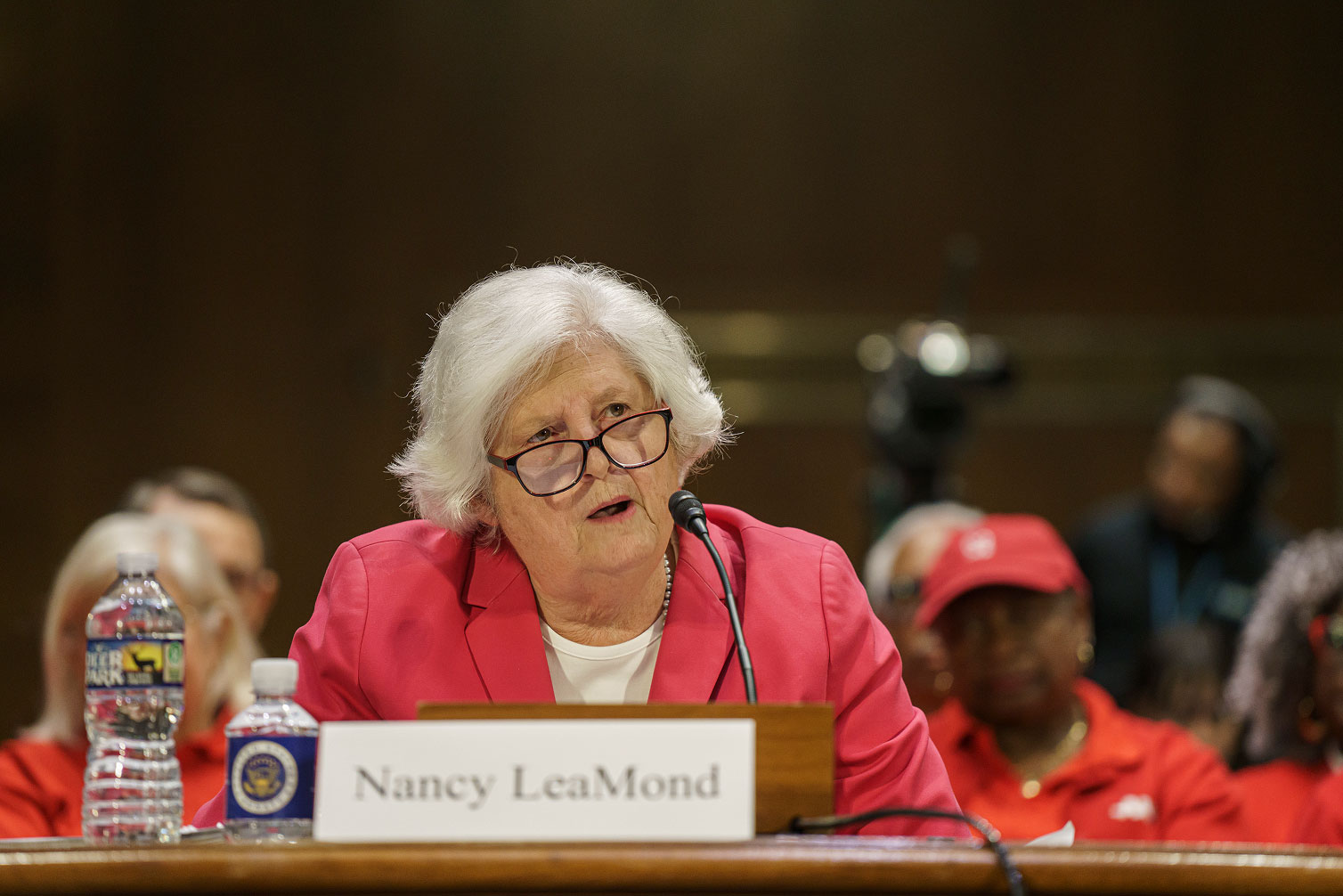
Photo: Greg Kahn for AARP
The third tier of AARP’s fight against age discrimination takes place on Capitol Hill and in statehouses across the country. In September 2025, Nancy LeaMond, Executive Vice President and Chief Advocacy and Engagement Officer, testified in front of the Senate Special Committee on Aging.
LeaMond championed bipartisan legislative solutions for age discrimination, such as the Protecting Older Workers Against Discrimination Act (POWADA) which would restore long-standing protections that ensure age discrimination is treated as seriously as other forms of workplace discrimination. She also spoke in support of the Protect Older Job Applicants Act (POJA), which would extend Age Discrimination in Employment Act protections to job applicants — closing a gap that leaves many vulnerable at the hiring stage. In states like California, Oregon, Connecticut and Delaware, AARP was integral in enacting legislation that prohibits employers from asking any age-related information in the hiring and recruiting process.
In perhaps the most critical part of her testimony, LeaMond pointed out that age discrimination isn’t just an older worker problem – it’s an economic crisis that affects everyone.
“AARP has found that age discrimination drains $850 billion from the U.S. economy every year, a figure projected to reach nearly $4 trillion by 2050,” LeaMond said. “At a time of labor shortages, sidelining skilled and eager workers is a loss we simply cannot afford.”
Find helpful job search tools at AARP.
0:00/0:00
Why age is an asset in today’s workplace
Voice is AI-generated. Inconsistencies may occur.