VIDEO
Told she shouldn’t pursue a dance career, she made a life-changing choice
When Crohn’s disease put her dream of dancing out of reach, Sunny had to decide who she would become. See what she did next.
Growing up, Sunny Dee wanted to be a dancer. A born performer, she was planning to dedicate her life to her art when Crohn’s disease forced her to reconsider. Symptoms including abdominal pain, frequent bowel movements and fatigue made everyday life difficult and dancing almost impossible. A naturally upbeat person, Sunny brings optimism and cheer to everything she does, but she wasn’t prepared for the challenge of Crohn’s disease, which completely upended her life.
“I was told I shouldn’t pursue a dance career,” said Sunny, “because my body wouldn’t be able to keep up with the physical demands of a professional dancer.”
Crohn’s disease belongs to a group of conditions called inflammatory bowel disease (IBD), which also includes ulcerative colitis (UC). These conditions can cause chronic inflammation in the digestive tract. Treatment options include advanced therapies, which are medicines that target specific pathways involved in inflammation to help reduce inflammation.1

Every patient responds to treatment differently. Still, many IBD patients report suboptimal results despite treatment with advanced therapies.
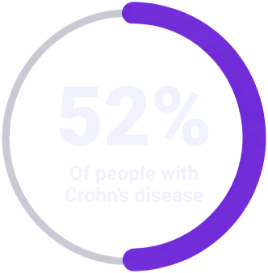
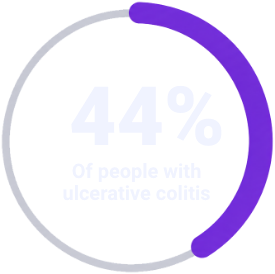
experienced sub-optimally controlled disease.
IBD-PODCAST stands for Proportion Of inadequate Disease Control And Strategy of Treatment in IBD. It is a non-interventional, crosssectional, multi-center study funded by AbbVie across 103 sites in 10 countries, which aimed to estimate the proportion of patients with CD and UC with suboptimal disease control in a real-world setting.
Source: IBD-PODCAST Study: https://onlinelibrary.wiley.com/doi/full/10.1002/ueg2.70117
Crohn’s disease is a disruptive condition, both painful and unpredictable. Over time, ongoing inflammation can lead to progressive damage to the bowel.2 As Sunny said, it is “more than a belly ache — it is truly something that affects your daily life.”
The complex nature of IBD means that what works for one patient might not work for another. IBD affects millions of people globally, including about 1 million in the United States.3
A real-world evidence study, IBD-PODCAST, revealed striking findings, including that worldwide 52 percent of people with Crohn’s disease and 44 percent of people with ulcerative colitis reported their disease was being sub-optimally controlled.4 At AbbVie, a global biopharmaceutical company, Dr. Kori Wallace, vice president and global head of immunology clinical development, is working to develop those treatments tailored to patients’ needs.
“What motivates me every day is meeting patients and hearing their journeys,” said Dr. Wallace. “Patients are always the North Star as to what we’re doing.”

Until we have a cure, we’re going to keep trying to get to that cure.
Kori Wallace, MD, PhD
Vice President of Clinical Development for AbbVie Immunology
Sunny spent years looking for relief for her Crohn’s disease, trying many different medications and multiple surgeries without success. The condition made it difficult to work, to socialize and to express herself, but even though it was part of her story, she never lost her spirit.
“What gives me so much resilience is my family knowing that even on hard days, those days don’t define who I am,” she said.
Drawing on the support of her family and friends, she shifted her focus from the arts to medicine, becoming a registered nurse and esthetician. She also started a podcast that provides community to people suffering from chronic illness, giving them a chance to share their stories and lean on each other for support.
“Invisible illness can be lonely because people just simply do not understand that you are truly in a space of trying your hardest,” she said of her motivation to start the show. It’s that community, Sunny said, that helps her remember that even when Crohn’s disease makes daily life a challenge, her life is about more than her condition.
Dr. Wallace understands what Sunny’s going through. A physician whose work has spanned patient care and IBD research, she’s seen firsthand how disruptive these conditions can be for people living with them. She traveled to Savannah to tell Sunny about AbbVie’s ongoing research into IBD, and how she and her team work relentlessly to elevate the standard of care.
“Until we have a cure, we’re going to keep trying to get to that cure,” Wallace told Sunny. “So one day, patients with autoimmune disease don’t have to think about their disease.”
Wallace, in turn, wanted to hear about Sunny’s journey — from dance to nursing to the podcast.
“The reason I started my podcast was so that I could create a community for people not just with Crohn’s disease, but with chronic illnesses in general,” Sunny told her.
“That’s amazing,” Wallace said. “You’re going to reach a lot of people.”
For anyone facing a chronic illness, Sunny’s advice is simple.
“Find your community,” she said. “And if you can’t find it, create it. Do not give up.”
Learn more about IBD research at AbbVie.
Share This Article
Sources