Six thingsyou need to know about

Killer of children and teens in the U.S.
Six thingsyou need
to know about

Killer of children
and teens in the U.S.

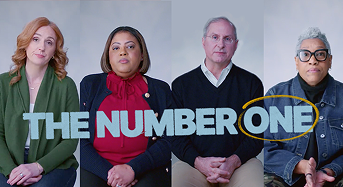
The statistic is almost too shocking to believe: Gun injuries are the number one cause of death for children and teens in America, surpassing car crashes and cancer for the first time in two decades. Nearly seven U.S. kids aged between 1 and 17 died per day from gun injuries in 2022, the most recent year for which data is available.1
Now, the Ad Council, the national nonprofit behind some of the country’s most iconic social impact campaigns, is launching its new “Agree to Agree” campaign, bringing together all Americans — gun owners, non-gun owners, parents, gun violence survivors, health care professionals and beyond — to highlight the common ground we share on how we can all help keep kids safe from gun injuries.
Because while guns may be perceived as a divisive issue in the U.S., there is one thing we can all agree on: Gun injuries should not be the number one killer of kids in this country.
At a recent Washington Post Live event, Ad Council CEO Lisa Sherman sat down with leaders in the field working to change that statistic to talk about actions we can all take — both large and small — to protect our children. Here are the six most important takeaways from their discussion.


Most Americans don’t know that gun injuries are the number one killer of children and teens in the U.S.
How can you fix a problem if most people don’t know it exists? Only 26 percent of Americans are aware that gun injuries are the leading cause of death for kids aged 1 to 17 in the U.S., according to a poll from the Ad Council Research Institute (ACRI)2. Raising awareness is the first step we need to take, said Ramon Soto, Senior Vice President and Chief Marketing and Communications Officer for Northwell Health, the largest healthcare provider in the New York metro area.
“The reality is, society doesn’t know that statistic,” Soto said. “We service 6 million New Yorkers a year, and we consider ourselves part of the front line who sees the devastation of this every day.”


We all agree we need to do more to protect children from gun injuries.
Guns might be a divisive topic in America, but protecting kids from gun injuries isn’t. A vast majority of Americans agree that we need to keep kids safe from gun injuries, polls show.3 Focusing on that common ground is how we can make progress — and that’s why it’s the key to the Ad Council’s campaign, said Juan Javier Peña, Chief Creative Officer for GUT Miami, the creative agency that worked on “Agree to Agree.”
“We found this stat that unlocked everything: [Over] 80 percent of both gun owners and non-gun owners agree that having more productive conversations can reduce gun-related injuries,” Peña explained. “We need to find common ground, because it’s the only way [to] help move [us] forward and find solutions.”


There are clear actions we can take to create change today.
When we talk about gun injuries, many of us think about mass shootings or interpersonal violence — but the statistic also includes unintentional injuries and suicide. The “Agree to Agree” campaign looks at tangible ways we can all keep kids safe from all forms of gun injuries.
The first is secure storage: Gun owners should keep their firearms locked, unloaded and away from ammunition when not in use. About 4.6 million children in the U.S. reportedly live in homes with unlocked and loaded guns.4 Securely storing guns is a proven way to reduce the risk of “family fire” — shootings that result from someone misusing an unsecured gun at home, which include unintentional shootings, gun suicides and many intentional shootings.5
A conversation can make a big difference as well. A core message the Ad Council supports is that the responsibility to protect kids from gun injuries lies with adults, not children. Simple questions — like asking other parents whether there are guns in a home your child is visiting, and whether those guns are securely stored — can make a life-saving difference. “We live in an age where we have no problem saying, ‘Johnny has peanut allergies’ and ‘Susie can’t swim,’” Soto said. “Now, there is this new hidden danger lurking in society that we need to have a conversation around.”
It’s also important to be aware of warning signs that a child or teen may be in crisis. By talking to young people about mental health struggles and preventing them from accessing firearms, we can create space between a teen in crisis and an unlocked gun.
Most of all, “Agree to Agree” aims to shift the idea that conversations about guns will become arguments. The devastating reality of this statistic is solvable, Soto said, and simply starting to talk about it is a major step toward change.


Gun injuries aren’t a political issue. This is a health crisis.
The fact that gun injuries are the leading cause of death for children and teens in America is a “call to action,” said Dr. Michael Suk, a gun owner and Chairman of the Board of Trustees for the American Medical Association. Suk is also a practicing orthopedic trauma surgeon, meaning he sees the reality of this issue firsthand — and treats children with gun injuries himself. To Suk, gun injuries are not a political issue. They’re a health crisis.
“What happens beyond the numbers is the devastating impact that occurs outside, [among] families and communities,” Suk said. Gun injuries don’t only affect the victim — the consequences ripple out into entire populations.
Those knock-on effects are wide-ranging. Family members of children killed because of gun-related injuries are more likely to develop psychiatric disorders.6 Kids exposed to gun injuries are more likely to develop PTSD, misuse substances and have problems at school.7
“We need to … have a conversation about what we can do about gun violence,” Suk continued. “In a way that is not partisan and less controversial, but looks at an outcome where, one day, gun violence won’t be the number one killer of kids and teenagers.”


Every single one of us can do something about this now.
Everyone needs to do their part to make this change, Sherman said.
“This issue is one that’s going to take a thousand actions, both large and small,” Sherman added. “I really want to challenge all of you to think about how you might want to get involved in this issue — because we really need everyone.”
Every single person in this country has a part to play, Suk agreed, and we can all take action right now. It’s going to take collaboration between all of us — parents, educators, health care professionals, community members and beyond — if we want to make concrete change. “I’m optimistic that we’re going to get there,” Suk said.


This is a complex problem. But the solution starts with talking about it.
Sherman noted that it can feel overwhelming to learn that gun injuries are the number one killer of kids in America. But she closed the panel by asking Peña, Soto and Suk where they see hope for the future. They all agreed that as complex a problem as this is, gun injuries do not have to be the number one killer of kids in America. Change begins with a conversation.
“[People] always say, ‘We’ll have to agree to disagree,’ which ends a conversation,” Sherman said. “But ‘agree to agree’ extends a conversation.”
That could be as simple as a conversation with a friend, asking if they knew that gun injuries are the leading cause of death for children and teens in the U.S. It could be asking a fellow parent about whether there are guns in their home and if they’re securely stored. It could also be a conversation with a teenager, checking in to make sure they’re okay.
“I’m a registered gun owner, but I’m also on the front-line treating patients who are injured by gun violence,” Suk said. “Agree to Agree means you can take people who are on both sides of me and put them in a room and have a conversation about responsible gun ownership.”

Together, we can protect children and teens from gun injuries.
Share this article:
Sources:
1 Johns Hopkins Center for Gun Violence Solutions
2 Ad Council Research Institute
3 Ad Council Research Institute