How college pays off for American University graduates
By Mike Unger, on behalf of American University
April 1, 2024
Gabriella Andrean can draw a straight line from her time as an undergraduate at American University to her successful career as a digital marketing manager at RCA. The 26-year-old did multiple internships in the entertainment industry and studied abroad while earning her bachelor’s degree in business and entertainment in 2019. These experiences prepared her for her role at RCA, just three months after she graduated.
“A lot of the professors that I was exposed to had real-life experiences,” she said. “Because of that I learned what this industry is all about. It was, ‘these are the people skills you need, these are the people you should be connecting with.’ I felt like I was really in the workforce, doing what I had to do.”
Peter To’s path from American University’s home in Washington, D.C., to Silicon Valley was a bit more circuitous. The 28-year-old majored in biology and worked several jobs before he got his current position managing partnerships at the venture capital firm Plug and Play. Still, he says he never would have landed the gig had it not been for his time at the Veloric Center for Entrepreneurship at AU’s Kogod School of Business, where he developed confidence and hands-on experience.
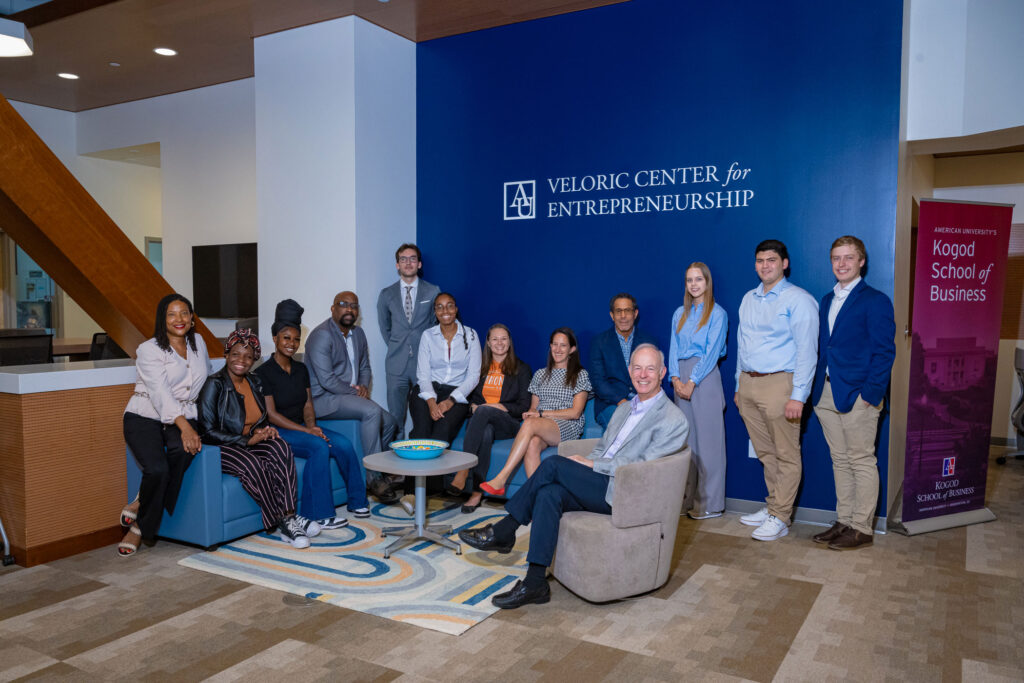
Photo credit: Jeff Watts
“I started a company that didn’t work out, but it taught me so much about startups, venture capital, how to pitch,” he said. “It gave me the kind of foundational skills you need to actually go to a big Silicon Valley firm.”
In recent years, the term ROI (return on investment) has become an increasingly important concept in higher education. Growing questions about the value of higher education, coupled with rising costs and student loan debt requires colleges and universities to define their value proposition in new and impactful ways. Students—and their parents—have become more interested in knowing how an undergraduate education and degree will benefit them financially in the job market after college.
It’s a legitimate question, says Gihan Fernando, AU’s assistant vice provost for the Career Center.
“The cost of a college education has been increasing over the years, and as you have more and more students from a variety of backgrounds, including some who are either borrowing or trying to earn their way through school, it becomes an issue of, ‘Is this a worthwhile investment?’” he said. “The good news is that all the national data points to the fact that a college education allows you to, over a lifetime, earn significantly more than somebody who doesn’t have one.”
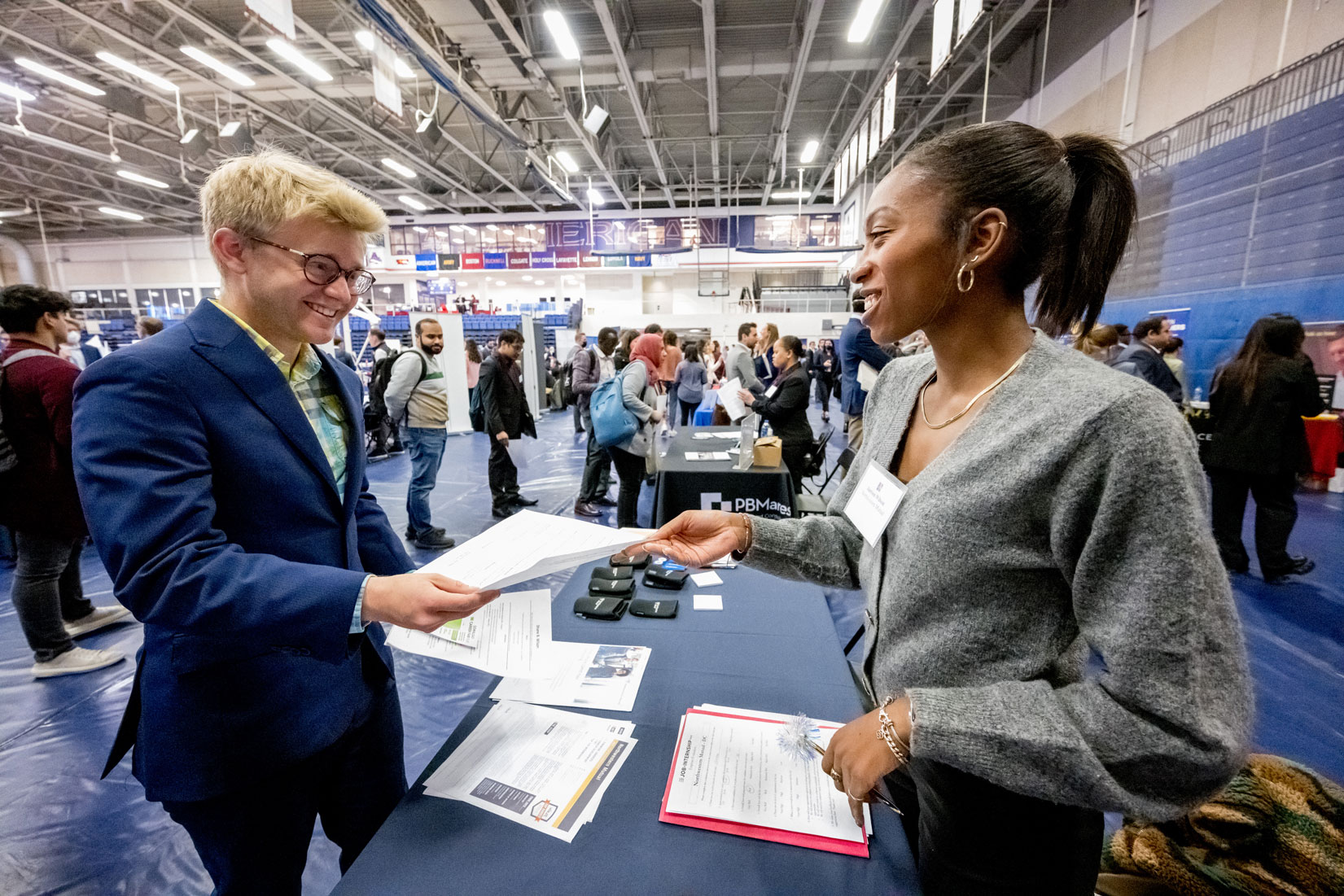
Photo credit: Sam Kittner
According to 2022 data from the U.S. Bureau of Labor Statistics, typical earnings for bachelor’s degree holders are 84 percent higher than those whose highest degree is a high school diploma. American University documents its undergraduate outcomes on the website american.edu/weknowsuccess. Ninety percent of American University alumni who graduated in May 2020, 2021, and 2022 were either working, in graduate school, or both within six months of graduating. While nearly 60 percent of its graduates join for-profit employers, AU graduates play an outsized role in the non-profit and government sectors. And the average salary for AU undergraduates from the class of 2023 was $65,909 within six months of graduating, with 13 percent of the class earning more than that.
Those are heartening statistics to Bridget Trogden, AU’s dean of undergraduate education and academic student services. She knows that AU is uniquely positioned to maximize those numbers.
“There’s research that shows when students take more courses outside of their majors, when they take more courses in the arts and humanities, they actually earn more money over a lifetime,” she said. “They’re in educational situations where they have to take the driver’s seat rather than be in the passenger seat. They’re working on unscripted problems. AU does that really, really, well.”
Photo credit: Jeff Watts
Peter To, the biology major, concurs. He credits his participation in the venture capital investment competition and a student managed investment fund for helping propel his career.
“Those gave me the confidence to show up in an interview and say, ‘I can do all the market research. I have the skills to do this in real life,’” he said.
American University is a leader in offering experiential opportunities—internships, study abroad, and service learning among them—that help graduates get jobs. Ninety one percent of AU students participate in an internship or other experiential learning activity.
Andrean did both. She studied in Spain for a semester and worked internships at Capital One Arena in Washington and AMC Networks in New York.
“I was able to immerse myself into opportunities that you can’t really get at a lot of other colleges,” she said. “I went to business school in Madrid and got a global perspective. After I came back, I got hands-on experience of helping run events. I feel like that was the switch that I needed to know that I really wanted to work in entertainment.”
One of AU’s greatest assets is its ecosystem that supports and values experiential learning, Fernando says.
“We hear from graduates regularly that the experiences that they had while they were in school, meaning the internship that they had or the study abroad experience that they had or the community project on which they worked, was really meaningful in shaping both their interests and in helping them to make connections that would allow them to enter that field successfully.”
Peter To is a prime example.
“My career worked out because I got involved across campus, not just in my major,” he said. “The world is evolving in a multidisciplinary nature.”
Andrean, a New York native, is living out her dream in sunny Los Angeles, the hub of the entertainment world. She works on digital marketing involving some of the biggest names in the recording industry, like SZA and Chris Brown.
Sometimes she has to pinch herself to remember that it’s all real.
“I’m so grateful every single day,” she said. “If you’re sitting around waiting for an opportunity to fall on your lap, you’re going to be waiting for a long time. It’s all about relationships, challenging yourself, broadening your horizons, and exposing yourself to new experiences and people. And I think AU is at the epicenter of all of that.”
Photo credit: Jeff Watts
Learn more about American University
The content is paid for and supplied by advertiser. The Washington Post newsroom was not involved in the creation of this content.
Content From
