The Need for Speed
Forget economies of scale. To thrive in a rapidly changing world, businesses need economies of speed.

By WP Creative Group
August 2, 2023
Business and IT leaders are facing some big challenges. In a world where instant gratification has become the norm, customer expectations are sky high. Meanwhile, macro trends like inflation, supply chain shocks and hybrid work are testing day-to-day operations.
How can enterprises build the resilience needed to overcome unexpected hurdles and gain the agility to seize new opportunities?
The answer, according to Amazon Web Services Enterprise Strategist Jake Burns, is to make speed a core value. More specifically, organizations must achieve what Burns calls economies of speed. Unlike economies of scale, where the emphasis is on making existing processes more efficient, economies of speed call for organizations to find new ways of working that enable quick pivots and rapid innovation.
This starts with a willingness to launch projects without a formal business case that is heavy on specifics like required resources and ROI goals. That’s because, by definition, the process to create something novel starts with more questions than answers in terms of what’s needed and the expected results.
“Economies of speed is a recognition that, in the modern world, we don’t necessarily know what we’re going to need to do, we don’t know what customer behavior is going to be and we don’t know how we’re going to need to pivot.”
– Jake Burns, Amazon Web Services Enterprise Strategist
Indeed, few organizations could have predicted the economic and social impacts of the pandemic or the geopolitical fallout from Russia’s invasion of Ukraine. Then there’s the sudden emergence of generative AI as a game-changing technology for virtually all industries. “The interest in generative AI that’s seemingly come out of nowhere – organizations that can pivot quickly, that don’t have to spend months or years building a business case, are going to be able to take advantage of this,” said Burns.
Accelerating innovation
So how can organizations achieve economies of speed? The journey begins with transforming culture, technology and processes.
Culturally, leaders must adopt new vocabularies that measure project success in terms of speed, not absolutes. While economies of scale are built around absolutes, such as budgets, timelines and headcount, organizations that have embraced economies of speed speak in terms of burn rate, cost per month, velocity, features delivered per sprint and other terms that capture rates of change.
Enterprises seeking transformation must also avoid defining success in terms of old benchmarks more appropriate to economies of scale, rather than economies of speed. Efficiency, for example, is the entire point of the former, but is not a good way to measure progress with the latter. “Up until recently, efficiency was the name of the game,” said Burns. “But if you focus on efficiency, then you’re really just focusing on doing the same things you’ve always been doing, just better.”
Organizationally, workers in small, autonomous teams should be encouraged to experiment fearlessly. “We have to recognize that with true experiments, most of them will fail,” said Burns. “If they don’t, they’re not real experiments.” The payoff is that by constantly experimenting and not waiting for the perfect idea or bulletproof business case, organizations are more likely to find that game-changing innovation that solves an intractable problem or brings a disruptive product to market.

Crucial to achieving economies of speed is reducing the cost and risk of experiments by leveraging cloud technologies. The agility and flexibility of the cloud allows teams to test new ideas quickly and easily. “The cloud is one of the best ways to get to economies of speed, because it allows you to experiment quickly and inexpensively,” said Burns, noting that cloud resources are inexpensive and can be consumed on demand.
The key is to not treat the cloud simply as a tech upgrade that adds efficiency to old ways of doing things. The music industry’s switch from tapes to CDs, to use an analogy, did not fundamentally change how music was consumed, it merely replaced one physical medium with a better one. But the industry’s move to streaming, which introduced subscription models, personalized playlists and access to a virtually unlimited song library, was truly disruptive because it changed how people engage with music. To drive similarly transformational change in their own industries, and not just be constantly adapting to new circumstances, organizations must use the cloud to support true innovation. “The cloud gives you the ability to try new things very quickly,” said Burns. “You can fail a hundred times, but the first time you get it right you forget the first hundred ever happened because the cost of each of those initial experiments was so low,” said Burns.
Gaining leverage
To achieve economies of speed, organizations must create levers for change that acknowledge the fact that technologies like the cloud, serverless architectures and microservices have made many previous constraints on progress, such as time and cost pressures, far less burdensome. There are four main levers that leaders can pull to take full advantage of this.
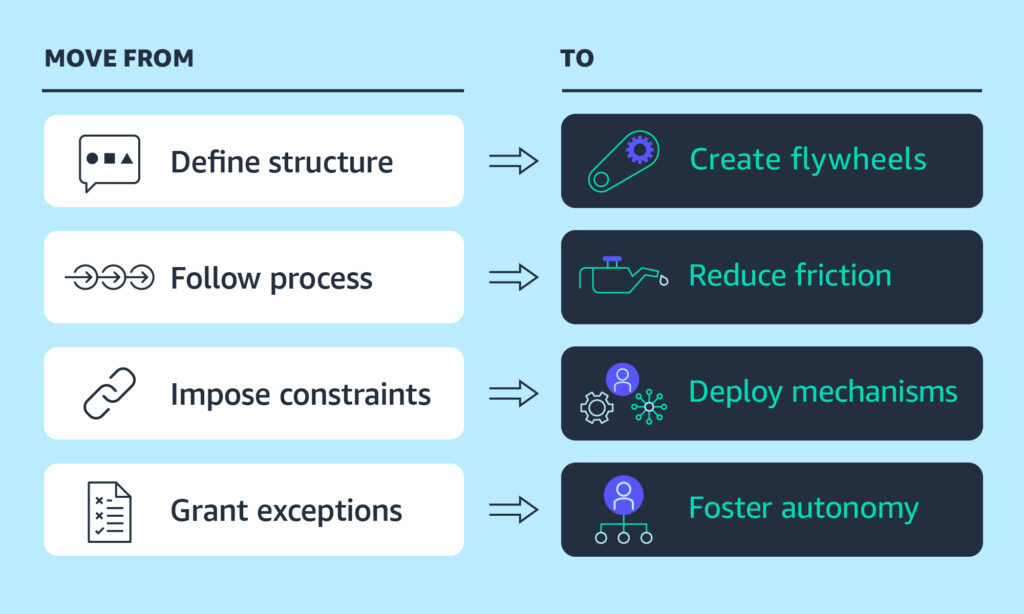
1: Create flywheels
Organizations can use the cloud to drive a flywheel approach to innovation. Each turn of this virtual wheel should produce new insights and opportunities. This recognizes the fact that progress is typically realized through small, continuous gains that reinforce each other, rather than giant leaps. For example, a move to the cloud immediately delivers cost savings. This in turn enables experiments that would have been cost prohibitive. This in turn delivers multiple new chances for innovation.
2: Reduce friction
Viewing their organizations as a combination of flywheels, leaders can identify pain points caused by misalignments arising from traditional, static structures. For example, having too many formal processes, such as weekly budget updates, review meetings, steering committees and the like can bog down innovation. Eliminating these points of friction is the second lever that leaders can pull to get to economies of speed. Automating manual processes and aligning incentives in a way that organically promotes collaboration across departments can help to promote this.
3. Deploy mechanisms
To ensure that experiments can flourish without putting the business at risk, organizations can replace friction-producing processes with what AWS calls mechanisms. These mechanisms organically keep things on track, so teams don’t go off the rails.
Mechanisms encode behaviors central to the company’s culture, through the creation of a tool, how adoption of the tool will be achieved and inspection of results in order to make course corrections. This “virtuous cycle” reinforces and improves itself as it operates. When all teams – infrastructure, apps and product – share a common understanding of the desired outcome, they can assess whether the mechanisms are delivering that outcome, and adjust the mechanism as needed.
This shared understanding leads to smaller projects, fewer risks, less stress, greater agility and the attraction of much needed talent. This is different than blindly following a process for the sake of process. The goal isn’t to become more efficient; it’s to enable different ways of working that generate more viable ideas, more frequently.
4: Foster autonomy
Finally, organizations cannot achieve economies of speed unless teams are granted the autonomy and resources to experiment and innovate. Cloud platforms are ideal for this as they provide controls and transparency while removing the undifferentiated heavy lifting such as managing IT. This allows teams to focus on generating new value for the business and its customers. Autonomy is possible when teams share a vision and are aligned around common goals. Critically, these autonomous teams require strong leadership in order to prevent autonomy from slipping into anarchy.

Walking the walk
Change is not always easy, so organizations must avoid some common mistakes that stop the journey to economies of speed in its tracks. One of these is when leaders talk the talk but fail to walk the walk. “You can tell your employees to invent and innovate and take risks, but if something doesn’t work out and you punish them, then everyone learns very quickly that it’s all talk,” said Burns.
Indeed, despite the emphasis on autonomy and agility, economies of speed still require strong leadership. CIOs, COOs and even CFOs must align IT to business needs, recognize high performers, create appropriate incentives and eliminate bias. In an era of unprecedented business challenges that demand economies of speed, the best measure of success is innovation. “It behooves all organizations to undertake this journey,” said Burns. “You’ll just get better at everything you do.”
Click here to learn more about how organizations can win by achieving economies of speed.