Bringing personal health data to the doctor’s office
By WP BrandStudio
As consumer health tech rises in popularity, more Americans are aware of what’s going on inside their bodies. But doctors still need to help them interpret the information they collect.
Last year, Dr. Jeremy Bock, a cardiologist at the Virginia Hospital Center Physician Group (VHC), saw a new patient who was frustrated with his medical care.
The man, in his fifties, had been having heart palpitations on and off for a few years, Bock said. He’d been to other specialists, who had given him a device to monitor his heart rate over a prescribed period of time. The tool was uncomfortable for the patient and the episodes never happened when he was wearing his monitor—so nobody discovered any anomalies.
Bock had a different idea. The patient had gotten a smartwatch and wore it all the time—it was easy and functional, and he liked it. Bock told him to simply enable the watch’s EKG monitoring tool, which could more regularly monitor the patient’s heart rate and collect the data in a single place, where Bock could later review it.
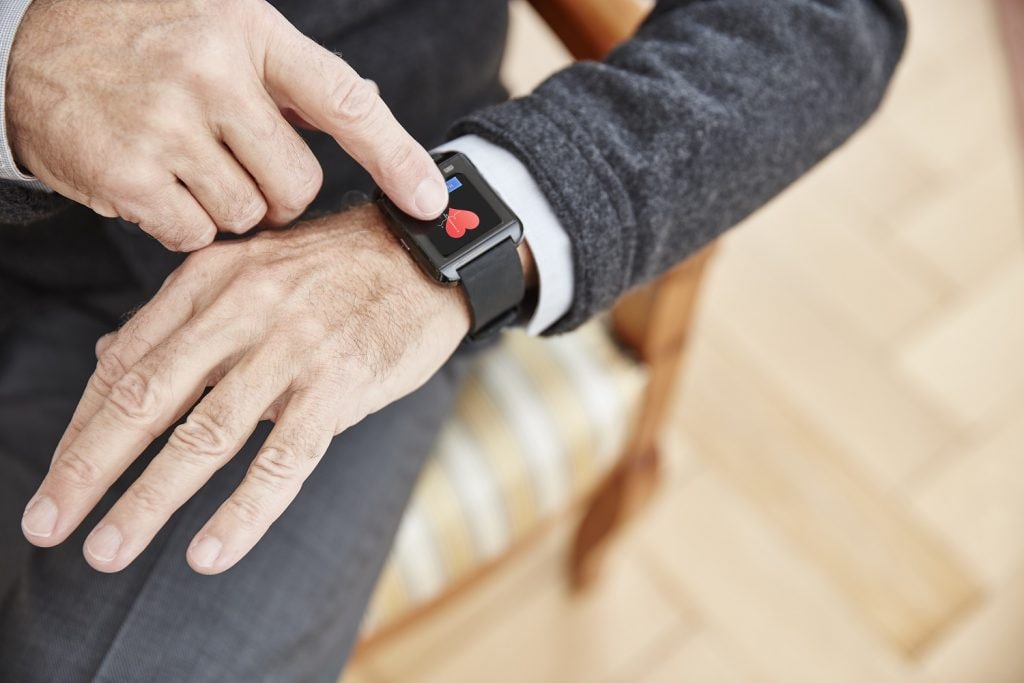
After culling more precise information about the man’s heart rate for a short time, Bock was able to spot something that no other doctor had noticed before: an irregular heartbeat. Bock put him on an appropriate medication for the issue, “and he hasn’t had a repeat episode since.” said Bock.
Thanks to popular new technologies, this type of story is becoming increasingly common. Wearables, apps and other developments have allowed patients to embrace “participatory health[1],” a model that involves them playing an active role in their treatment. And as Americans become increasingly savvy about their well-being, healthcare professionals are working to make the most of the data that these technologies collect.
Being strategic
As a top trend this year, according to Expert Review of Medical Devices journal, consumer-facing technology has the power to address some of the most common health issues in the United States.
Heart monitors can help keep track of impending heart disease; fitness and BMI trackers can help address obesity; glucose-monitoring apps and devices can assist diabetics with their insulin levels. And in the future, technology may even be able to assist people with Parkinson’s, kidney disease and respiratory disease.
But the promise of these advancements depends on communication between a patient and a healthcare provider.
“A wearable is going to measure your EKG or your steps or your blood, but you have to figure out what to do with that information,” said Albert H. Titus, PhD, professor and chair of biomedical engineering at the University at Buffalo. If a wearable is collecting data from your body, “something has to happen to that data to make it usable.”
That “something” is a professional interpreting the information based on what they know about the patient—and what they know about health in general.

Alice Greenwood, a nurse practitioner at the VHC Physician Group, recently uncovered the cause of a patient’s chronic migraines by interpreting her health data. The patient happened to track her periods on a smartphone app. The data collected on the app, combined with the fact that periods can be linked to intense headaches, led Greenwood to diagnose the patient with menstrual migraines.
The everyday person may not know the connection between migraines and most other medical patterns and phenomena, for that matter, and would have a hard time making connections between their data and what it means.
So Greenwood noted that, while it’s important for people to track their health, eat well and exercise, it doesn’t take the place of visiting the doctor. Technology, after all, can’t draw labs or listen to a patient’s heart or lungs, and it can’t infer things based on the data that it collects.
Things can happen…[Technology] doesn’t take the place of having good primary care, Greenwood said.
(Not) under pressure
While many patients revel in tracking their health stats, there are others who find large amounts of data too overwhelming. Dr. Christopher Walsh, an internist and Chief of Primary Care, with the VHC Physician Group, reminds people who are prone to anxiety that wearables and apps are fundamentally a tool: “Just like stethoscopes and computers, they’re great for getting people engaged and aligned with their goals.”
But when patients turn to the wrong sources in order to interpret that data, it can exacerbate their stress—stumbling across inaccuracies about the cause of someone’s symptoms, he said, can lead to their imagination running wild.
“Unfortunately, there’s [a lot of] misinformation out there in the world—and healthcare is not immune to that,” said Walsh. A clinician can help patients sort through the data and separate the pros from the cons, the evidence from the speculation.

Bock agrees that there are some people who can become fixated on tracking their health, but overall he thinks that the abundance of wearable-generated data is a good thing. Before people can take action about their health and seek professional help, they have to know there’s a problem to begin with, or be aware of what risks they may face. The ideal situation, he said, is finding a balance between being aware of what’s going on in your body, “but not being obsessive about it.”
And monitoring your own health shouldn’t get in the way of day-to-day living, Bock said. Just as we keep track of our finances, looking at what we earn and what we spend, we shouldn’t let it control us.
“You’ve got to live a little bit,” Bock said. “You can’t be so focused on your health that you don’t have fun every once in a while.”
The value of connection
The need for better connections between patients and their doctors is well documented. Indeed, one survey found that 55 percent of patients believe their medical history is sometimes missing or incomplete when they visit the doctor.[2]
Fortunately, as technology continues to change and improve human life in a wide number of areas, healthcare is no exception. And it’s not just patients who are increasingly connected. It’s doctors, too—and ideally, entire hospitals.
Titus believes that this ever-growing aggregation of health data “will provide broader information for overall diagnoses,” not only for the individual but also collectively. That’s why VHC isn’t satisfied with simply helping patients understand their own health stats—it also uses technology like its Epic electronic health record system to help all VHC doctors know their patients’ complete histories.
That unification of data, Walsh said—knowing whether a patient has been to the ED recently or was on a certain medicine, for instance—makes it easier to navigate someone’s health narrative.
“It becomes reassuring to the patient [whenever] they go see somebody,” Walsh said. “It’s just better care.”
Learn more about cutting-edge primary care at Virginia Hospital Center.
________________________
[1] https://www.ey.com/en_us/future-health/tech-enabled-change-health-care
[2] https://surescripts.com/connectedpatient/default.html#emotions
More Content from Virginia Hospital Center:
The importance of making advanced-age pregnancy safer
In Virginia, a less invasive approach to a widespread pain problem
One Hospital’s evidence-based approach to reducing C-section rates
Content From


