Are taxes dragging you down?
By Fidelity Wealth Management
Take a deep dive into your investment income to see what you are paying and why.

When considering your investing strategy, taxes might not be the primary concern driving your decisions, but it’s still important to understand what you are paying and how it affects the overall growth of your portfolio. There may be ways to structure your investments in a more tax-savvy way.
“We all have to pay our tax bills, but we don’t need to leave a tip,” said Michelle Howell, vice president, financial consultant at a Fidelity Investments Center based in Edina, Minnesota.
Key takeaways
- Taxes might not be your first concern, but it’s important to understand their impact on your overall portfolio’s growth.
- Your annual tax statements will show you how much tax you are paying on investment income, but you may want to dig into more detail.
- If it’s too complicated to figure this out on your own, a financial professional may be able to help.
Tallying up what taxes you pay on your investments and why is not an easy task—it involves a lot of paperwork and digging through tax statements. In any given year, you might incur income taxes on interest, dividends and realized gains on investments. The rates you pay depend on various factors which will be specific to your financial holdings and your overall income.
It can be important to think about whether you are invested in the right accounts, because tax-smart asset location can potentially help improve after-tax returns. But often investors end up with tax-inefficient investments nonetheless, which can affect their portfolio’s overall performance.
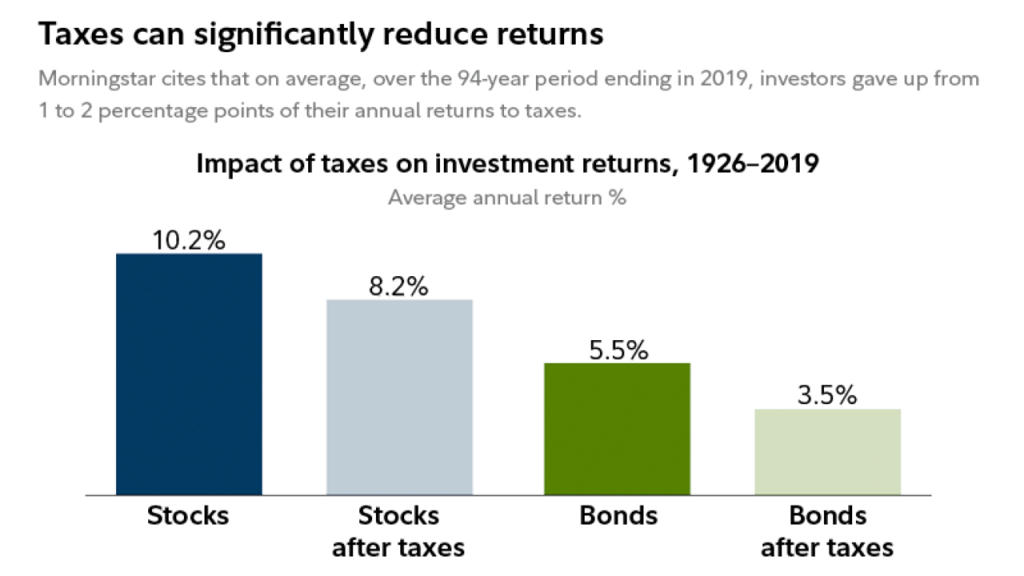
This illustration is for hypothetical purposes only. Investing in this manner involves risk, including the risk of loss, and will not ensure a profit. See footnote 1 for important additional information.
Whether you work with a professional to build a more tax-savvy investment plan or try a DIY approach, here’s how to get started.
1. Check your accounts
The first thing to do is see if you have your money in the right accounts for your goals, starting with tax-deferred accounts like 401(k) plans and traditional IRAs, then thinking about a Roth IRA, 529 college savings account or a Health Savings Account, where growth is potentially tax-free, said Klara Iskoz, vice president of retirement income solutions at Fidelity.
Next, look at what holdings you have in your taxable investment accounts and how much tax you are paying on the dividend and interest income they are generating during the year. Some securities may also pass along capital gains. You may see holdings that are generating more in taxes than other positions.
For instance, Howell had a client with a nest egg of around $1 million whose tax issue centered around one large position in a particular investment. Over a one-year period, the distributions from the one investment resulted in approximately $70,000 in federal taxes, and the client was concerned about the tax-efficiency of that position in their portfolio.
Note that selling investments in a taxable account produces potential tax consequences too, either with capital gains or capital losses. Even the common practice of reinvesting your dividends and interest income doesn’t change the tax implications of receiving those distributions, because you’ll generally still have to pay tax on what you’ve earned in a taxable account.
You can get all the information you need to assess your portfolio’s tax burden from reporting documents like 1099 forms from your account custodian, but most people don’t do it because it’s difficult, Iskoz said.
Because these types of assessments are complicated, you should consult with a financial professional to assess your specific situation. They may have software that can help crunch the numbers.
2. Develop a transition plan
The strategy question is: What do you do with the observations once you know what tax you are paying and why?
To change things up with your taxable accounts, you don’t necessarily have to sell a position completely, potentially generating capital gains. Howell says instead you can do something as simple as stop reinvesting dividends or interest income from an investment and start putting that money into more tax-efficient investments. One option might include your own state’s municipal bonds, which would be triple-tax-free in many cases.
If you decide to make changes, you don’t want to just dump all your current holdings and start over from scratch with other investments. The order of operations becomes key to tax management.
“It can be important to use as many of your existing suitable positions as possible, while adding additional tax-efficient positions,” says Howell.
Howell’s client with the large tax bill decided to work on shifting to a more tax-efficient position over time. The strategy that they chose for their own needs and goals focused more on buying individual securities. That strategy might not be the best for everyone, as the vast majority of individual investors might not want to assemble a portfolio of individual securities and manage it closely.
3. Keep an eye on things
Ongoing maintenance is key. Restructuring your portfolio for tax efficiency is not a one-shot deal. You need a plan going forward, and you might want to shift your positions throughout the year with tax-loss harvesting to try to offset your gains with losses by strategically selling investments.

This illustration is for hypothetical purposes only. Investing in this manner involves risk, including the risk of loss, and will not ensure a profit. See footnote 2 for important additional information.
This is how it worked for another of Howell’s clients, who had about $1.5 million in taxable investment accounts. They had been paying about $11,000 a year in federal taxes and wanted to see if they could reduce that amount with a different mix of assets. After running the numbers, they came up with a plan to shift to a particular set of investments. After that, the goal was to reduce future tax drag by managing the new positions with ongoing tax loss harvesting, maximizing the potential impact of tax-smart investing over time.
4. Think long-term
If your long-term plans include giving away your assets, you might want to consider other structures that will allow the money to grow tax-free to manage the tax impact to both yourself and your beneficiaries. The latest Insights Live webcast covers certain types of trusts and estate-planning strategies you can consider and various charitable giving options.
Bottom line
Every tax situation is different, so you want a strategy that meets your needs and that you have the ability to maintain. Tax strategies are particularly complex, so you should consult with a tax advisor and a financial professional to assess your specific situation and help you set the right course.
Looking for the next step? Talk one-on-one with a Fidelity professional.
Additional Information from: Impact of Taxes on Investment Returns — 1926–2019
1. Taxes Can Significantly Reduce Returns data, Morningstar, Inc., 2/28/2020. Federal income tax is calculated using the historical marginal and capital gains tax rates for a single taxpayer earning $120,000 in 2015 dollars every year. This annual income is adjusted using the Consumer Price Index in order to obtain the corresponding income level for each year. Income is taxed at the appropriate federal income tax rate as it occurs. When realized, capital gains are calculated assuming the appropriate capital gains rates. The holding period for capital gains tax calculation is assumed to be five years for stocks, while government bonds are held until replaced in the index. No state income taxes are included. Stock values fluctuate in response to the activities of individual companies and general market and economic conditions. Generally, among asset classes, stocks are more volatile than bonds or short-term instruments. Government bonds and corporate bonds have more moderate short-term price fluctuations than stocks, but provide lower potential long-term returns. U.S. Treasury bills maintain a stable value if held to maturity, but returns are generally only slightly above the inflation rate. Although bonds generally present less short-term risk and volatility than stocks, bonds do entail interest rate risk (as interest rates rise, bond prices usually fall, and vice versa), issuer credit risk, and the risk of default, or the risk that an issuer will be unable to make income or principal payments. The effect of interest rate changes is usually more pronounced for longer-term securities. Additionally, bonds and short-term investments entail greater inflation risk, or the risk that the return of an investment will not keep up with increases in the prices of goods and services, than stocks.
2. This hypothetical illustration assumes that the investor met the holding requirement for long-term capital gains tax rates (longer than one year), the gains were taxed at the current maximum federal rate of 23.8%, and the loss was not disallowed for tax purposes due to a wash sale, related party sale, or other reason. It does not take into account state or local taxes, fees, or expenses, or the net gain‘s potential impact on adjusted gross income, which could impact exemption and deduction phaseouts and eligibility for other tax benefits. Potential tax savings are based on the following calculation: (Realized Long-Term Losses x Long-Term Tax Rate) + (Realized Short-Term Losses x Short-Term Tax Rate). A 3.8% Medicare surtax may be added to tax rates, if applicable to your situation. If an investor is subject to the alternative minimum tax (AMT), the appropriate AMT tax rate may also be added to the calculation.
Fidelity does not provide legal or tax advice. The information herein is general and educational in nature and should not be considered legal or tax advice. Tax laws and regulations are complex and subject to change, which can materially impact investment results. Fidelity cannot guarantee that the information herein is accurate, complete, or timely. Fidelity makes no warranties with regard to such information or results obtained by its use, and disclaims any liability arising out of your use of, or any tax position taken in reliance on, such information. Consult an attorney or tax professional regarding your specific situation.
Keep in mind that investing involves risk. The value of your investment will fluctuate over time, and you may gain or lose money.
In general, the bond market is volatile, and fixed income securities carry interest rate risk. (As interest rates rise, bond prices usually fall, and vice versa. This effect is usually more pronounced for longer-term securities). Fixed income securities also carry inflation risk, liquidity risk, call risk and credit and default risks for both issuers and counterparties. Lower-quality fixed income securities involve greater risk of default or price changes due to potential changes in the credit quality of the issuer. Foreign investments involve greater risks than U.S. investments, and can decline significantly in response to adverse issuer, political, regulatory, market, and economic risks. Any fixed-income security sold or redeemed prior to maturity may be subject to loss.
This information is intended to be educational and is not tailored to the investment needs of any specific investor.
Fidelity Brokerage Services LLC, Member NYSE, SIPC, 900 Salem Street, Smithfield, RI 02917
975556.3.0
Content From
