
Innovative care is yielding
improved outcomes for
Dallas’ tiniest patients

Innovative care
is yielding
improved outcomes for
Dallas’ tiniest patients
Learn how Children’s HealthSM in Dallas
brings the future of neonatal care to
the present.
For families in north-central Texas requiring prenatal and neonatal care, Children’s Health is an easy choice, as it’s ranked in all 10 pediatric specialties by U.S. News and World Report. The hospital, which has been pursuing its mission of making life better for children since 1913, stays at the forefront of progressive fetal, neonatal and pediatric medical advances by empowering physicians with the resources they need to offer excellent care, from access to research and collaboration between specialties to advanced technology in a Level IV NICU. All of these factors come together to make Children’s Health, which serves the Dallas, Plano and surrounding communities, a standard-bearer for the future of pediatric medicine.
Cutting-edge TeleCooling and
neuro-NICU care
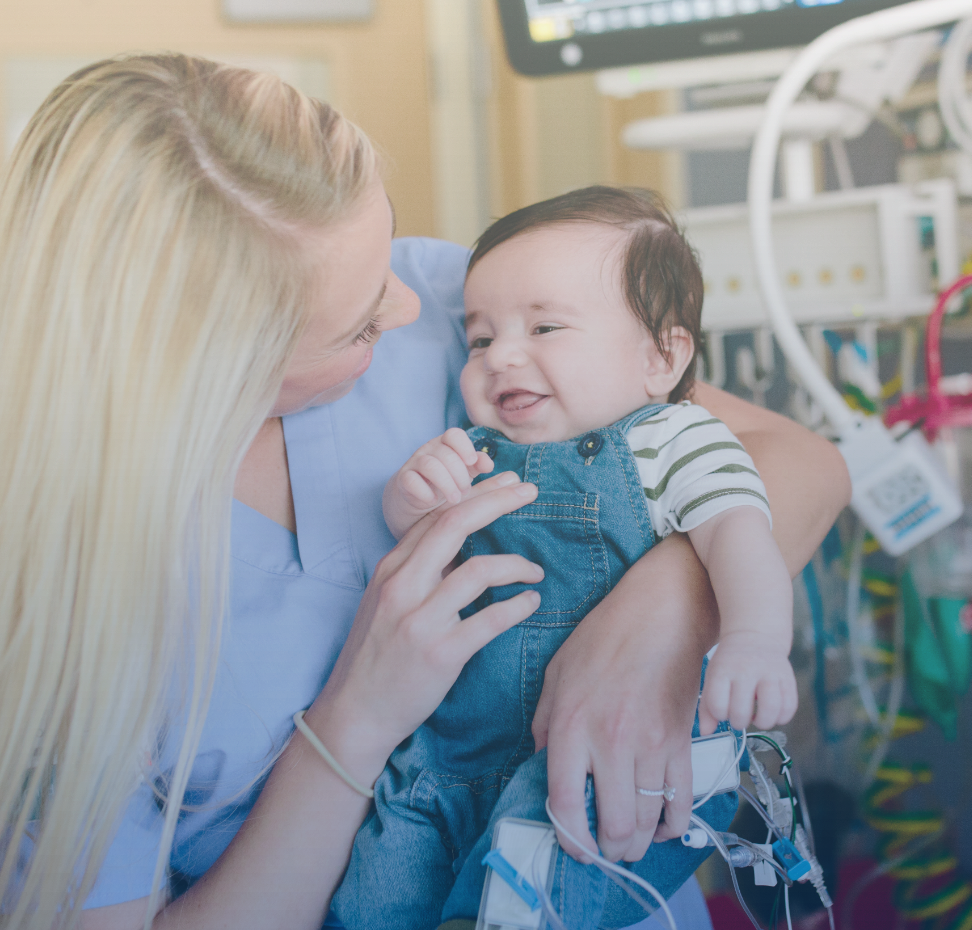
For newborns with brain abnormalities or injuries, Children’s Health in Dallas is one of the best places to receive care, thanks to state-of-the-art programs and infrastructure, as well as doctors and researchers committed to discovering new modalities. Sometimes diagnosis and intervention start at the hospital’s FETAL Center, where the team can identify problems before birth and assemble a cross-disciplinary care plan for delivery and beyond. Once these babies with critical brain issues are born, they have a place for care at the state’s only neurological neonatal intensive care unit (NeuroNICU), where Lina Chalak, M.D., M.S.C.S., serves as founding medical director.
“We have completely changed the landscape of asphyxia from a modifiable condition to something that we can treat if we intervene early on.”
—
Lina Chalak,
M.D., M.S.C.S., NeuroNICU director
“I resuscitate babies at the edge of viability,” she said. “The neuro-NICU is quite unique. It contains all the elements: a clinical program, state-of-the-art research funded by National Institutes of Health (NIH) and Patient-Centered Outcomes Research Institute (PCORI), and we’ve created a new fellowship in neonatal neurology. It’s comprehensive.” In addition to her extensive work with seizures and other brain abnormalities, Chalak has made significant advancements in cooling to reduce the brain damage associated with asphyxia during birth. In 2018, she and her team launched an innovative TeleCooling program. It allows babies outside of the hospital’s immediate area to receive treatment within the critical six-hour window after brain trauma, giving the doctors a chance to halt asphyxia-triggered damage that took place during birth.
Chalak and the Children’s Health team have been on the forefront of research. They were instrumental in the original cooling trials which proved that asphyxia could be reversed with early intervention and have since been involved in other studies on rewarming to reverse the therapy, all of which have influenced the neuro-NICU’s best-in-class protocols. “We have completely changed the landscape of asphyxia from a modifiable condition to something that we can treat if we intervene early on,” she said. And she’s nowhere near stopping: Her team has just received seven million dollars of PCORI funding for a clinical trial to look at babies with mild hypoxic-ischaemic encephalopathy, who were not included in the earlier trials.
Unique academic support
The opportunities for forward-thinking care at Children’s Health expand beyond the hospital’s walls through the well-established academic research affiliation with UT Southwestern, one of the top medical education and biomedical research institutions in the nation. Patients reap the benefits of this unique relationship between research and clinical organizations as doctors and academics collaborate to uncover promising treatments.
“We’re always looking for
the next possible cure,
therapy or intervention.”
—
Sushmita Yallapragada,
M.D., NICU medical director
Sushmita Yallapragada, M.D., NICU medical director, sees the whole ecosystem work in harmony. “We’re always looking for the next possible cure, therapy or intervention,” she said of the environment’s academic underpinning. “It motivates us and keeps our fingers on the pulse of new and upcoming data.”
Most of the hospital’s physicians, Yallapragada included, teach at the university, flexing their academic research muscles while treating pediatric patients at Children’s Health. Doctors are encouraged to pursue professional development and research opportunities outside the hospital as well, further expanding the hospital’s influence and abilities. For example, three Children’s physicians and faculty members are on the national Neonatal Resuscitation Protocol committee, impacting the standards for care at pediatric hospitals around the country. The hospital is also at the forefront of establishing best practices for neonatal care as a part of the Children’s Hospitals Neonatal Consortium (CHNC), a network of the top Level IV NICUs across North America.
Yallapragada and her team work on a neonatal sedation protocol, which will have far-reaching effects for infants needing acute care. “We are one of the main sites that has participated in a quality improvement project through CHNC to erase pain. It could potentially change the way that we manage some of our sickest infants in the NICU and even beyond,” said the neonatologist, explaining how the partnership between academia and practical application drives medical innovation forward.

State-of-the-art transport and
flexible telehealth
For patients who rely on immediate treatment, the robust offerings of Children’s Health can be made available, even if the patient isn’t physically at the hospital. “Our Neonatal and Pediatric Specialty Transport Services team is our eyes and ears in the community,” said Yallapragada of the fleet that includes 12 neonatal/pediatric-equipped ambulances, a Citation Encore jet and one Sikorsky helicopter to bring critical patients to the hospital and treat them on the way. Staffed around the clock to be ready for any emergency, the program was the first in the nation to receive a Commission on Accreditation of Medical Transport Systems’ (CAMTS) in all three modes of transport—ground, helicopter and fixed-wing. Paired with the hospital’s high-tech telemedicine capabilities—to allow physician consultations before a patient arrives at the hospital—Children’s Health can serve an ever-growing area.
12
Neonatal/pediatric-equipped ambulances

2
Aircrafts equipped to bring critical patients to the hospital and treat them on the way.

Frictionless cross-discipline
collaboration
A spirit of collaboration is a guiding principle at Children’s Health. “We have a multidisciplinary approach. We are proud to continue searching for more treatments, strategies and team-based approaches to care,” Chalak said. From a pioneering, cross-discipline long-covid clinic and the Thrive Program that provides specialized follow up care for NICU babies through their fifth birthday to more than 95 clinical trials in pediatric oncology alone, the hospital’s culture invites new approaches to best serve patients.
Sonia Voleti, M.D., pediatric cardiologist, sees this spirit of collaboration play out in the ongoing expansion of the hospital’s neurodevelopmental program. She explained how a recent hire of an additional neurodevelopmental psychologist, Randi Cheatham-Johnson, Ph.D., to care for congenital heart disease patients enables a 360-degree approach to patient care. While Voleti is adept at addressing the physical elements of such a diagnosis, her psychology partners can help both the child and their family prepare emotionally and practically. “Now there’s more attention on what life looks like, not just about the heart and how we fix it, but how that translates into a patient’s life,” Voleti said of the team effort, adding that greater preparation and support can lead to improved outcomes.
“Whatever you are interested in, you’ll be able to find a niche and the encouragement to participate.”
—
Sonia Voleti,
M.D., pediatric cardiologist
This spirit of collaboration and encouragement to pursue leading edge modalities and new approaches to care infuses every department. “Whatever you are interested in, you’ll be able to find a niche and the encouragement to participate,” Voleti said, from continuing education fellowships and new in-hospital programs to grant writing and clinical trials. This future-focused ethos means that doctors, nurses and clinicians are bringing the future of pediatric and neonatal care to their patients now at Children’s Health.

Discover the pioneering work
at Children’s Heath.
All physicians mentioned in this article are employed by UT Southwestern, and provide care for patients at Children’s Health.

washingtonpost.com © 1996-2023 The Washington Post
Privacy Policy • CA Notice of Collection • Do Not Sell My Info • Terms of Service