Creating business opportunity through sustainability
Companies that effectively manage their water resources are primed to outpace their peers, but they must design and implement a plan to meet sustainability commitments now.
By WP Creative Group
May 21, 2024
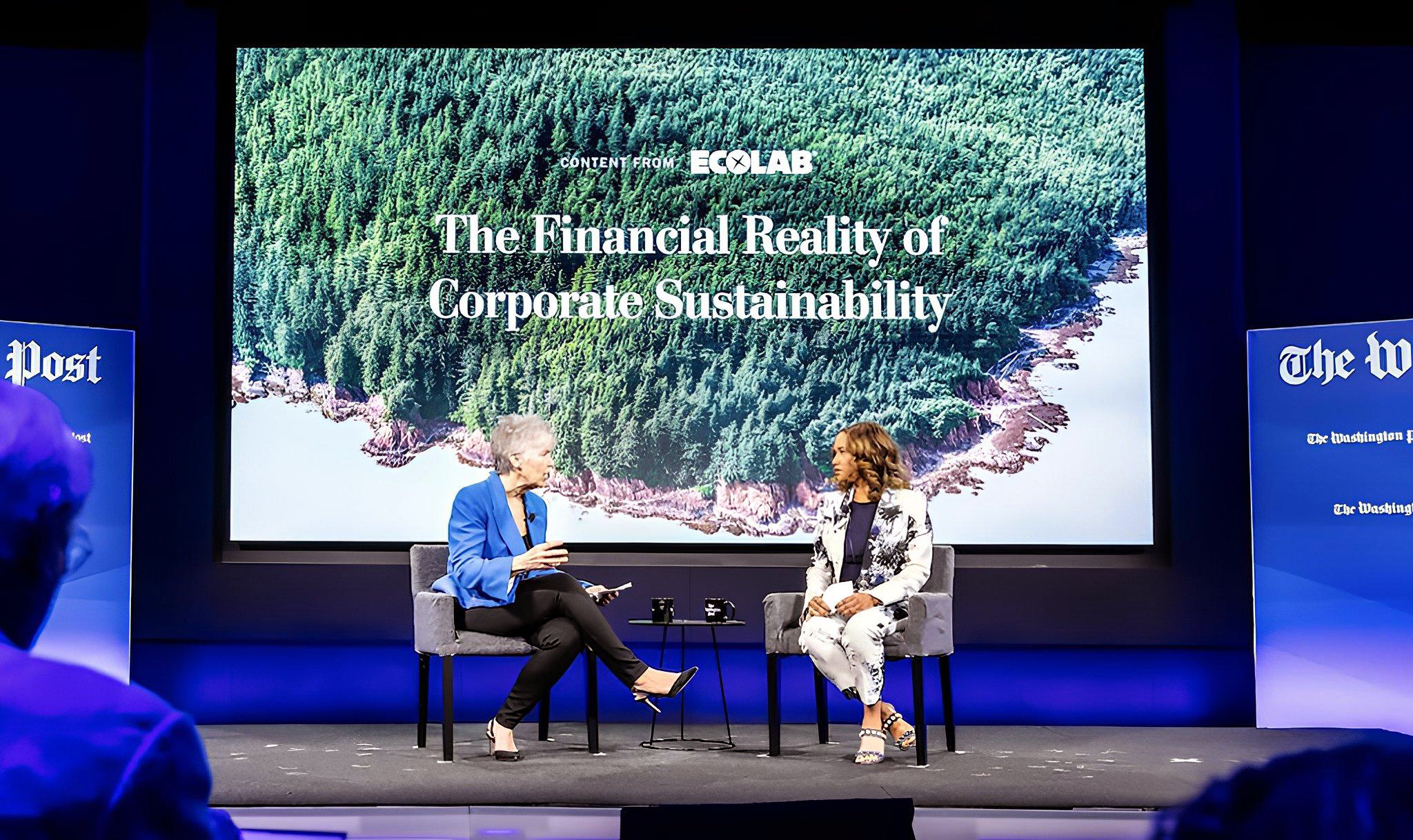
Achieving corporate sustainability doesn’t have to mean sacrificing business goals. In fact, for well-managed companies, moving toward 2030 climate goals can also bring financial rewards, says Tiffany Atwell, senior vice president of global government relations at Ecolab.
“You do not have to sacrifice profitability and being a successful business by trying to meet your sustainability goals.”
– Tiffany Atwell, senior vice president of global government relations at Ecolab.

Speaking at a recent Washington Post Live summit on climate in Washington, D.C., Atwell commented, “You do not have to sacrifice profitability and being a successful business by trying to meet your sustainability goals. You can make more money, be more successful, but leave the world in a much better place.”
Atwell, whose background includes both government and industry roles in regulatory oversight, cited a 2023 study1 of 2,269 public companies that showed that businesses that were already achieving growth and profitability gain an even stronger competitive advantage by committing to sustainability. These companies, according to the study, delivered two percentage points of annual total shareholder return over companies that only outperformed on financial metrics—and seven percentage points above the rest of the group.
“We will save enough drinking water by 2030 to help one billion people have access to clean drinking water.”
– Tiffany Atwell, senior vice president of global government relations at Ecolab.
Perhaps the most convincing evidence, however, is Ecolab itself and its customers. The company, a global sustainability leader offering water, hygiene and infection prevention solutions and services, reported annual revenue of $15.3 billion in 2023, a nearly eight percent increase from the year prior. As a global company originally founded in 1923, Ecolab recently launched its Ecolab Water for Climate™ program—which is designed to help companies reduce, reuse and recycle water across an enterprise to help achieve business and sustainability goals—to join its other offerings for cleaning, sanitizing, food safety and infection prevention.
Through better water stewardship in conjunction with customers in 40 industries, Atwell said on Washington Post Live, “we will save enough drinking water by 2030 to help one billion people have access to clean drinking water.”
Using less water for commercial and industrial purposes means organizations use less energy, subsequently reducing costs and lowering emissions—a green domino effect. “We know that there’s an interconnectedness between water and greenhouse gases,” noted Atwell. Through its work with customers, Ecolab aims to prevent the release of six million metric tons of greenhouse gases annually by 2030, Atwell said.
For example, in water-intensive industries like beverage brewing, Ecolab Water for Climate is designed to help customers cut water use, on average, by 25 percent, energy consumption by 12 percent and greenhouse gas emissions by six percent, the company states.

Regulatory and legislative landscape creates a further incentive
Around the world, trends in regulation and legislation are leading to increased pressure on companies to disclose their environmental and climate risks and related mitigation efforts. The evolving landscape adds even more urgency for companies to gain command of their energy use and how to reduce it. Since roughly 75 percent of electricity usage in commercial settings can be devoted to the management of water (cleaning, cooling, heating, transporting, etc.), the focus comes back once again to smarter water management. Atwell said that digital tools like Ecolab’s 3D TRASAR can play a key role in analyzing and optimizing water use. “We do an audit and look at what customers are doing great and how they can improve,” she explained. “We’re trying to get them to grow using less resources, whether it’s water or everything else.”
Consumers expect corporate responsibility
Consumers are largely ahead of businesses when it comes to water scarcity and protections. The 2023 Ecolab Watermark™ Study, commissioned by Ecolab and conducted by Morning Consult, showed growing consumer awareness and focus on water issues2. In the United States, 81 percent of survey respondents identified access to clean and safe water as a key concern. And, equally important, they backed their worries with behavior changes, with 66 percent saying that they are willing to pay more for environmentally sound products and 37 percent refusing to buy products that they believe require too much water to manufacture.
“If government policy is not enough and being more profitable is not enough, understanding that your customers care about these issues should help you understand that you need to get on board with this.”
– Tiffany Atwell, senior vice president of global government relations at Ecolab.
While the survey showed that respondents believe that water concerns can be addressed effectively (70 percent), fewer believe that businesses were actually doing so (35 percent). From Atwell’s point of view, consumers’ dour take on corporate responsibility and preparedness represents a call to action. “If government policy is not enough and being more profitable is not enough, understanding that your customers care about these issues should help you understand that you need to get on board with this,” said Atwell.
Ecolab is transforming the way the world thinks about water by helping companies protect water resources without sacrificing growth. Learn more.

RELATED CONTENT FROM ECOLAB


New demands on water require innovative solutions


The path to profitability passes through sustainability