New demands on water require innovative solutions
AI data centers are increasingly driving the demand for water, which puts a growing focus on corporate sustainability.
By WP Creative Group
OCTOBER 30, 2024
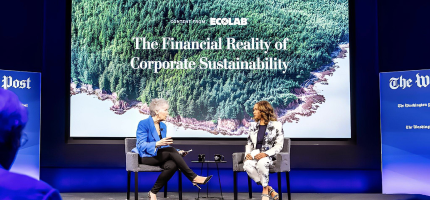
“When companies think about being sustainable, sometimes they think it’s a high hurdle to try to achieve. But the fundamental start of that journey can really be connected to water: It’s a tool that can help them be more sustainable,” said Tiffany Atwell, Ecolab executive vice president of global government relations. Speaking in September at a Washington Post Live summit on climate in New York City, Atwell added that being a good corporate steward of water is a win-win for companies, especially ones that have been investing heavily in artificial intelligence (AI)–a water-intensive endeavor.
In a 2021 study,1 scientists noted that the United States is home to a quarter of all data centers worldwide. Of those domestic data centers, 20 percent draw water from local watersheds that are already moderately to highly water-stressed, and nearly 50 percent rely on electricity from power plants operating within water-stressed regions. According to this research, a mid-size data center goes through 300,000 gallons of water a day, a number that will balloon as more AI models come online.
Fortunately, Atwell said, the high-tech industry tends to be forward-looking and is receptive to sustainability solutions such as Ecolab’s Water for Climate™ program. “Data centers are some of the best corporate stewards of water,” said Atwell.
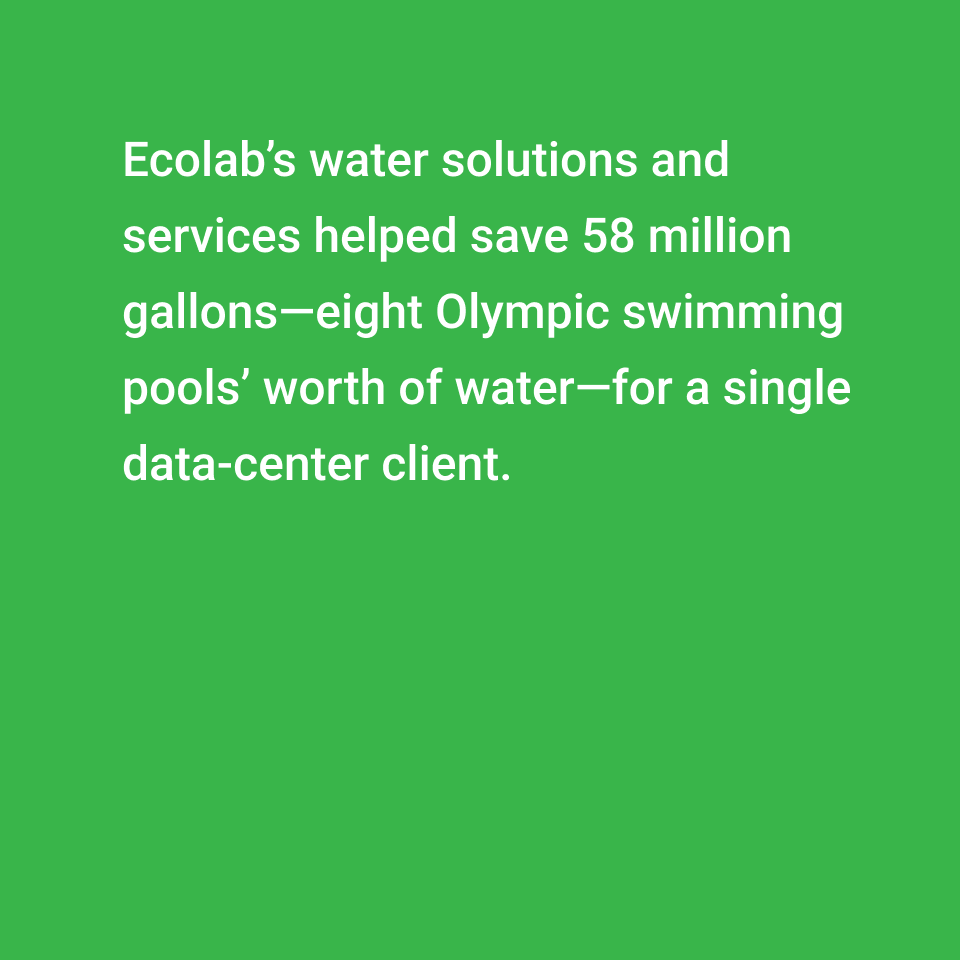
Founded in 1923, Ecolab has grown to be a global sustainability leader in water, hygiene and infection-prevention solutions and services. The Ecolab Water for Climate™ program is designed to help companies reduce water usage across an enterprise to achieve business and sustainability goals. Ecolab’s water solutions and services helped save 58 million gallons—eight Olympic swimming pools’ worth of water—for a single data-center client, Atwell said during the WP Live summit.
With customers in 40 industries, Ecolab’s water stewardship “will save enough drinking water by 2030 to help one billion people have access to clean drinking water,” Atwell explained.
Looking at a thirsty AI future
Focusing specifically on AI’s role in increasing water demand for cooling, humidification and power, researchers last year2 found that the process of training a large language model consumes about 185,000 gallons of water. When the model is complete and responding to queries, the water consumption continues, evaporating about 16 ounces every 10-50 queries. In a published paper, the researchers included a straightforward warning, stating that, “The growing tension over the enormous water usage between data centers and human needs may create new environmental risks and even social conflicts.”
But where there’s tension, Atwell and Ecolab see opportunity. “There’s still a lot of work that needs to be done,” Atwell said, emphasizing that the magnitude of the water crisis demands a combined effort by government, industry and NGOs. “But I’m inspired,” she added.

Working on public-private collaborations
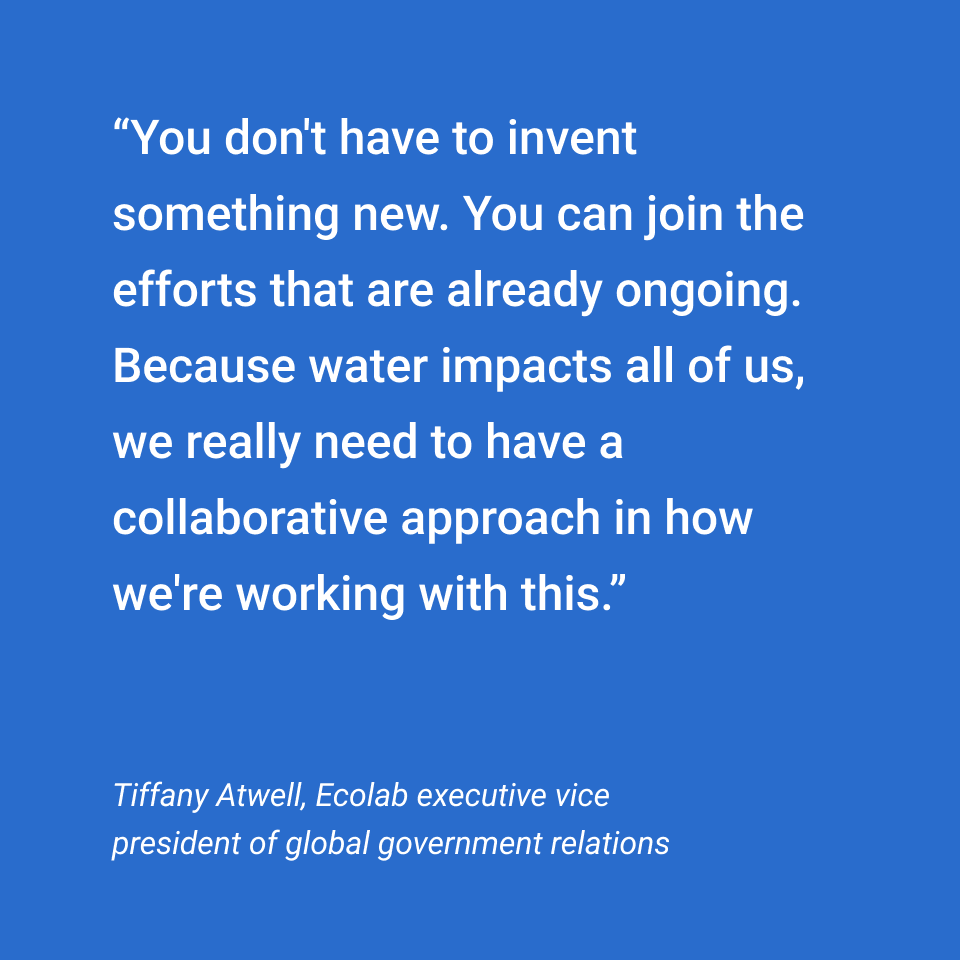
Atwell emphasized the importance of businesses strengthening their efforts by partnering with other organizations, rather than trying to go it alone. “You don’t have to invent something new,” she said. “You can join the efforts that are already ongoing. There are many NGOs working in this space. Because water impacts all of us, we really need to have a collaborative approach in how we’re working with this.”
Speaking to existing cooperative efforts, Atwell cited the United Nations’ Global Compact’s CEO Water Mandate as “a great model.” The CEO Water Mandate’s Water Resilience Coalition initiative is chaired by Ecolab chairman and chief executive officer, Christophe Beck, in partnership with a nonprofit research group. It includes more than 40 companies that have agreed to make commitments to reduce their water footprint and work toward a net positive water future. As Beck wrote last year, “It’s now or never for water stewardship, and the path forward lies in collective action by businesses worldwide.”
Atwell encourages companies to start their journey at Ecolab’s website with the Smart Water Navigator, a free tool to track and understand water input, needs and risk. “You can actually build out what your water reduction target should be,” she said, “and map out a plan for your consumption.”
“We know our customers need to make a profit,” Atwell added. “Everything that we’re doing in partnership with them is geared towards that. But the benefit to society is something that inspires me every day.”
Ecolab is transforming the way the world thinks about water by helping companies protect water resources without sacrificing growth. Learn more.
RELATED CONTENT FROM ECOLAB
Creating business opportunity through sustainability

The path to profitability passes through sustainability
Sources
- Md Abu Bakar Siddik et al, “The environmental footprint of data centers in the United States,” May 2021 Environmental Research Letters, vol. 16, no. 6.
- Pengfei Li, Jianyi Yang, Mohammad A. Islam, Shaolei Ren, “Making AI Less ‘Thirsty:’ Uncovering and Addressing the Secret Water Footprint of AI Models” April 2023 arXiv.