Modernizing legacy mainframes: A sensible approach to an urgent problem
By Guidehouse
Tackling the enormous challenge of updating outmoded government computer systems is a bit like opening a time capsule. Several federal agencies are still using mainframes installed during the Nixon Administration. When some of these systems were introduced, back in 1972, the first personal computer was still two years away, scientific pocket calculators were brand new and “high-speed connection” referred to train travel.
Obsolete systems—some of them 30-50 years old—pose a major threat to government agencies and their constituencies, leaving them vulnerable to cyber-attacks, unable to address changing service needs and market realities and saddled with the high costs and inefficiencies of maintaining decades-old technology with workaround solutions.
The key question is: Can agencies successfully migrate from obsolete technologies to less expensive, more agile systems that can mitigate security risk, improve taxpayer services and reduce support costs? According to a new report by Guidehouse, a leading global provider of technology, management and risk consulting services to both the public and commercial sectors, the answer is: Yes.
The urgency of this problem is clear. Recent congressional testimony by the Government Accountability Office (GAO) noted that 10 of the 15 federal agencies investigated have 249 systems vulnerabilities, of which 168 pose significant risk to the security of their operations. Further, the legacy systems, primarily mainframes, rely on obsolete programming languages, as well as hardware and software that are no longer supported by manufacturers.
Legacy mainframes open agencies to significant risks
While the effort and cost of modernizing legacy systems are substantial, the risks of doing nothing are far greater. Failure to modernize these systems can cause chronic issues, including:
- Security risk:Many mainframe systems are so old that they are no longer supported by their vendors, creating security exposures and additional costs. These systems often have known vulnerabilities that are either technically difficult or prohibitively expensive to address.
- Unmet mission needs:Many systems are too obsolete to support even basic mission functions and unable to flexibly respond to changing taxpayer demands and agency needs.
- Staffing issues:The archaic mainframe systems need programmers experienced in older languages like COBOL and MUMPS, many of whom have exited the market, resulting in a premium for these skills.
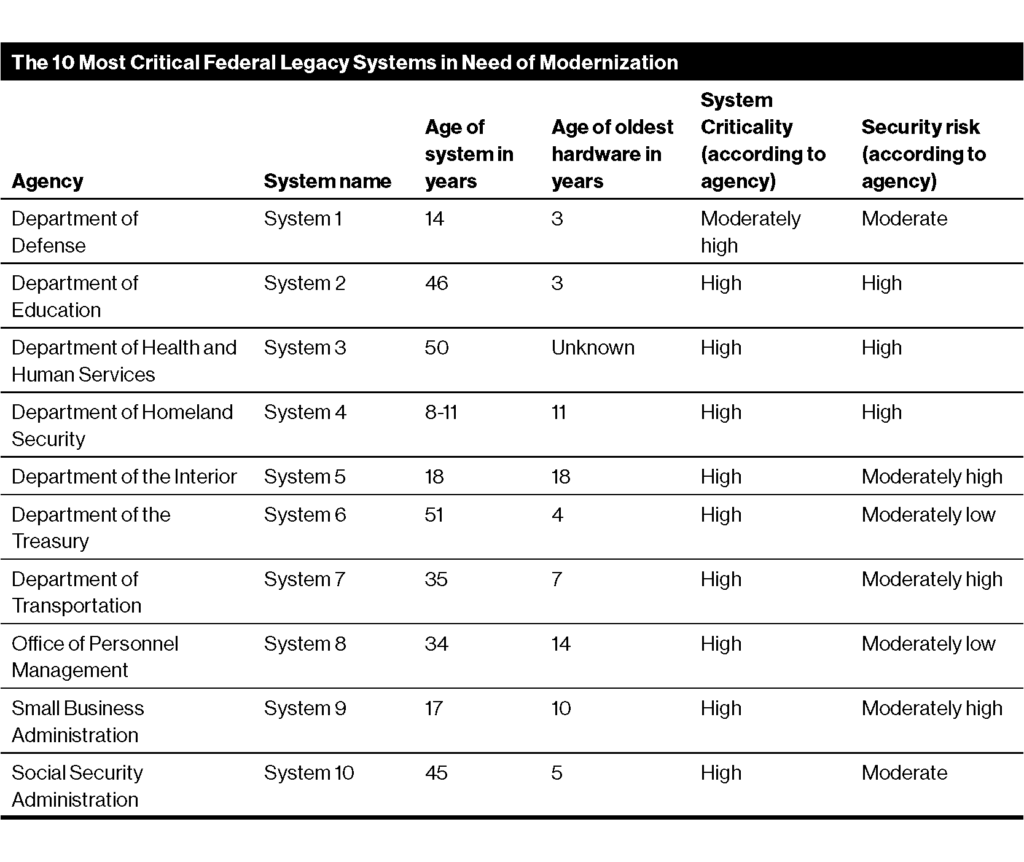
- Increased cost:The cost of maintaining the aging mainframe systems grow with time. The federal government’s 10 legacy systems most in need of modernization cost about $337 million a year to operate and maintain—dollars that could be spent to modernize the systems.
Benefits of mainframe migration far outweigh risks
Mainframe modernization is not without risks, of course. A lack of documentation and limited understanding of the old system at a business and technical level is a problem. Aging systems tend to have many unsupported software programs and the original developers, analysts and business users have left the workforce, creating a knowledge gap that can cause deterioration of the code and system components. Additionally, the inflexibility, lack of interoperability and difficulty of making changes to the mainframe architecture force technology teams to develop shadow and ancillary distributed systems to bypass the mainframe, increasing the number of interfaces and data exchanges, creating a “spaghetti” technology environment that becomes messy to untangle.
These stumbling blocks are well worth navigating considering the compelling benefits of modernization—fewer manual processes, improved data quality and greatly reduced overhead. The process can also help agencies address security vulnerabilities and audit concerns in running ancillary systems.

For example, the Department of Housing and Urban Development (HUD) migrated five critical business systems from a legacy mainframe to the cloud. The systems affected by this migration impact some 30,000 users and keep more than 100 agency grant, subsidy and loan programs running. By converting the legacy system’s code from COBOL to Java, HUD is estimated to save up to $8 million annually.
Ultimately, mainframe migration should result in streamlined operations and a “future-ready” technology environment. The transformation process can enable senior agency leadership to optimize spending, enhance organizational agility and respond to the public’s changing needs.
Based on Guidehouse’s experience with multiple mainframe modernizations, we have learned that success depends on a disciplined assessment; alignment with the agency’s mission, priorities and business case; and a migration plan that is methodically focused on achieving steady, incremental progress.
A framework for successful transformation
Federal agencies would be well-advised to work with a trusted partner that combines a strong technical approach with deep expertise in the government technology arena, as well as specially developed tools and accelerators that expedite the modernization journey. At Guidehouse, we have identified several other critical success factors:
- Governance and structure:Mainframe modernizations are complex, involve large teams and rarely go as planned. Consequently, a strong governance model with clear roles and responsibilities for each team member and a nimble decision-making process to quickly resolve risks and issues are essential.
- People:Assemble a project team with the skills needed to analyze mainframe system components like data, code, jobs, schedule, etc. Often, confusing requirements and one-off scenarios are embedded in the code, and even the operations team may not be aware of the specific use cases. For that reason, create small, nimble and focused teams with the right mix of technical and non-technical skills to tackle specific problems.
- Process:A thorough understanding of the operations and business functions is the foundation for any modernization effort. Over time, not only do systems become obsolete, but processes become outdated and inflexible. It is essential to create a detailed concept of operations and a requirements traceability matrix to validate the system design and implementation requirements. Additionally, we suggest documenting detailed process flows, both as-is and to-be.
- Technology:Specialized tools and accelerators can significantly increase the pace of modernization. Mainframes come with archaic software and data storage in formats that do not cooperate with modern distributed architecture. Resolving these issues requires specific tools and a strong network of technology tool providers. Also, not all the components and solutions embedded in a mainframe system are bad and disposable. Identifying and reusing the still-viable pieces of the mainframe may require some reverse engineering, but can expedite the delivery of the new system.
Given the serious technical challenges of modernizing mainframe platforms, agencies need to adopt a path that helps them assess the comparative and aggregate value—business, technical and economic—of these legacy applications. More importantly, with limited money and time, agencies need an application portfolio management strategy that is efficient and delivers effective IT, both during and post-transition. In our experience, a solution that aligns IT investments with business value, while enabling prioritization of key initiatives, provides the best chances of success.
To speak to an expert and learn more about how Guidehouse can support your IT Modernization goals click here.
The content is paid for and supplied by advertiser. The Washington Post newsroom was not involved in the creation of this content.
Content From