AI: EMPOWERING INNOVATION
Powered by Intel, Zoom’s AI tools help workers thrive in the new economy
Today’s knowledge workers face a firehose of data, including e-mails, direct messages, conference calls, collaboration tools, and more. Managing it all and differentiating what is critical and actionable versus what is lower priority can be challenging.
The good news: new services, powered by artificial intelligence and advanced computing hardware, offer solutions.
There is no better example of this than Zoom Communications, whose AI Companion helps workers capture, interpret, prioritize, and act on information from multiple sources, live and asynchronously.
“We are going to bring people together, help them collaborate, and get work done in a much more efficient way,” says Xuedong Huang, Chief Technology Officer, Zoom. “We’re really helping you to transform from meetings to milestones, from conversation to completion.”
Zoom became the go-to platform for video calls during the pandemic. Its intuitive and reliable tools pushed it past industry stalwarts to become the dominant service. Huang relays, “We brought people from everywhere together, virtually.”
With AI Companion and a host of powerful new tools for enterprises, Zoom is now moving beyond videoconferencing. It aims to be an all-in-one AI-first work platform that can inform contact centers, track customer and employee sentiment, help drive revenue growth, and act as every worker’s personal assistant.
To optimize the performance of its AI services, Zoom worked closely with Intel. The chipmaker’s latest processors are purpose-built to give AI a boost. “Intel has been a strategic partner for AI across our client and cloud offerings,” notes Huang.
Agents of progress
Zoom AI Companion’s newest capabilities, introduced in March 2025, lean heavily into agentic AI. Going beyond basic tasks, these agentic tools can reason and automatically orchestrate events, such as scheduling meetings, tracking action items, and planning follow-ups.
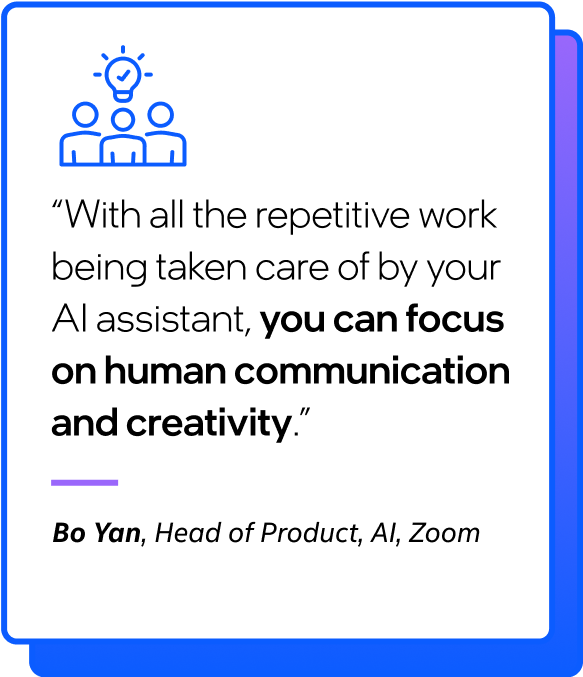
“In our daily life, we have lots of repetitive and administrative work that you don’t want to spend time on,” says Bo Yan, Head of Product, AI, Zoom. “With all the repetitive work being taken care of by your AI assistant, you can focus on human communication and creativity.”
Indeed, Zoom AI Companion can heighten the impact of human-to-human communication through tools that capture verbatim meeting transcripts, as well as the context, meaning, and nuance that is essential to understanding.
“It’s almost as good as your executive assistant,” explains Huang.
Zoom AI Companion is embedded across the platform, including:
- Zoom Docs
- Zoom Meetings
- Zoom Team Chat
- Zoom Contact Center
- Zoom Whiteboard
- Zoom Workflow Automation
For consistency across applications, these services all call upon the same data sets. “At Zoom, we have many applications, but we have one AI Companion: one memory, one history,” says Yan.
To drive its AI Companion capabilities, Zoom uses a federated approach to AI – combining the capabilities of leading, third-party models with its homegrown AI – including its “small” language models, which employ as many as 2 billion parameters.
For privacy and security reasons, Zoom does not use customer content to train its models.
Intel chips in
Intel engineers worked closely with their counterparts at Zoom to optimize how Zoom’s software runs on Intel-based systems, including laptops, desktops, and servers.
The partnership dates back to 2019, when the two companies initially focused on improving the performance of features like virtual backgrounds, background blurring, speech recognition, and noise suppression.
The collaboration has grown to include optimizing Zoom AI Companion on Intel hardware, whether users are accessing AI services from the cloud, running them locally on PCs or relying on a combination of the two.
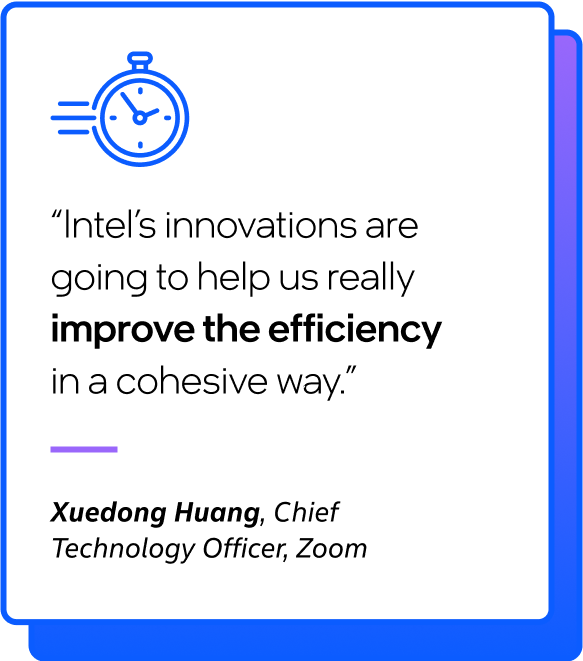
“We are going to combine both edge and cloud intelligence in a seamless way,” states Huang. “Intel’s innovations are going to help us really improve the efficiency in a cohesive way.”
For locally run services, Zoom’s software includes hooks that tap the power of Intel’s Neural Processing Unit (NPU). The NPU is an on-chip accelerator that is aboard the latest Intel® Core™ Ultra-based desktops and laptops.
The NPU accelerates processing and throughput of AI-related computations. This not only speeds things up but also helps manage power consumption, which can be an issue for organizations that employ AI broadly.
“How to manage the efficiency, latency, and battery power is a constant challenge,” says Huang. “We have been working closely with Intel to optimize performance across all those metrics.”
From the edge to the client
Local processing lets users run some AI Companion features without a connection to the cloud. “When you’re running in a disconnected mode, the AI can still function,” describes Yan. “You can still search for information and get things done. That’s the beauty of having AI Companion everywhere.”
The latest Intel Core Ultra Processors for notebooks and desktops are genuine AI powerhouses, designed to enhance AI workloads through its multiple accelerators: the NPU for power efficiency, the GPU for high throughput, and the CPU for low latency. These components work in tandem to handle all AI tasks locally and efficiently, ensuring optimal performance with longer battery life.
Zoom’s AI workloads leverage this diverse processing power to deliver the best possible user experiences on Intel platforms. By utilizing the strengths of each accelerator, Intel provides a seamless and robust environment for all Zoom users.
For cloud-based functions, such as inferencing, Zoom’s AI Companion uses Intel® technology that scales across the datacenter. Intel® Xeon® 6 processors with Performance-cores (P-cores) power the most demanding workloads with AI acceleration built into every core. Intel® Gaudi® AI accelerators focus on specific AI tasks, like fine-tuning and inference.
Zoom AI Companion also leverages assets like Intel® Extension for PyTorch to improve the performance of deep learning models.
All of this adds up to a future in which AI plays a more prominent role in the workplace, giving human workers superpowers to create and innovate. Yan concludes, “I had a dream one day that everyone can have more time to interact with people, work happier, and maybe even work less.”
Intel technologies can help your organization make the most of agentic AI.