Inside Ohio’s Military-Industrial Synergy
How two military contracting businesses found success in the state.

By WP Creative Group
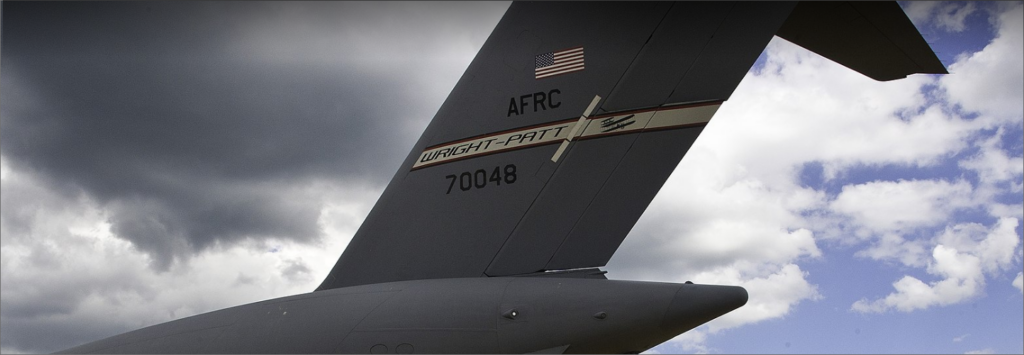
There’s an intermittent thrum of aircraft engines and train horns at Wright-Patterson Air Force Base (WPAFB), Ohio’s largest single-site employer. More than 30,000 employees work in and around what’s affectionately known as “Wright-Patt,” including 15 air force units, dozens of associate Air Force and Department of Defense organizations and everyday businesses like barbers, childcare and a medical center. These groups all work toward a common goal: innovating the future of aviation and flight.
The sprawling 12.5-square-mile base also hums as the economic engine energizing the entire region. It’s the largest Air Force contracting base in the U.S., generating more than $16 billion in gross economic output. Many of Ohio’s 550 aerospace and aviation organizations are located in or near Dayton and the base.
Beyond the base’s perimeters, around 50,000 contractors and subcontractors work with the Air Force in various specialties, including aircraft modification and building and procuring parts. All told, Wright-Patterson and similar military bases are critical to the Ohio economy, contributing 1.2 percent to the state’s GDP.
Local Support, National Security
There’s a “synergy” for companies close to the base, says retired General Lester L. Lyles with the base’s Air Force Materiel Command. The command keeps Air Force weapons capable and prepared for war through research, development, testing and evaluation, and providing acquisition management services and logistics support.
“There’s a great relationship, and always has been, between the base and the things that the base does, and the general economy in the State of Ohio or individual communities,” Lyles says.
Over his career, General Lyles was assigned three times to WPAFB, including overseeing a new missile propulsion system and the development of the F-16 Fighter Plane. Back in the 1980s and earlier, young engineers would stop by mom-and-pop development and manufacturing shops in nearby cities like Dayton, Lyles says.
Hear General Lyles speak about the history of Ohio’s military and local businesses.
0:00/0:00
These small- and large-business opportunities have grown a thousand fold as Dayton’s Aerospace Corridor continues to expand beyond aviation into space and the future of flight. Businesses are drawn to the area by the mix of healthy existing industrial and military investment, innovative opportunities, Ohio’s central location and manufacturing capability.
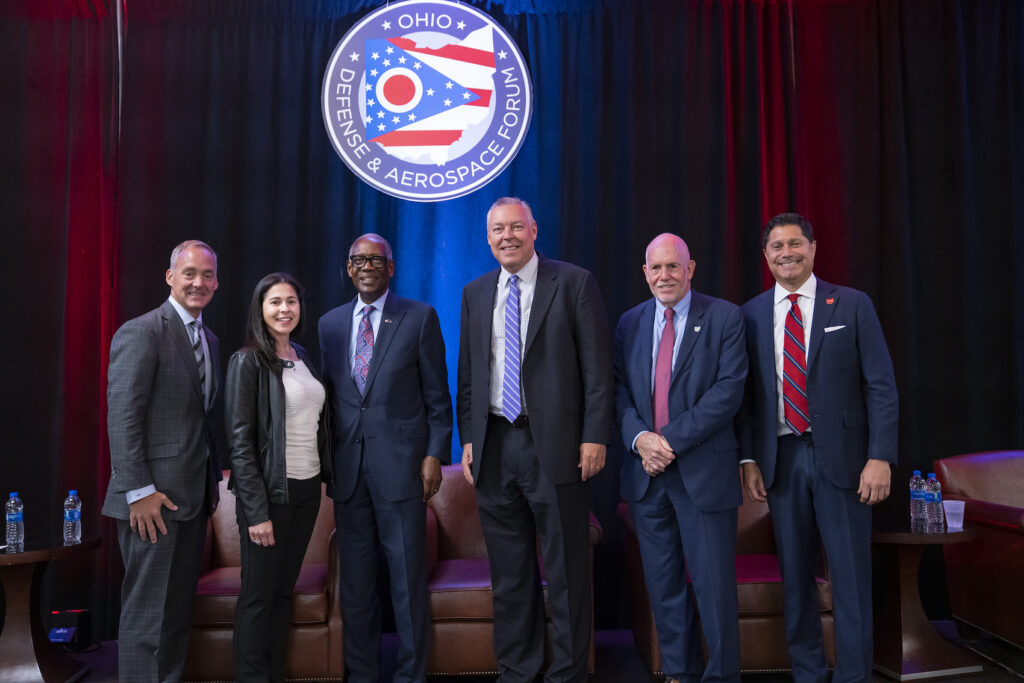
The Air Force now provides billions of contracting dollars, according to Jeff Hoagland, president and CEO of Dayton Development Coalition. “We see our employment grow, our community grow, our state grow because of the impacts of Wright-Patterson,” he says.
Military-Industrial Complexity
The region’s web of work includes international corporations, universities, the air force, and small businesses amid Ohio’s fertile intellectual fields. Ohio’s defense contracts primarily concentrate on aerospace product and parts manufacturing, and scientific research and development.
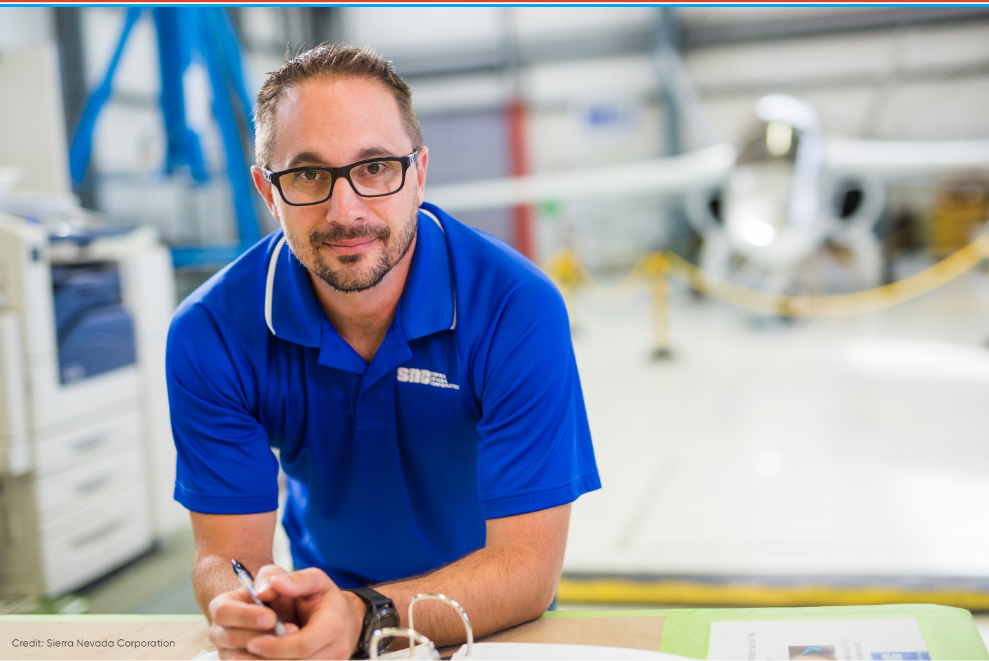
Sierra Nevada Corporation (SNC) is a government contractor working with the Department of Defense to provide aircraft design, modification and mission systems integration, including services out of Wright Patterson. SNC specializes in adding new capabilities to proven aircraft, such as flight deck upgrades and modernization of mission systems.
Thanks to help from JobsOhio, the state’s economic development corporation, SNC decided to construct an Aviation Technology Center consisting of two new aircraft hangars at the Dayton Airport. SNC’s hangars will accommodate growing work on some of the world’s largest military aircraft as an expected 150 new SNC employees tackle maintenance, repair and overhaul.
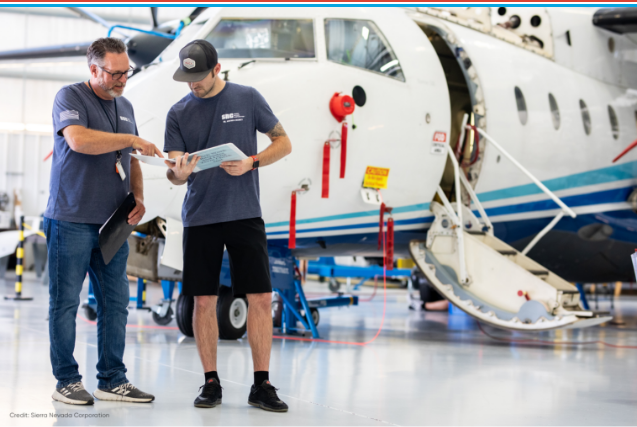
Proximity to the customer is critical for government contractors, says Mark Williams, vice president within Sierra Nevada Corporation’s Intelligence Surveillance and Reconnaissance, Aviation and Security Business Area.
“Doing aviation modification is complex work that requires a high degree of interaction between the customer, contractor and subcontractor,” Williams says. “You’re right next to the main hub for aviation acquisition with Wright-Patterson Air Force Base and close to the customers.”
Planning for Development
Previously, SNC’s Dayton office provided services to various base missions and military aircraft work, with additional hangars in Colorado. After SNC decided to expand its footprint and started evaluating sites suitable for large aircraft work, the Dayton Development Coalition (DDC) made a successful appeal for the Dayton area. “They see the workforce that we have, the quality of life, the affordability. It’s the Midwest. They’re seeing a great market here,” Jeff Hoagland, president and CEO of DDC, says.
DDC helps existing companies grow and attract new companies, and preserve, protect and grow Wright-Patterson Air Force Base. As a driver of economic development, the base boosts payrolls and property taxes that help fund schools, local governments and community amenities. “Ohio is a great place to invest for any company, but we have a special place in our heart for those who support our national defense. Our state has worked to create a welcoming environment for both contractors and active-duty personnel,” says Elaine Bryant, executive vice president of Aerospace and Defense, DDC and managing director, Military and Federal Sector, JobsOhio.
“They see the workforce that we have, the quality of life, the affordability. It’s the Midwest. They’re seeing a great market here”
Jeff Hoagland, president and CEO of DDC
JobsOhio and DDC work together as a “one-stop shop” with businesses, acting as a single point of contact for companies considering entering Ohio’s financially rewarding military-industrial complex—scouting locations and lining up employees. JobsOhio acts as a catalyst for high-growth business investments and job creation, helping propel the Ohio’s economy. JobsOhio, the state of Ohio and local government entities present an incentive package resulting from a consolidated, focused group effort among partners.
Hear Jeff Hoagland expand on DDC’s “one stop shop” approach
0:00/0:00
Investing in Research
Another household name has been steadily investing in expanding Western Ohio capacity, particularly in the electrical power systems that help feed an aircraft’s devices, radars and sensors. In the past 10 years, General Electric built a GE Aviation Electrical Power Integrated Systems Center on the University of Dayton’s campus, where GE sponsors a professor in power electronics engineering. At the Center, GE Aviation works with the Air Force Research Lab (AFRL) to design, fabricate and test components.
In recent years, AFRL added GE Aviation to a $409 million contract to develop next-generation fighter and bomber aircraft technologies. This year, GE Aviation also opened a 280,000-square-foot engine component manufacturing facility for civil and military aviation in Miami Valley, near Wright-Patt.
Thanks to industry, higher ed, the state of Ohio and the Air Force collaboration, local research is ever expanding. In nearby Springfield, construction began in September 2022 on a new advanced air mobility projects facility for industry-military cooperation, thanks to a $9.35 million investment from the city of Springfield, JobsOhio and the Department of Defense. One such project? The $35 million “Agility Prime” program developing electrical vertical take-off and landing machines (also known as electric flying cars) that could ascend into Ohio’s blue skies by 2023.
Workforce and Air Force
Dayton’s draw includes a talent pipeline providing enthusiastic engineering, political science and business majors from eight top state universities – and from retired military service members. More than 30 percent of SNC’s workforce is drawn from the military.
Perhaps one of the most significant advantages for a business locating to the Dayton area is that many new hires come ready-trained. “Every state is looking for talent, and these are some of the most talented individuals in the world,” Lyles says of retirees from Wright-Patterson AFB. Seasoned, experienced veterans fill critical industry jobs, particularly in technology and leadership.
Retired airmen are often a perfect fit for companies partnering with the base as employees who already understand the military-industrial environment, right down to the acronyms. As a military-friendly state, Ohio encourages retirees — who may be young, in their thirties, forties, or fifties — to stay in-state.
Hear General Lyles speak about why Ohio is a military-friendly state
0:00/0:00
For example, Ohio doesn’t tax military members’ retirement pay. Airmen can continue the work they were trained for, thanks to Dayton-area defense contractor employment. They continue serving their country — without experiencing a big tax bite, Hoagland says.
“One of the goals is for Ohio to be the number one military-and-veteran-friendly state in the country,” Hoagland says, with bipartisan political support from the state’s federal delegation and state and local backing. “We’ve seen the intellectual capital staying here in Dayton, Ohio. They’ve fallen in love with Ohio. The tax structure is right.”
Location Appeal
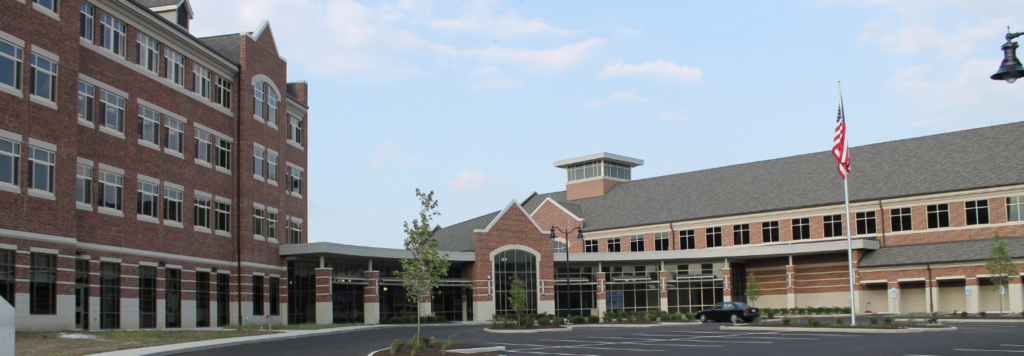
In addition to proximity to customers like WPAFB and workforce skills, Dayton offers companies accessible geography, a proven logistics hub and a well-developed yet still-growing web of contracting and subcontracting relationships. “Ohio is situated geographically in a sweet spot,” Hoagland says. “We can get to about 60-to-70 percent of the population in a day’s drive.”
Interstates 70 and 75 connect a large portion of the country from a population and logistics standpoint, SNC’s Williams notes. “It’s a good location for aerospace and a defense industrial base. It’s going to be very beneficial for us to have this type of facility and capability in this region.”
GE partners with small businesses for some equipment or people, whether engineers to perform testing or buy printed circuit boards, says Joe Krisciunas, who leads GE’s Dayton-based electrical power division. This division develops and improves the electrical grid that operates and manages the safety and reliability of loads on the plane’s systems.
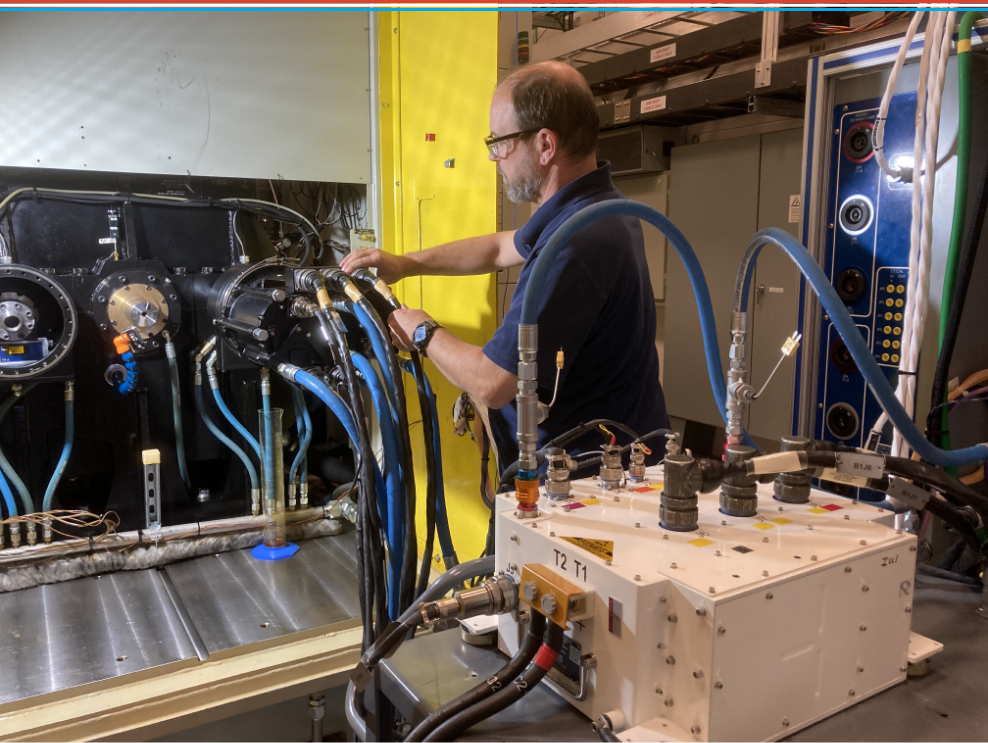
The dependable supplier network and supply chain sustain the production phase, with much work performed locally. “There’s an aerospace corridor here, with aerospace supply chain infrastructure,” Krisciunas says
Krisciunas has worked all over the eastern seaboard with GE but now lives between Dayton and Cincinnati, which are only 40 miles apart. “The areas are big enough to have the infrastructure needed to make it a great place to live,” he points out—arts, education, industry and professional sports teams. But traffic in the region might consist of a five-minute slowdown due to construction — but no hour-long commute of 20 miles.
Hear Joe Krisciunas talk about partnerships with Ohio universities
0:00/0:00
“The universities are engaged, the military’s engaged, the local government’s engaged and supportive,” Krisciunas says. The community’s infrastructure works well together and communicates to create a “virtuous circle,” he says, to develop the workforce, identify the right capabilities, provide the R&D and the product to support the mission for Wright Pat and the Air Force.
“The Air Force has a long and rich history in Ohio of protecting our national security while also providing an economic boost to our state,” said J.P. Nauseef, JobsOhio president and CEO. “In addition to spurring innovation and attracting private investment, the Air Force has brought talented Airmen who have been critical contributors to Ohio communities for generations, which is why we continue working to make Ohio one of the most military-friendly states in the country.”
To see if military life in Ohio could be for you, click here.