
The key to connection: How rural gigabit service is powered by private-public partnerships

Local governments are partnering with broadband service providers to build high-speed internet networks.
In 2021, the World Economic Forum reported that nearly half of adults in the US expressed an interest in living in a small town or rural community. The shift has the potential to turn struggling rural communities into thriving economies because remote workers can bring in needed tax revenue — but revitalizing rural communities is about much more.
“The local communities do benefit from the higher tax base, but it takes people,” explained Tony Thomas, president and CEO of Windstream, an Arkansas-based communications company. “It’s not only about economic development. It’s also about healthcare and education. They all play a role in making rural America relevant and keeping people in those communities so those populations can grow, which will create a healthy and sustainable rural America over the long term.”
One of the primary drivers of growth and opportunity in rural communities is the ability for residents to work remotely. One potential barrier to success is lack of access to high-speed broadband, which is going through a resurgence of its own. The country is rapidly moving to fiber gigabit service, which transmits data at 1,000 megabits per second (Mbps) — roughly 10 times the average internet speed in the United States, and considerably faster than the six-year-old FCC standard of 25 Mbps.
“This is a critical period of time where we can actually deliver on high quality gigabit broadband that will allow rural communities to grow and thrive,” explained Bob Udell, president and CEO of Consolidated Communications. “It really opens up a new world of economic development that otherwise wouldn’t be possible.”
As part of the $1 trillion-plus Infrastructure Investment and Jobs Act, the federal government is investing a historic $65 billion to improve broadband in rural areas. Nearly two-thirds of the funds will be distributed as grants to the states by the National Telecommunications and Information Administration (NTIA).

Upstream, downstream
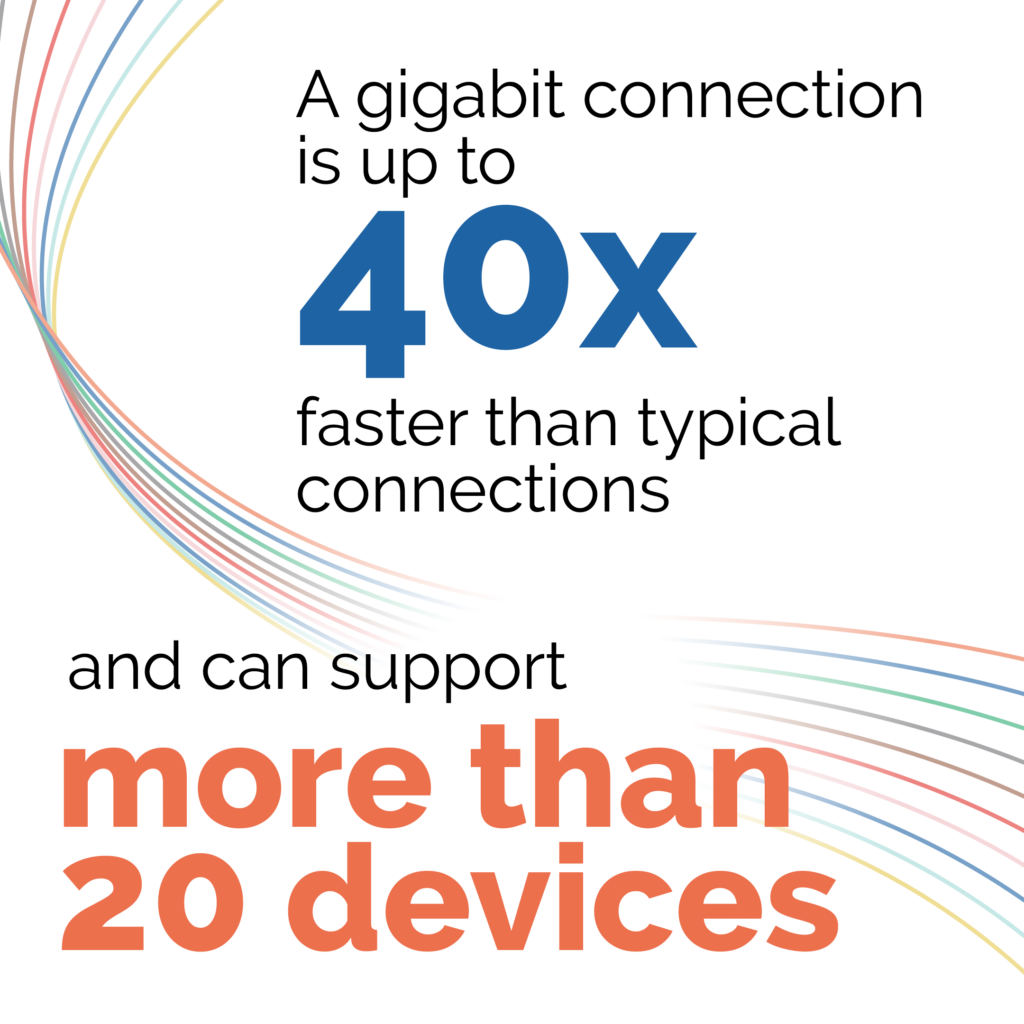
When most of us think about internet speed, we’re thinking of content streaming from the cloud to our devices, when we watch a movie or our favorite music, for example. But in both our personal and professional lives, more and more we’re pushing data up to the cloud as two-way communications — from gaming to telehealth visits to video calls — driving demand for faster upload speeds, as well. This is why fiber gigabit broadband is so vital. These networks can deliver symmetrical, ultra-high-speed internet — upstream and downstream — which is considered future proof for its ability to accommodate whatever comes next in our connected lives. A gigabit connection is up to 40 times faster than typical connections, allowing for HD video meetings or telehealth calls to be conducted with ease. While a 100 Mbps connection can support two to three devices streaming simultaneously in HD, a gigabit connection can support more than 20 devices, effortlessly allowing gaming, video conferencing, streaming movies and more all at once and at the highest quality.
As applications get ever more sophisticated, melding machine learning, artificial intelligence and virtual reality, enormous amounts of data will need to flow upstream.
“The biggest bandwidth constraint, even for urban customers, is a lack of upload speed. It’s a technical difference but one that’s incredibly important as the economy is morphing into a high-tech workplace,” Thomas said.
The problem isn’t just a lack of coverage; it’s that not all internet is created equal.
Current cable technologies have limited upload speed (which is why many customers experience faster download than upload speeds). The only way to upgrade current infrastructure is to connect the network with fiber. Modern fiber broadband is future-proof and saves the cost of doing minor upgrades in the future. Fiber connectivity offers symmetrical bandwidth, high speeds in both directions, which will support increasingly sophisticated applications and the expansion of Americans working remotely.
“More rural, less dense population areas make it economically infeasible for the customer demand to support the infrastructure. That’s where the government programs come into play.”
– Bob Udell, president and CEO of Consolidated Communications
The power of partnerships
One of the main barriers to building or upgrading to fiber gigabit broadband in rural America is the financial challenge of deploying and maintaining costly infrastructure across a vast geography and relatively sparse base of potential customers. The combination can be cost-prohibitive for carriers to take on alone. That’s why broadband providers, including Consolidated and Windstream, are working with local and government partners to get the job done in communities across the country.
“More rural, less dense population areas make it economically infeasible for the customer demand to support the infrastructure. That’s where the government programs come into play,” Udell said.

Consolidated Communications, which has numerous partnerships in various states, recently partnered with the Connect Maine Authority and received $18.3 million in NTIA grants.
“That will cover 22,000 addresses that otherwise wouldn’t get access,” Udell said.
In addition to providing funding, partnering with government agencies allows companies to cut through the red tape and overcome other challenges of large infrastructure projects.
“We’re working in ditches, we’re laying fiber, we need rights-of-way, we need permits. We need community assistance to get that fiber to those communities on an accelerated basis,” Thomas explained. He added that building the network is only half the challenge.
“It’s one thing to have the technology, but have you equipped your community to leverage it? It takes strong partnerships throughout the community to leverage that technology, so seniors feel comfortable receiving medical guidance and advice over telemedicine, for example.”
Windstream has been able to invest over $300 million in public-private partnership funds, between the company and state and local officials, to serve more than 100,000 rural households.
Changing lives
The average person may not know the difference between a gigabit and a megabit, but they do know whether their children are able to join remote classes and upload their homework. They know whether their aging parents have access to telehealth visits. And they know whether they can work from home and still meet all the technical requirements of their job.
In Grant County, Arkansas, access to gigabit service has the potential to save lives and businesses. “Almost 20 percent of our residents are 65 or older, and there’s no hospital in Grant County so access to healthcare can be an issue,” explained Randy Pruitt, Grant County’s chief executive judge. Through a partnership with Windstream, the county is delivering ultra-high-speed fiber broadband to approximately 6,800 homes and businesses in rural parts of the county. Not only will this partnership provide telehealth services to those in need, but also help residents run their businesses and continue their education. “Expanding access to fiber broadband truly does level the playing field to help Grant County attract business and drive residential growth,” Pruitt added.
“Expanding access to fiber broadband truly does level the playing field to help Grant County attract business and drive residential growth.”
– Randy Pruitt, chief executive judge, Grant County
Consolidated, too, takes inspiration from the real-world impacts of their connectivity work. “We’re doing something that changes people’s lives and allows them to connect with the outside world, in the format that they want, with the devices that they want,” Udell said. “That’s just huge and very motivating. It has enhanced our culture. It makes it exciting to get up every day and focus on our goal of bringing fiber to 1.6 million new locations in the communities that we can serve.”
Private-public partnerships are the key to delivering future-proof gigabit broadband to families across rural America — and strong rural communities benefit all of us.

Discover how America’s broadband providers are delivering affordable, high-speed internet to communities across the country.
SHARE THIS ARTICLE
washingtonpost.com © 1996-2022 The Washington Post
Privacy Policy • CA Notice of Collection • Do Not Sell My Info • Terms of Service