At Virginia Tech, tomorrow’s national security leaders are already at work today
By Laura Freeman, Deputy Director Of The Virginia Tech National Security Institute
june 15, 2023
As a nation, we’ve arrived at a complex crossroads.
The combination of our aging federal workforce is being met head-on with an ever-evolving, evermore connected technological landscape and in an increasingly complex geopolitical context. Just look at the news. Foreign wars, spy balloons and cybertheft – these are the ingredients of potentially devastating security vulnerabilities.
This space — where policy, security and emerging technologies collide — will not only create difficult issues to resolve, but will also generate opportunities to propel research, education and society forward. Both security and success, however, rely on the availability of highly skilled, experienced and innovative defense and intelligence professionals.
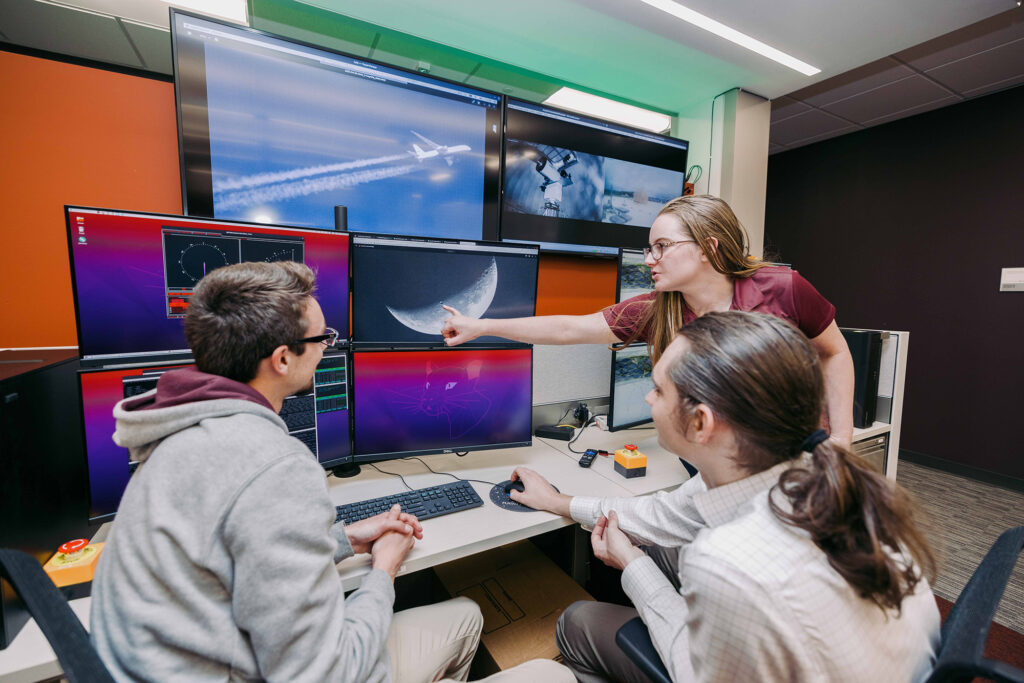
Photo by Christina Franusich/Virginia Tech
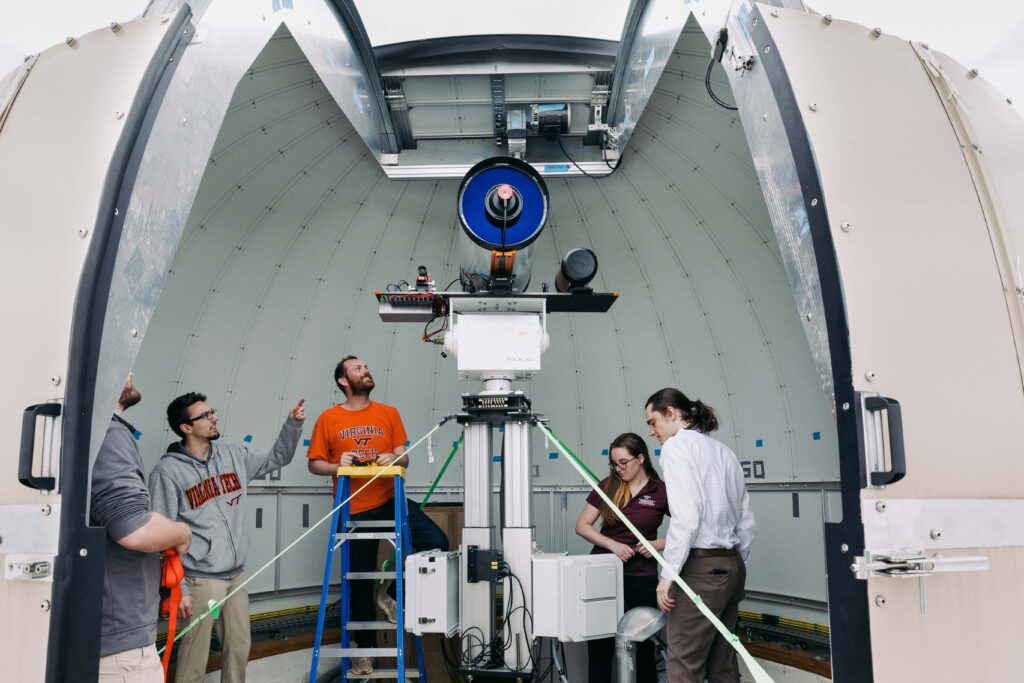
At the Virginia Tech National Security Institute, our Hokies are ready to face these challenges, and more importantly, to lead others through them. We know this because at that same intersection — and in the thick of those same problems — our students learn through hands-on experience starting on their very first days with us. They are not just solving tomorrow’s problems, but implementing those solutions today alongside partners from government and industry.
The Virginia Tech National Security Institute, launched in 2021, prioritizes the development of a robust and talent-ready workforce by partnering with government and industry to pinpoint critical labor shortfalls and emphasize mission-critical skills. We combine basic and applied research with experiential learning to give undergraduate and graduate students problem-solving experience on real-world projects with real-world partners.
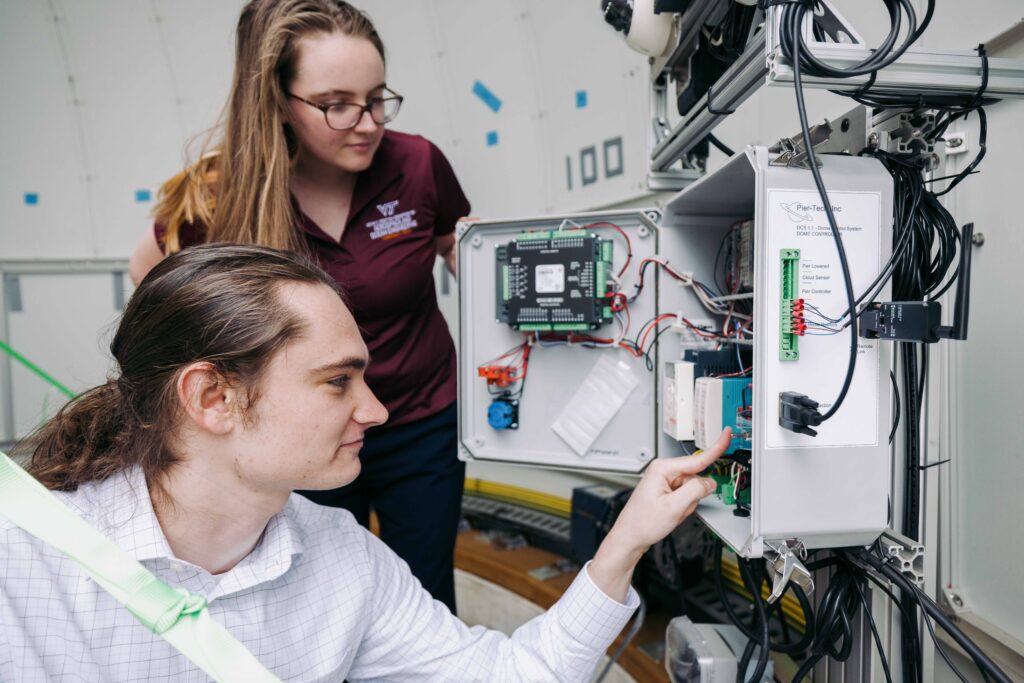
Building on the workforce development mission of the Ted and Karyn Hume Center for National Security and Technology, we take students out of traditional classroom settings and place them in the middle of the world’s messiest problems. This experience moves students beyond traditional academia’s definition of interdisciplinarity — for example, teaming an aerospace engineer with a computer scientist — into more expansive spaces including public policy, ethics and other human factors.
Because of this important work, I joined Virginia Tech in 2019, after nine years supporting the Department of Defense from the Institute for Defense Analyses. Helping provide students applied learning opportunities is the best part of my job, and I know the value of that learning experience.
During my own education, I had the opportunity to conduct research with NASA and I was thrown into the middle of a problem that I honestly didn’t fully understand. Being a statistician, I thought I had to come ready with answers. But I very quickly learned that when dealing with hard problems, it’s most important to ask questions, actively listen to the answers and ask even more questions.
That work, that stress and that experience working on a real problem is what set me up for success when I began supporting senior leaders in the Pentagon. I love that we are providing not only hands-on research and problem-solving to our students, but also helping them learn to clearly communicate their research through activities such as mock presidential briefings.
What does all this actually look like?
Our institute currently engages close to 900 undergraduate students and 70 graduate students who work on dozens of government agency or industry sponsored projects with partners such as the Department of Defense, the U.S. Department of Homeland Security, NASA, Raytheon, CACI, Leidos, Boeing, Northrop Grumman, Lockheed Martin and numerous other companies in the D.C. area and across the country.
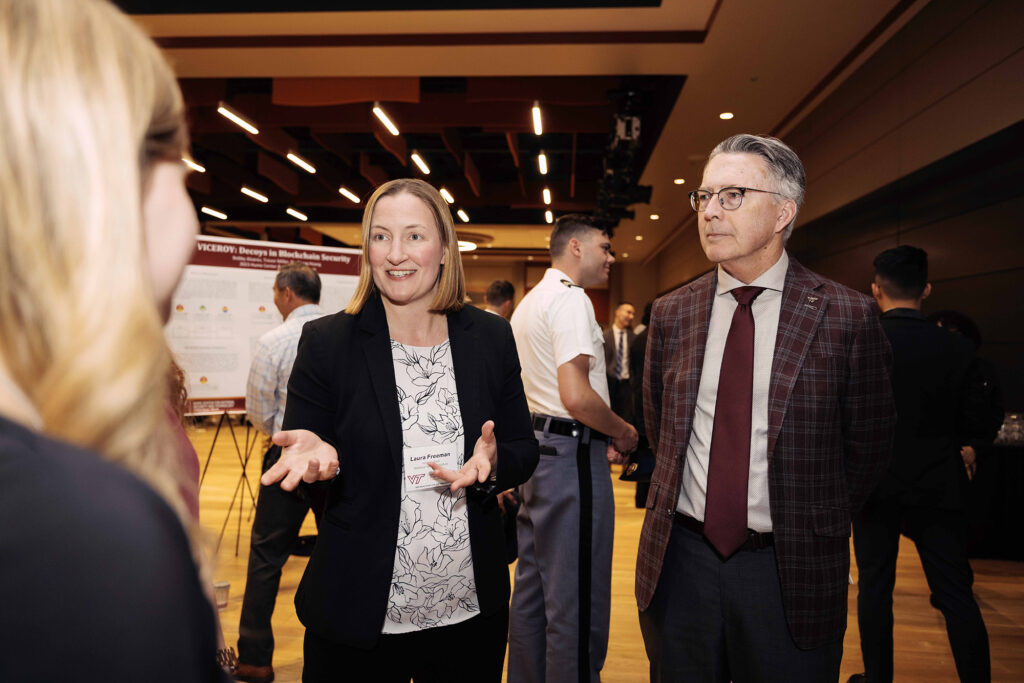
Our recent 10th annual Hume Center Colloquium convened more than 100 students from across Virginia Tech’s academic disciplines to discuss their ongoing work. Projects included securing underwater communications, developing algorithms that leverage the speed of quantum computing and improving confidence in and managing uncertainty for artificial intelligence algorithms. Students presented on use of 3D printing for in-space assembly as well as many security-related policy problems, such as the use and abuse of personal information by domestic and foreign actors and potential national security risks of social media platforms such as TikTok.

At our state-of-the-art research facilities in both Blacksburg and the D.C. area, students work with specialized computer systems and test beds while partnering with Virginia Tech’s world-class faculty. This work includes figuring out how to test and evaluate high-tech, high-dollar government tools such as drones, stealth fighters, submarines and satellites and exploring how machine learning and artificial intelligence can be used to support national security and to safely improve society. This model supports the defense and intelligence missions of our country while leading students to the challenging and rewarding careers they seek.
Not only can our students count these experiences toward their degree, but it is the Virginia Tech National Security Institute’s priority to make sure all students can take advantage of these opportunities by eliminating financial barriers to participation. That’s why we prioritize paying students for their research and learning through our sponsored research projects, which improves access to these experiences for students of all socio-economic backgrounds.
This supports Virginia Tech’s university-wide, multi-year commitment to remove barriers for students from underserved communities and offer the broad educational experience to admitted undergraduate students from Virginia, while also emphasizing the importance of equity and inclusion in recruiting the breadth of skills and experiences needed for the next generation of intelligence and defense leaders. Our world’s toughest problems do not discriminate, and these complex problems will be best solved by bringing people together with a broad spectrum of perspectives, opinions and life experiences. This is why we actively recruit from a diverse range of backgrounds and strive to provide a work environment that accommodates our employees’ needs for a strong sense of work-life balance.
There has perhaps never been a more critical time for this work. It’s a truth Congress and the Department of Defense recently acknowledged through the authorization of Defense Civilian Training Corps, of which Virginia Tech is a pilot institution.
Virginia Tech has a long tradition of placing students at the intersection of service and emerging technologies. As one of six senior military colleges in the United States and built on the foundation of our university motto, Ut Prosim (That I May Serve), Virginia Tech has a history of supporting our nation’s security, and our motivation to continue doing so sets us apart from our peers.
Few universities have our history. Few have our passion for service. And even fewer have a commitment to this nation’s security that runs all the way to the top of their Board of Visitors — Tish Long, Virginia Tech rector July 2021-2023, is the first woman to lead a major U.S. intelligence agency.
The Virginia Tech National Security Institute exists at this complex crossroads and because of that, is able to guide students through their academic careers and toward the critical needs of our country today and tomorrow.
We are here to lead. Partner with us today.
Laura Freeman is the deputy director of the Virginia Tech National Security Institute. She is also the assistant dean of research for the Virginia Tech College of Science in the greater Washington, D.C. metro area and research professor in the Department of Statistics, and an affiliated researcher with the Commonwealth Cyber Initiative.
The content is paid for and supplied by advertiser. The Washington Post newsroom was not involved in the creation of this content.
Content From