Take this 7 step financial wellness check-in
How to manage your investments in uncertain times

By T. Rowe Price
When life feels uncertain, concerns about your personal finances can make you especially nervous about the future. To help ease your financial anxiety, take control with this quick check-in to help ensure your money and investments are aligned with your long-term goals.
With more than 80 years of experience successfully guiding clients through all types of markets, even in today’s environment, T. Rowe Price’s strategy and advice hold constant. Here are seven easy steps you can take to prioritize your own financial wellness and help prepare your family for the road ahead.

1. Keep an active eye on your finances. Take some time to review (or set up) your budget. Look for places where you might easily trim your expenses. When managing your long-term financial goals, look beyond what the market is doing at any particular moment and focus instead on adhering to your plan. Continue to save, invest, and maintain an investment mix that is appropriate for your time horizon and risk tolerance.
You should also review your financial accounts and your personal credit report on a regular basis to ensure no errors or irregularities are present. You can access one free report from each major credit bureau per year.

2. Continue to save for retirement. “How much you need to save depends on several factors, including your lifestyle, how much you earn, and your unique vision for this next stage of life,” says Judith Ward, CFP®, a senior financial planner with T. Rowe Price. “However, if you are in a position to save for retirement right now, aim to save at least 15% of your income—including any employer match—to give yourself a better chance to maintain your current lifestyle in retirement.”
If 15% is out of reach at this point in time, start where you can and plan to increase that amount over time. Each extra percentage point you save can make a significant difference in your retirement savings over time. T. Rowe Price’s 15% guideline is based on several factors, including the potential that your retirement may last 30 years or longer, exposing you to risks, including the need to fund many years of spending, a decrease in purchasing power from inflation, and higher health care costs. A 15% target can help your savings generate an income stream for years to come.

3. Consider your asset allocation. Holding an appropriate mix of stocks, bonds, and cash can help mitigate the effects of volatility on a portfolio. The precise definition of “appropriate” will depend on your time horizon and risk tolerance. In general, the longer your time horizon, the more of your portfolio you should hold in stocks as, historically, they’ve been the main driver of growth in a portfolio.

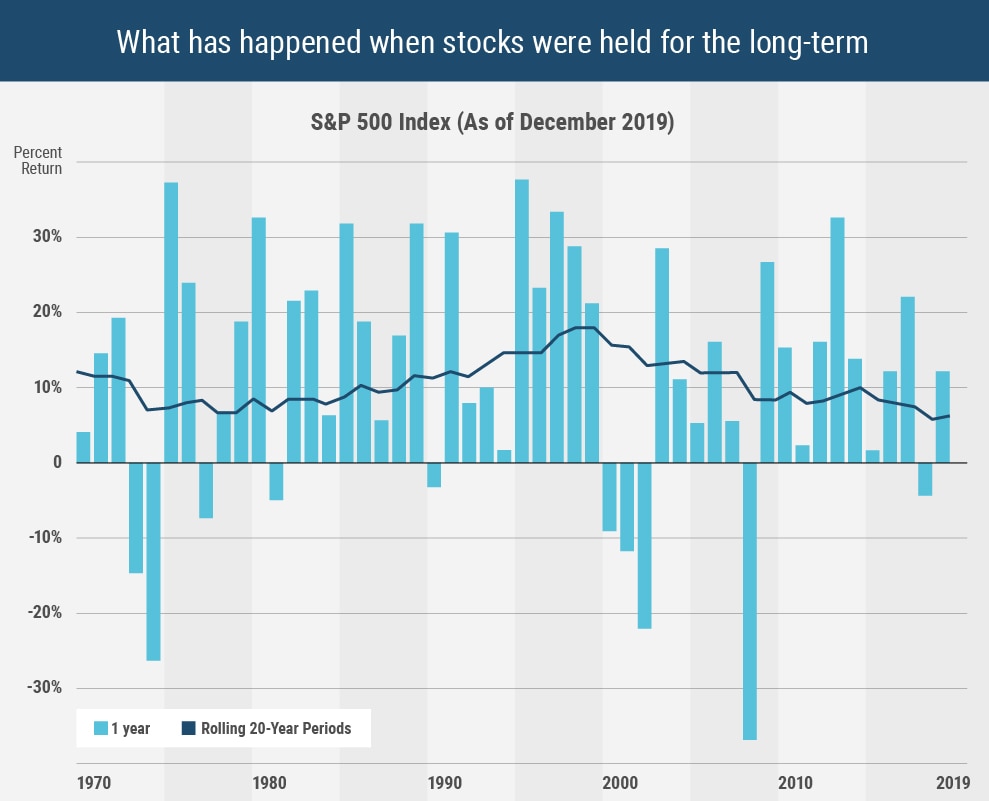
4. Keep a healthy (and long-term) perspective on market volatility. A good strategy is to maintain an appropriate perspective when viewing long-term retirement account balances during market volatility and limit the time you spend checking your investments. Equity markets historically have delivered large returns in the years immediately following a bear market, with the potential to deliver double-digit average annual gains for several years.
As the chart below shows, historically the S&P 500 Index has delivered positive returns for every rolling 20-year period since 1970—and since 1926, in fact. So even though there are difficult down years like 2008, and past performance does not provide any promise of future results, holding investments over a long-term period is typically a way to manage volatility.
5. Make your 2020 IRA contribution. “The coronavirus pandemic is hurting some people financially,” says Roger Young, CFP®, senior financial planner with T. Rowe Price. “We know that those individuals aren’t in a position to make IRA contributions right now. However, if you remain in good shape financially, contributing to an IRA remains an opportunity to help keep your retirement savings on track.”
Individuals can contribute up to S6,ooo (or S7,000 if 50 or older) to an IRA for the 2020 tax year. A Traditional IRA contribution is potentially tax deductible, whereas people who qualify for Roth IRA contributions can benefit from potential tax-free income in retirement. In this time of uncertainty, it is also important to remember that Roth IRA contributions can be withdrawn at any time free of taxes and penalties.

6. Talk with your spouse about your finances and bring your adult children into the conversation. Households tend to divide and conquer: One spouse may take care of the day-to-day finances, while the other handles the longer-term investments. Both spouses, however, need to understand the entire picture of the household finances should something happen to the other, or the marriage. It’s also helpful to have a summary of all financial accounts and insurance policies, with pertinent information and instructions for how to access the financial institutions. It’s not a bad idea to share with your adult children if you’re comfortable.
Regardless of the size of your investments, holdings, accounts, finances, and assets—large or small—it’s also important to put an estate plan into place. A well-crafted plan will lay out your wishes regarding your health care and finances, your children’s future, and all your assets and possessions. And if you are an adult child, understanding your parents’ wishes will help you better plan for your future—and theirs.

7. Help school-age children learn about money. Use the time you have with the children in your life to engage in activities to help them become regular savers and conscientious spenders. Teaching children about money is a series of ongoing conversations that can happen on a long walk, at the dining room table, and while unpacking groceries. Money Confident Kids® from T. Rowe Price offers tools, games, teaching guides, and digital magazines to support these conversations.
While you ensure financial education for your children, don’t forget to continue to educate yourself. Find a book or blog to learn more about financial topics that interest you.
You can also learn more about how you can reach your financial goals by visiting T. Rowe Price Insights and resources.
For over 80 years, T. Rowe Price has been guiding investors like you through change, helping them stay on track and pursue financial goals with confidence. Gain access to our insights and partner with a Financial Consultant who can help you design an investment portfolio that is personalized to your goals. No matter the market, planning and investing for retirement is one of the best ways to create the future you envision.
To learn more, visit T. Rowe Price.

Additional Disclosures:
An IRA should be considered a long-term investment and distributions may be subject to taxes and penalties. IRAs generally have expenses and account fees, which may impact the value of the account. Maximum contributions are subject to eligibility requirements. Roth IRAs have holding periods for any account earnings. For more detailed information about taxes, consult IRS Publication 590 or a tax professional regarding personal circumstances.
S&P — The “S&P 500 Index” is a product of S&P Dow Jones Indices LLC, a division of S&P Global, or its affiliates (“SPDJI”), and has been licensed for use by T. Rowe Price. Standard & Poor’s® and S&P® are registered trademarks of Standard & Poor’s Financial Services LLC, a division of S&P Global (“S&P”); Dow Jones® is a registered trademark of Dow Jones Trademark Holdings LLC (“Dow Jones”). T. Rowe Price’s product is not sponsored, endorsed, sold, or promoted by SPDJI, Dow Jones, S&P or their respective affiliates, and none of such parties make any representation regarding the advisability of investing in such product nor do they have any liability for any errors, omissions, or interruptions of the “S&P 500 Index.”
T. Rowe Price Investment Services, Inc.
This content is paid for by an advertiser and published by WP BrandStudio. The Washington Post newsroom was not involved in the creation of this content. Learn more about WP BrandStudio.